
I have had an interesting cluster of questions from clients recently.
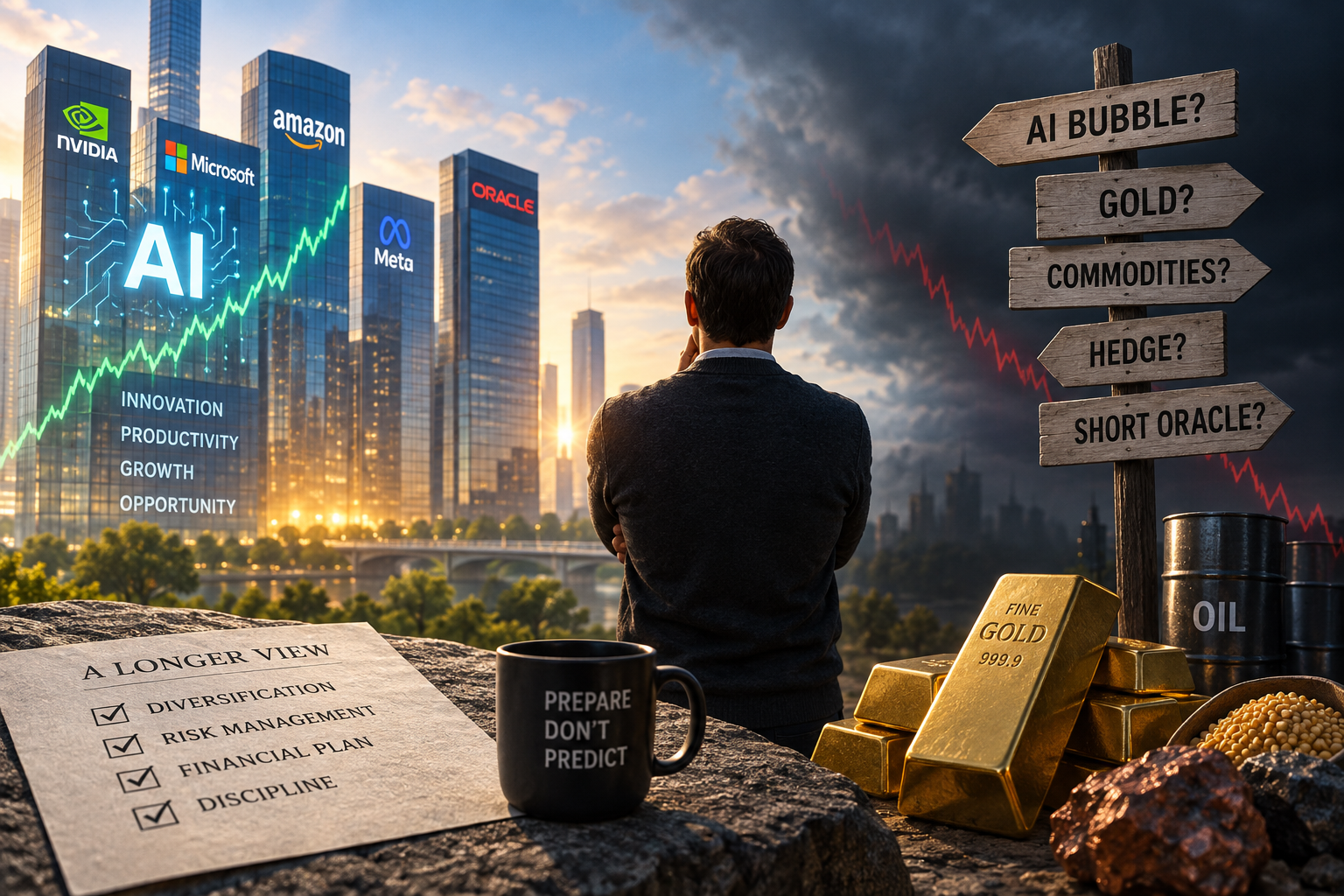
What happens if the AI boom turns into an AI bust? Should we buy gold? Commodities? Should we hedge the stock market? One client even asked whether shorting Oracle might be a way to protect against an AI bubble bursting.
There is a little irony in writing about the risks of an AI bubble at the same time AI is becoming a bigger part of how people find financial advice. Over the past several months, ATX Portfolio Advisors has been showing up consistently when people ask various AI models to recommend an Austin financial planner, fiduciary advisor, or fee-only financial advisor.
I am obviously pleased to see that. More importantly, I think it reflects something useful about how search is changing. People are no longer just typing a few keywords into Google. They are asking much more specific questions about who they should trust, what type of advisor they need, and how different firms approach investing and financial planning.
That makes AI particularly relevant to me in two very different ways. It may be changing how businesses operate and how investors find advice, but that still does not tell us whether AI-related stocks are currently overvalued, when enthusiasm might cool, or what the next market selloff will look like.
These are reasonable questions. When markets have been strong and a relatively small group of companies seems to dominate the headlines, it is natural to start thinking about what might bring the party to an end.
My answer, though, usually starts with another question.
Are we trying to manage risk, or are we trying to predict what happens next?
The Temptation to Protect Ourselves
Let's say you're convinced AI is a bubble. You could short a high-flying tech stock, but that introduces a massive new risk. You have to be right that the trend is ending, right about exactly which company will suffer most, and right about the timing. You could also buy an options-based hedge against a broad market decline. The hedge acts like insurance, and just like insurance, it has a cost. You pay a premium, the policy usually expires unused, and you buy it again. Over time, that constant drag can quietly erode your returns. Hedging can make sense if limiting a specific loss is critical to keeping you invested, but it is not a source of free return.
Gold and commodities often enter the chat here too. They absolutely have a place as diversifiers in a thoughtfully constructed portfolio. But buying gold today specifically because you think an AI crash is imminent isn't diversification; it's market timing. You're making a forecast, which means you now have to perfectly time when to buy in and when to cash out.
A Real-World Example
I recently walked through this exact scenario with a client concerned about an AI-driven crash. The reality was, his portfolio was already doing the heavy lifting. He wasn't just sitting in an S&P 500 index dominated by mega-cap tech; he was globally diversified, tilted toward profitable small-cap and value companies, with roughly 40 percent in fixed income and alternatives.
More importantly, we had a financial plan. I stress-tested his portfolio against a 2008-style collapse. The model showed an 18 percent drawdown. Nobody wants to see their accounts drop 18 percent, but even in that scenario, a thousand Monte Carlo simulations showed his plan still had an 85 percent probability of success. Once you know your plan can survive a severe bear market, you stop desperately trying to prevent it. That is what actual risk management looks like.
When a Good Story Becomes a Bad Investment Plan
History is full of perfectly logical arguments that turned out to be terrible investment signals. In 1979, BusinessWeek ran its famous "The Death of Equities" cover. Inflation was rampant, rates were high, and stocks had floundered for years. The logic was completely sound, and the market stayed ugly for three more years. But if you finally gave up in 1982, you missed the start of a historic bull run. The facts were right, but assuming they told you exactly what was coming next was a costly mistake.
On the flip side, look at Apple in 2004. There were legitimate questions about whether the iPod could truly transform a niche computer company. Hindsight makes Apple's dominance look inevitable, but nobody buying stock in 2004 knew the iPhone was coming. We have to invest facing forward, even though the market only makes sense looking backward.
Human Ingenuity Is the Investment Thesis
This is why I rely on broad diversification instead of trying to outsmart the news cycle. The stock market isn't just a collection of tickers; it's a mechanism for funding human ingenuity. People will continually invent better semiconductors, cure diseases, and find manufacturing efficiencies. Owning thousands of companies worldwide means you don't have to guess which will change the world; you just get to participate in that growth.
You Still Need a Plan
Protection doesn't always mean buying something new. Asset allocation, maintaining cash reserves, and systematic rebalancing—these are your real protections, and they don't require a crystal ball.
There will absolutely be another bear market. It might be sparked by an AI bust, a geopolitical crisis, or something nobody is talking about yet. My job as an Austin financial planner isn't to prevent that decline but to build a portfolio and a financial plan that can weather it. If you're concerned about your exposure, please reach out for us to review your asset allocation. Just don't confuse preparing for uncertainty with predicting the future.