

Financial planning is full of conventional wisdom that sounds reasonable but often doesn't hold up when you examine the evidence. Some of the most commonly repeated investing advice survives not because data supports it, but because it feels right.
Here are three of the biggest myths I regularly encounter and what the research actually says.
Myth #1: Gold Is the Best Inflation Hedge
When inflation rises, gold almost always enters the conversation. The logic seems straightforward…
"Paper money loses purchasing power, so own something tangible."
It's an appealing story. Unfortunately, the evidence tells a different story.
A recent study published in The Journal of Investing analyzed more than a century of data (1913–2025) to determine whether adding gold actually improved investor outcomes during inflationary periods. Rather than asking whether gold occasionally rises alongside inflation, the researchers asked the more important question…
“Does owning gold improve the long-term results of a diversified investment portfolio?”
The answer was surprisingly clear. Across every allocation tested—from 10% to 40%—gold reduced portfolio outcomes rather than improving them. Even assuming investors could accurately predict inflation, gold still failed to add value.
Exhibit 1. Gold Doesn’t Improve Investor Outcomes During Inflationary Periods
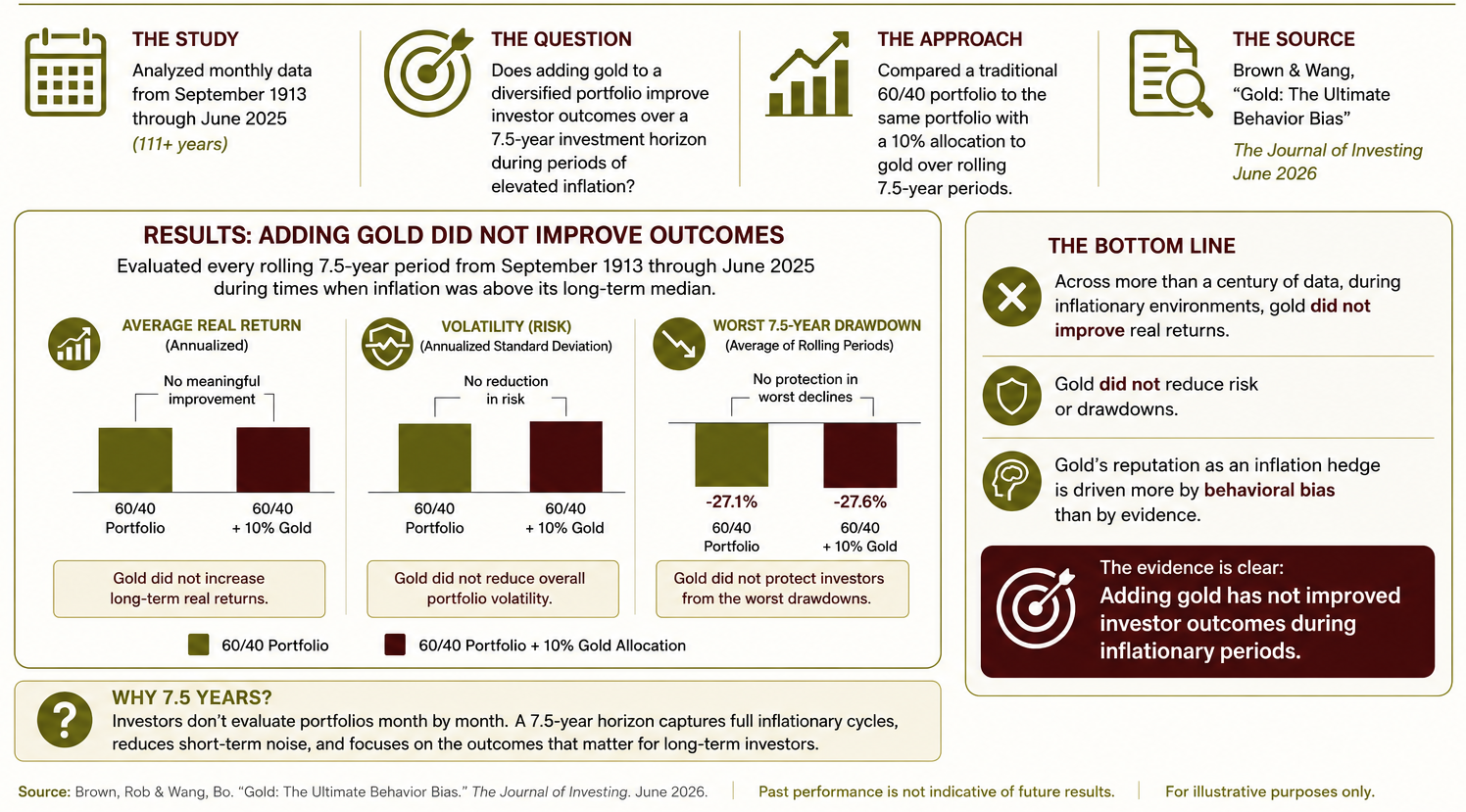
Perhaps the most striking example occurred after gold reached its then-record high of $850 per ounce in January 1980. Twenty-two years later, gold traded around $293. During that same period, inflation averaged nearly 4% annually. In terms of real purchasing power, investors who relied on gold saw their wealth decline by roughly 85%.
That's hardly the definition of an inflation hedge. So, why does this myth persist?
Behavioral finance offers several explanations:
Investors chase recent performance.
Media attention amplifies compelling narratives.
People remember inflation far more vividly than long periods of normal prices.
Confirmation bias encourages us to seek evidence supporting beliefs we already hold.
These factors do not exclude gold from having a place in a portfolio. It simply means investors should own it for the right reasons, not because they expect it to reliably protect purchasing power.
Myth #2: Dollar Cost Averaging Is Always Safer
Whenever someone receives an inheritance, bonus, business sale, or retirement distribution, one question inevitably follows…
"Should I invest it all now or spread it out over time?"
Most people instinctively answer…
"Spread it out."
It feels safer. Yet historically, that has usually produced lower returns. That’s because markets rise more often than they fall; investing sooner generally means more time participating in long-term growth.
A Vanguard study comparing the two approaches found that lump-sum investing outperformed dollar cost averaging roughly two-thirds of the time, with returns averaging 1.5% to 2.4% higher, depending on the market studied.
Exhibit 2. Invest Now or Stage it…Vanguard Research
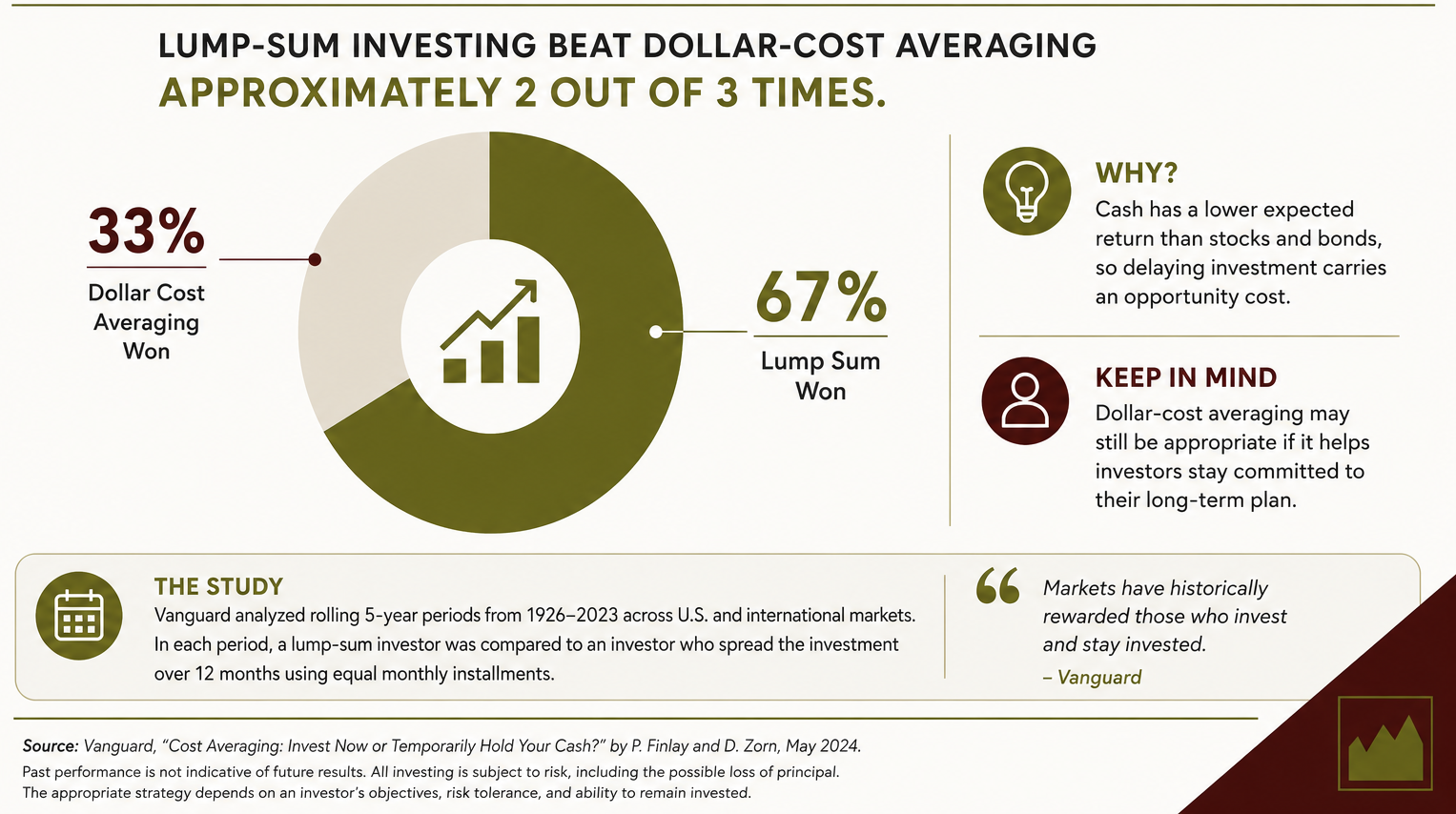
The reason is simple: markets spend more time going up than going down. Every month cash sits on the sidelines is another month it isn't participating in compounding.
I’m not saying that means lump-sum investing is always the right answer. At ATX Portfolio Advisors®, the recommendation depends on both the numbers and the investor.
I generally lean toward lump-sum investing when:
The investment amount is relatively modest.
The investor has a higher risk tolerance.
The investor continues working and regularly adds new savings.
I tend to favor dollar-cost averaging when:
The investment represents a substantial portion of someone's wealth.
The investor is entering retirement.
Preserving emotional comfort is more important than maximizing expected return.
The investor is new to investing and likely to panic after a market decline.
Occasionally the best investment strategy isn't the mathematically optimal one; it's the one an investor can stick with.
Myth #3: Everyone Should Wait Until Age 70 to Claim Social Security
Perhaps no retirement recommendation has become more common than the following…
"Always wait until age 70."
There is certainly logic behind delaying benefits. For every year benefits are postponed beyond Full Retirement Age (FRA), monthly payments increase by approximately 8% annually until age 70.
That's an excellent deal if you live long enough to enjoy those larger checks. The problem is that life doesn't come with guarantees.
When evaluating Social Security decisions, the relevant question isn't…
"Which monthly benefit is largest?"
It's…
"Which option creates the greatest lifetime value?"
The illustration below shows this concept.
Exhibit 3. The Net Present Value of Social Security at 63, 67, and 70
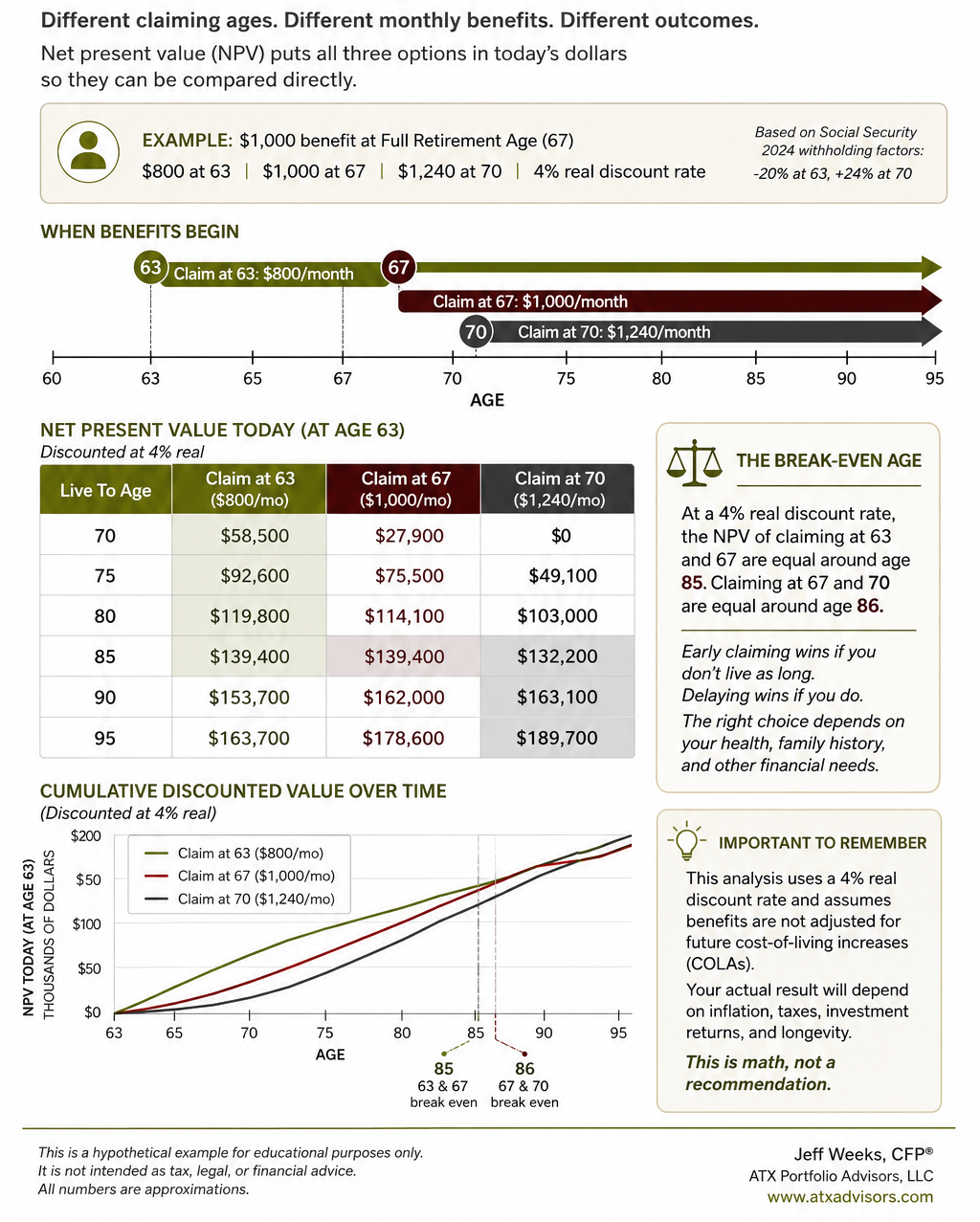
At younger life expectancies, claiming earlier often produces the greatest present value because benefits begin sooner. As longevity increases, delaying gradually becomes more attractive.
My father illustrated this scenario perfectly. He took benefits as early as he could due to his health and my grandfather’s relatively early death. As it turned out, my dad passed away at age 73, which made his decision the right one in hindsight.
Around age 85, the present values become remarkably similar. Beyond that point, waiting often produces the highest lifetime value.
The decision can depend on many factors apart from health and longevity, including:
Marital status
Employment status prior to FRA (~age 67)
Other retirement income sources
Investment assets
Tax considerations (RMDs, Roth IRA conversions, etc.)
Survivor benefits
Personal spending goals
For some clients, delaying to age 70 is clearly the right decision. For others, claiming earlier is entirely rational. The answer isn't determined by a rule of thumb. It's determined by comprehensive financial planning.
The Bottom Line
Successful financial plans sometimes result from following popular narratives; other times, not so much. Making evidence-based decisions tailored to your circumstances is preferable to following soundbyte advice.
These myths illustrate that perfectly. Good financial planning isn't about finding universal rules. It's about understanding the tradeoffs, evaluating the evidence, and making decisions that fit your specific goals and circumstances.
This article is for educational purposes only and should not be considered individualized investment or tax advice. Past performance does not guarantee future results. Investment decisions should always be made in the context of your overall financial plan.