
When I was in college in the 1980s, Stephen Covey published The Seven Habits of Highly Effective People. It wasn’t an immediate success. It took several years to gain traction before becoming a corporate and cultural mainstay in the early 1990s.
Its longevity came from a simple idea: it focused on behavior, not quick fixes. It wasn’t about what to do when conditions were ideal, but how people operate when things get difficult.
After more than 30 years working with investors, I’ve come to believe the same framework applies to investing.
I’ve been fortunate to work with many successful investors. But it’s the investors who didn’t succeed who have had the most impact on how I approach financial planning. Their plans didn’t fail because markets behaved badly. They failed because normal, rational people behaved very predictably when uncertainty showed up.
I’ve sat across the table from business owners, engineers, physicians, retirees, and executives. These individuals are smart and have consistently made wise decisions throughout their lives. Yet when markets became volatile, the same mistakes repeated themselves. Not because of a lack of intelligence or discipline, but because money has a way of triggering instincts that don’t always serve us well.
The investors who reach their long-term financial goals aren’t necessarily smarter or more informed. They’re simply more consistent in how they behave, especially when markets test them.
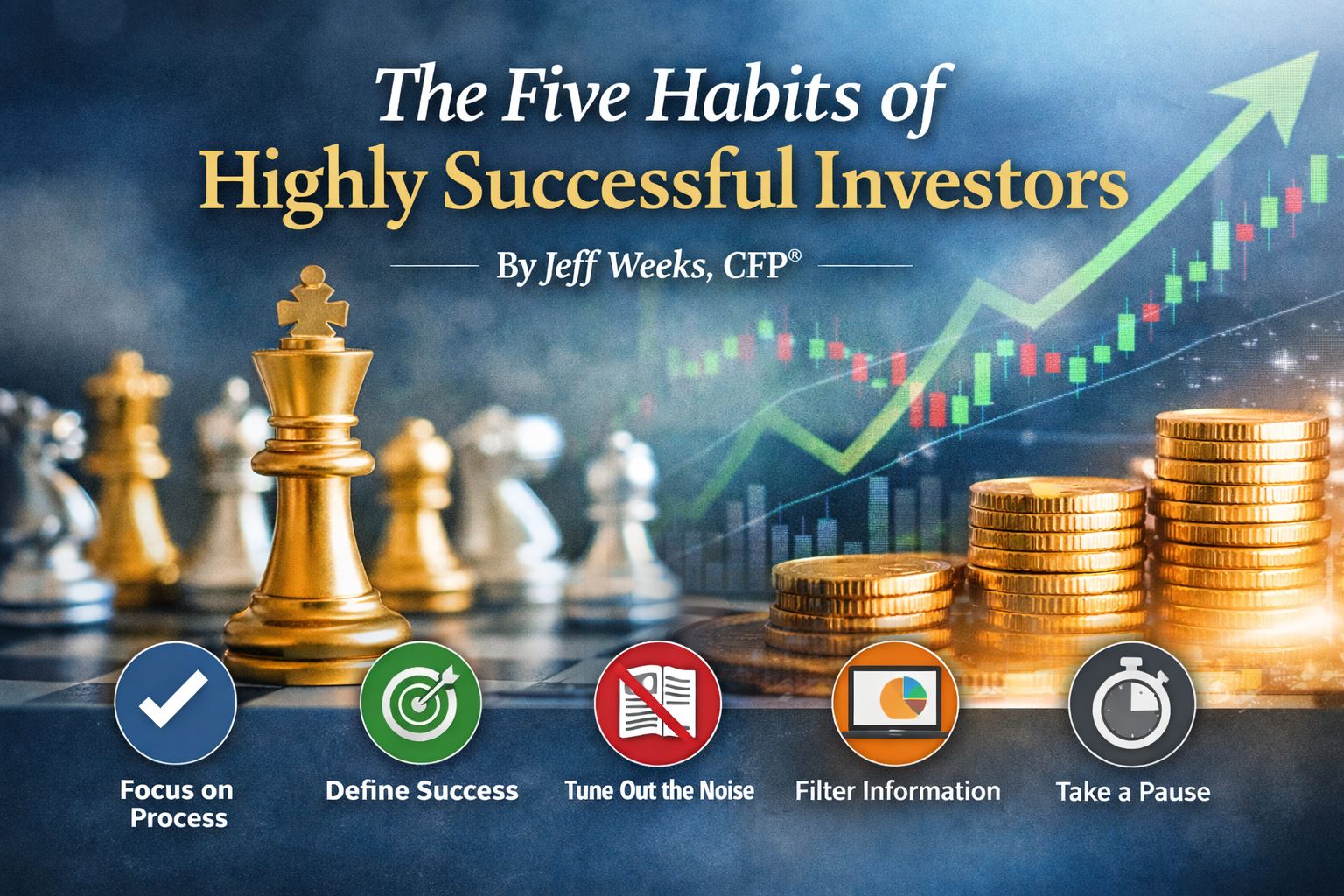
Over time, I’ve seen five habits show up again and again among highly successful investors.
Habit #1: Separate Decision Quality from the Outcome
Some of the hardest conversations I’ve had with clients happened after the fact, when a decision didn’t work out as hoped. The immediate conclusion is often, “That was a mistake.”
Sometimes it was. Often, it wasn’t.
Markets can be poor teachers. Markets reward poor decisions just often enough to make investors feel smart, while punishing good decisions just often enough to lead people to abandon them. Judging decisions solely by outcomes trains investors to learn the wrong lessons.
I’ve heard many versions of, “I knew that was going to happen,” after a market event. That hindsight feels comforting, but it often creates false confidence about predicting the future.
Successful investors judge decisions based on what was known at the time they were made. If a decision was reasonable given the information available, the outcome doesn’t invalidate the process.
Habit #2: Define Success Before Emotions Get Involved
I’ve worked with many investors who were making steady progress toward their financial plan goals and still felt dissatisfied.
They didn’t lose money. They lost perspective.
A diversified portfolio delivered a solid return, but attention shifted to what they didn’t own. “Yeah, but if I had just owned more Nvidia,” or “If I had put it all in Bitcoin, I’d be retired by now.” I’ve heard those lines more times than I can count.
If a portfolio delivers a 10% return, is that good? If I ask that before the fact, usually the answer is yes, I’d take that. But if I ask if that was a good return LAST YEAR, it’s more likely that the answer is, “It depends.” Depends on what else happened. Depends on what someone else made.
Successful investors define success in advance. They measure progress by whether the plan is doing its job, not by whether they captured the best-performing investment in hindsight.
Habit #3: Don’t Let Stories Rewrite the Plan
Every market cycle comes with a compelling narrative. Sometimes it’s optimistic. Sometimes it’s fearful. Almost always, it’s delivered with confidence.
I’ve seen investors abandon thoughtful, long-term strategies not because their goals changed, but because the market story became uncomfortable to live with. Humans are wired to find patterns, even when none exist.
It’s no different than watching a coin come up heads several times in a row and feeling certain tails is due. Intellectually, we know better. Emotionally, the urge remains.
Highly effective investors are cautious about changing strategy in response to stories. They distinguish between changes driven by life events and changes driven by market discomfort. When it’s the latter, they slow down.
Habit #4: Control the Information Diet
Early in my career, market information arrived in limited doses. Closing stock prices, news stories, and opinions were read about in the following day’s newspaper. Today, it arrives constantly and is often tailored to reinforce existing beliefs based on algorithms designed to get your attention.
I’ve watched investors talk themselves into fear or overconfidence simply by consuming too much information. During volatile periods, the loudest voices tend to be the most certain, and certainty is rarely a reliable guide.
Highly effective investors stay informed, but they don’t immerse themselves in nonstop opinion. They recognize that information that increases urgency without increasing clarity is usually noise, not insight.
Habit #5: Slow Down Big Decisions
The investors who navigate multiple market cycles successfully don’t rely on willpower in the heat of the moment. They rely on structure.
Written investment policies, rebalancing rules, predefined risk ranges, and objective conversations all serve the same purpose. They create space between emotion and action.
Some of the most valuable moments in my career came during periods of market stress, when the best service I could provide wasn’t an answer, but a pause. Very few good investment decisions require urgency.
Final Thoughts
Markets will always be unpredictable. That’s not a flaw; it’s the price of admission for long-term returns. What is predictable is how investors tend to react when uncertainty rises.
The Five Habits of Highly Successful Investors won’t eliminate emotion, but they do prevent emotion from becoming policy. Over time, that distinction matters far more than any tactical adjustment or market forecast.
Successful investing isn’t about doing extraordinary things. It’s about doing ordinary things consistently, especially when they’re hardest to do.
If recent headlines, regret about what you didn’t own, or anxiety about what comes next are influencing your decisions, it may be time to revisit your plan. Get in touch if I can help.