

Finance Is Not a Sport

Photo by My Army Reserve

I love college football season. The pageantry, energy, and traditions are, in my opinion, unrivaled in the world of sports. The 12th Man at Texas A&M, calling the Hogs at Arkansas, Auburn’s War Eagle, tailgating in “The Grove” at Ole Miss, and the Michigan band playing “The Victors” over and over and over and over are just a few examples of what makes the experience so enjoyable.

But science has started to explain why that may be. Watching your favorite team win can increase your testosterone level according to some studies. Some people see their dopamine levels increase when their team does well, which literally increases the feeling of pleasure. Other hormones such as adrenaline, cortisol, and oxytocin have also been shown from endocrinology to increase in sports fans.

This may help explain why my family leaves me alone on Saturdays to watch my favorite team in solitude. I am not truly alone as inevitably up to a dozen college friends will engage in a group text or chat with the season seemingly riding on each play.

Just this last weekend, I received messages that alternately suggested the coach of my favorite team is grossly over rated and should be fired to being a genius deserving of a raise, all in the span of a couple of hours from the same person. Referees were accused of being biased until they were celebrated for making the right call. 

While my family may disagree while I’m screaming at the TV, it is the thrill ride of vicariously experiencing the ups and downs of my team that make watching sports so enjoyable. Unfortunately, mainly due to the proliferation of media into all areas of life, investing has taken on a similar dynamic.

It wasn’t that long ago that financial news and information were delivered in much less timely and dynamic ways. Closing stock prices were found in the back of the business pages of the newspaper. If you wanted an actual quote, if you didn’t work on Wall Street in New York, you either called your broker or went to his office.

On those days that the Dow Jones Industrial Average (DJIA) reached a milestone, such as breaking 1,000 for the first time in 1972, it may have warranted a small headline, below the fold, in major newspapers. During precipitous declines, like Black Monday in 1987 when the DJIA fell 22.61% (508 points to 1,738.74), Dan Rather led his 5:30 PM broadcast with the bad news, but then turned the page to other items such as the American response to an Iranian missile attack on US tanker in the Persian Gulf.

Compare that to today, when you can get real time quotes of virtually any stock in any market around the clock. Turn on the business channel in the morning and immediately see what the futures markets are doing. A headline this morning, for example, “BREAKING: Dow futures fall 150 points as Street digests jobs.”

Is that really any different of a feeling than if your team just fumbled the opening kickoff? If we do have a big selloff, rest assured that there will be at least 4 talking head “experts” on screen at once all trying to talk over one another to deliver us the play by play. All that is missing is a few hundred screaming fans with cleverly written signs in the background.

Much like in sports, you can follow social media for instant analysis, commentary, and even advice on what to buy or sell. You can even play “fantasy” by opening simulated trading accounts with any number of online ventures and compete against other “investors”.

As entertainment, it can be argued whether our addiction to sports as a society is a net positive. When it comes to our investments, allowing our emotions to get the best of us makes about as much sense as deciding to forfeit the game in the 1st quarter because the ball didn’t bounce our way.

Whether your plan is a risk averse approach designed to control the clock with a bruising ground game and strong defense or a wide open passing attack that is primarily worried about outscoring the opponent, successful teams typically have success by staying the course.

Investing is a 4 quarter game that rewards those that keep their cool when the momentum swings to the other team. Understanding the tendencies of the opponent, such as stocks tend to outperform bonds over time, help us keep perspective and stick with our game plan.

It’s a long season, do yourself a favor and watch more football and less CNBC. 
3 Things to Do During a Correction

For the past month or so, there have been a lot of more down days than up ones in the stock market. Does the current market volatility have you down? Try running a wealth management business that doesn’t charge anything when accounts lose value!

You may have read my 2015 Accountable Update when I referenced Vanguard founder, John Bogle, in a July 2014 AAII Journal article. Bogle made a case that an advisors job is to keep our clients from “doing anything” that may ultimately reduce their chances of being successful investors.

While letting our emotions get the best of us during times of volatility can lead to poor decision making and timing, it may be over simplistic to say we shouldn’t do “anything” in reaction to lower prices in the market. Whether the bulls are running or the bears are roaring, there is always something we CAN be doing to increase the chances that we will be successful investors. This week’s update will focus on three things you can do right now to take advantage of the recent market turmoil.

The Patience Principle

Jim Parker, Outside the Flags
Vice President, Dimensional Fund Advisors

Global markets are providing investors a rough ride at the moment, as the focus turns to China’s economic outlook. But while falling markets can be worrisome, maintaining a longer term perspective makes the volatility easier to handle.

A typical response to unsettling markets is an emotional one. We quit risky assets when prices are down and wait for more “certainty.”

These timing strategies can take a few forms. One is to use forecasting to get out when the market is judged as “overbought” and then to buy back in when the signals tell you it is “oversold.”

A second strategy might be to undertake a comprehensive macro-economic analysis of the Chinese economy, its monetary policy, global trade and investment linkages, and how the various scenarios around these issues might play out in global markets.

In the first instance, there is very little evidence that these forecast-based timing decisions work with any consistency. And even if people manage to luck their way out of the market at the right time, they still have to decide when to get back in.

In the second instance, you can be the world’s best economist and make an accurate assessment of the growth trajectory of China, together with the policy response. But that still doesn’t mean the markets will react as you assume.

A third way is to reflect on how markets price risk. Over the long term, we know there is a return on capital. But those returns are rarely delivered in an even pattern. There are periods when markets fall precipitously and others when they rise inexorably.

The only way of getting that “average” return is to go with the flow. Think about it this way. A sign at the river’s edge reads: “Average depth: three feet.” Reading the sign, the hiker thinks: “OK, I can wade across.” But he soon discovers the “average” masks a range of everything from 6 inches to 15 feet.

Likewise, financial products are frequently advertised as offering “average” returns of, say, 8%, without the promoters acknowledging in a prominent way that individual year returns can be many multiples of that average in either direction.

Now, there may be nothing wrong with that sort of volatility if the individual can stomach it. But others can feel uncomfortable. And that’s OK too. The important point is being prepared about possible outcomes from your investment choices.

Markets rarely move in one direction for long. If they did, there would be little risk in investing. And in the absence of risk, there would be no return. One element of risk, although not the whole story, is the volatility of an investment.

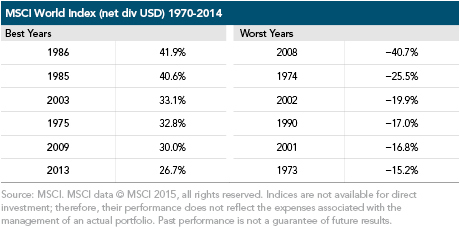
Look at a world stock market benchmark such as the MSCI World Index, in US dollars. In the 45 years from 1970 to 2014, the index has registered annual gains of as high as 41.9% (in 1986) and losses of as much as 40.7% (2008).

But over that full period, the index delivered an annualized rate of return of 8.9%. To earn that return, you had to remain fully invested, taking the unsettling down periods with the heartening up markets, but also rebalancing each year to return your desired asset allocation back to where you want it to be.

Timing your exit and entry successfully is a tough task. Look at 2008, the year of the global financial crisis and the worst single year in our sample. Yet, the MSCI World index in the following year registered one of its best ever gains.

Now, none of this is to imply that the market is due for a rebound anytime soon. It might. It might not. The fact is no one can be sure. But we do know that whenever there is a great deal of uncertainty, there will be a great deal of volatility.

Second-guessing markets means second-guessing news. What has happened is already priced in. What happens next is what we don’t know, so we diversify and spread our risk to match our own appetite and expectations.

Spreading risk can mean diversifying within equities across different stocks, sectors, industries, and countries. It also means diversifying across asset classes. For instance, while stocks have been performing poorly, often bonds have been doing well.

Markets are constantly adjusting to news. A fall in prices means investors are collectively demanding an additional return for the risk of owning equities. But for individual investors, the price decline, if temporary, may only matter if they need the money today.

If your horizon is five, 10, 15, or 20 years, the uncertainty will soon fade and the markets will worry about something else. Ultimately, what drives your return is how you allocate your capital across different assets, how much you invest over time, and the power of compounding.

But in the short term, the greatest contribution you can make to your long-term wealth is exercising patience. And that’s where your advisor comes in.


Past performance is not a guarantee of future results. Diversification does not eliminate the risk of market loss. There is no guarantee investment strategies will be successful. International investing involves special risks such as currency fluctuation and political instability. Investing in emerging markets may accentuate these risks. Fixed income securities are subject to increased loss of principal during periods of rising interest rates. Fixed income investments are subject to various other risks, including changes in credit quality, liquidity, prepayments, and other factors.

Dimensional Fund Advisors LP ("Dimensional") is an investment advisor registered with the Securities and Exchange Commission. 

All expressions of opinion are subject to change without notice in reaction to shifting market conditions. This content is provided for informational purposes, and it is not to be construed as an offer, solicitation, recommendation or endorsement of any particular security, products, or services.