3 Things to Do During a Correction

For the past month or so, there have been a lot of more down days than up ones in the stock market. Does the current market volatility have you down? Try running a wealth management business that doesn’t charge anything when accounts lose value!

You may have read my 2015 Accountable Update when I referenced Vanguard founder, John Bogle, in a July 2014 AAII Journal article. Bogle made a case that an advisors job is to keep our clients from “doing anything” that may ultimately reduce their chances of being successful investors.

While letting our emotions get the best of us during times of volatility can lead to poor decision making and timing, it may be over simplistic to say we shouldn’t do “anything” in reaction to lower prices in the market. Whether the bulls are running or the bears are roaring, there is always something we CAN be doing to increase the chances that we will be successful investors. This week’s update will focus on three things you can do right now to take advantage of the recent market turmoil.

The Patience Principle

Jim Parker, Outside the Flags
Vice President, Dimensional Fund Advisors

Global markets are providing investors a rough ride at the moment, as the focus turns to China’s economic outlook. But while falling markets can be worrisome, maintaining a longer term perspective makes the volatility easier to handle.

A typical response to unsettling markets is an emotional one. We quit risky assets when prices are down and wait for more “certainty.”

These timing strategies can take a few forms. One is to use forecasting to get out when the market is judged as “overbought” and then to buy back in when the signals tell you it is “oversold.”

A second strategy might be to undertake a comprehensive macro-economic analysis of the Chinese economy, its monetary policy, global trade and investment linkages, and how the various scenarios around these issues might play out in global markets.

In the first instance, there is very little evidence that these forecast-based timing decisions work with any consistency. And even if people manage to luck their way out of the market at the right time, they still have to decide when to get back in.

In the second instance, you can be the world’s best economist and make an accurate assessment of the growth trajectory of China, together with the policy response. But that still doesn’t mean the markets will react as you assume.

A third way is to reflect on how markets price risk. Over the long term, we know there is a return on capital. But those returns are rarely delivered in an even pattern. There are periods when markets fall precipitously and others when they rise inexorably.

The only way of getting that “average” return is to go with the flow. Think about it this way. A sign at the river’s edge reads: “Average depth: three feet.” Reading the sign, the hiker thinks: “OK, I can wade across.” But he soon discovers the “average” masks a range of everything from 6 inches to 15 feet.

Likewise, financial products are frequently advertised as offering “average” returns of, say, 8%, without the promoters acknowledging in a prominent way that individual year returns can be many multiples of that average in either direction.

Now, there may be nothing wrong with that sort of volatility if the individual can stomach it. But others can feel uncomfortable. And that’s OK too. The important point is being prepared about possible outcomes from your investment choices.

Markets rarely move in one direction for long. If they did, there would be little risk in investing. And in the absence of risk, there would be no return. One element of risk, although not the whole story, is the volatility of an investment.

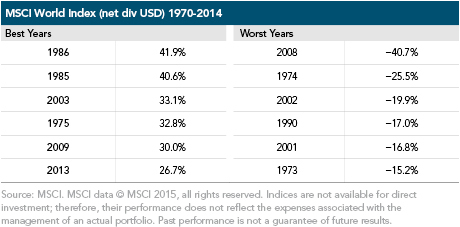
Look at a world stock market benchmark such as the MSCI World Index, in US dollars. In the 45 years from 1970 to 2014, the index has registered annual gains of as high as 41.9% (in 1986) and losses of as much as 40.7% (2008).

But over that full period, the index delivered an annualized rate of return of 8.9%. To earn that return, you had to remain fully invested, taking the unsettling down periods with the heartening up markets, but also rebalancing each year to return your desired asset allocation back to where you want it to be.

Timing your exit and entry successfully is a tough task. Look at 2008, the year of the global financial crisis and the worst single year in our sample. Yet, the MSCI World index in the following year registered one of its best ever gains.

Now, none of this is to imply that the market is due for a rebound anytime soon. It might. It might not. The fact is no one can be sure. But we do know that whenever there is a great deal of uncertainty, there will be a great deal of volatility.

Second-guessing markets means second-guessing news. What has happened is already priced in. What happens next is what we don’t know, so we diversify and spread our risk to match our own appetite and expectations.

Spreading risk can mean diversifying within equities across different stocks, sectors, industries, and countries. It also means diversifying across asset classes. For instance, while stocks have been performing poorly, often bonds have been doing well.

Markets are constantly adjusting to news. A fall in prices means investors are collectively demanding an additional return for the risk of owning equities. But for individual investors, the price decline, if temporary, may only matter if they need the money today.

If your horizon is five, 10, 15, or 20 years, the uncertainty will soon fade and the markets will worry about something else. Ultimately, what drives your return is how you allocate your capital across different assets, how much you invest over time, and the power of compounding.

But in the short term, the greatest contribution you can make to your long-term wealth is exercising patience. And that’s where your advisor comes in.


Past performance is not a guarantee of future results. Diversification does not eliminate the risk of market loss. There is no guarantee investment strategies will be successful. International investing involves special risks such as currency fluctuation and political instability. Investing in emerging markets may accentuate these risks. Fixed income securities are subject to increased loss of principal during periods of rising interest rates. Fixed income investments are subject to various other risks, including changes in credit quality, liquidity, prepayments, and other factors.

Dimensional Fund Advisors LP ("Dimensional") is an investment advisor registered with the Securities and Exchange Commission. 

All expressions of opinion are subject to change without notice in reaction to shifting market conditions. This content is provided for informational purposes, and it is not to be construed as an offer, solicitation, recommendation or endorsement of any particular security, products, or services. 

Should Investors Sell After a "Correction"?

Weston Wellington, Down to the Wire
Vice President, Dimensional Fund Advisors

Stock prices in markets around the world fluctuated dramatically for the week ended August 27. On Monday, August 24, the Dow Jones Industrial Average fell 1,089 points—a larger loss than the “Flash Crash” in May 2010—before rallying to close down 588. Prices fell further on Tuesday before recovering sharply on Wednesday, Thursday, and Friday. Although the S&P 500 and Dow Jones Industrial Average rose 0.9% and 1.1%, respectively, for the week, many investors found the dramatic day-to-day fluctuations unsettling.

Based on closing prices, the S&P 500 Index declined 12.35% from its record high of 2130.82 on May 21 through August 24. Financial professionals generally describe any decline of 10% or more from a previous peak as a “correction,” although it is unclear what investors should do with this information. Should they seek to protect themselves from further declines by selling, or should they consider it an opportunity to purchase stocks at more favorable prices?

Based on S&P 500 data, stock prices have declined 10% or more on 28 occasions between January 1926 and June 2015. Obviously, every decline of 20% or 30% or 40% began with a decline of 10%. As a result, some investors believe that avoiding large losses can be accomplished easily by eliminating equity exposure entirely once the 10% threshold has been breached.

Market timing is a seductive strategy. If we could sell stocks prior to a substantial decline and hold cash instead, our long-run returns could be exponentially higher. But successful market timing is a two-step process: determining when to sell stocks and when to buy them back. Avoiding short-term losses runs the risk of avoiding even larger long-term gains. Regardless of whether stock prices have advanced 10% or declined 10% from a previous level, they always reflect (1) the collective assessment of the future by millions of market participants and (2) the expectation that equities in both the US and markets around the world have positive expected returns.

Exhibit 1 below shows that US stocks have typically delivered above-average returns over one, three, and five years following consecutive negative return days resulting in a 10% or more decline. Results from non-US markets are similar.

Contrary to the beliefs of some investors, dramatic changes in security prices are not a sign that the financial system is broken but rather what we would expect to see if markets are working properly. The world is an uncertain place. The role of securities markets is to reflect new developments— both positive and negative—in security prices as quickly as possible. Investors who accept dramatic price fluctuations as a characteristic of liquid markets may have a distinct advantage over those who are easily frightened or confused by day-to-day events and are more likely to achieve long-run investing success.


REFERENCES

“Wild Ride Leaves Investors Grasping,” Wall Street Journal, August 25, 2015.

“Investors Scramble as Stocks Swing,” Wall Street Journal, August 25, 2015.


Dimensional Fund Advisors LP ("Dimensional") is an investment advisor registered with the Securities and Exchange Commission. 

All expressions of opinion are subject to change without notice in reaction to shifting market conditions. This content is provided for informational purposes, and it is not to be construed as an offer, solicitation, recommendation or endorsement of any particular security, products, or services. 

Contrary to the beliefs of some investors, dramatic changes in security prices are not a sign that the financial system is broken but rather what we would expect to see if markets are working properly. The world is an uncertain place. The role of securities markets is to reflect new developments— both positive and negative—in security prices as quickly as possible. Investors who accept dramatic price fluctuations as a characteristic of liquid markets may have a distinct advantage over those who are easily frightened or confused by day-to-day events and are more likely to achieve long-run investing success.