Accountable Update

Memorial Day, Take a Minute

Photo by Beverly

Photo by Beverly

Greater love hath no man than this, that a man lay down his life for his friends.
— John 15:13

It's Memorial Day weekend! School is out and summer is finally here. But while you are enjoying your time on the water, at the BBQ, or with family and friends, please pause and give thanks to the over 1 million true heroes that made the ultimate sacrifice in service to our country since the Revolutionary War.

Perhaps you know someone personally that made the ultimate sacrifice, but odds are that is not the case.

In today's all volunteer military, less than .5% of the US population is serving in the active military. With active duty forces numbering a little less than 1.5 million today, it can be easy to disregard or overlook the relatively tiny percentage of fallen soldiers, sailors, and airmen. This is why this day is so important, to never forget the cost of freedom.

Since 9/11, 6855 US service members have died in or as a result of their service in Operation Enduring Freedom, Operation Iraqi Freedom and Operation New Dawn, according to Military Times.

602 of those were from Texas.

22 were from Austin.

21 from my alma mater, Texas A&M.

All who have served have made sacrifices, but it is the few who sacrificed all that make our way of life possible. Please join me in honoring those heroes that have given all in service to our great country. Fly your flag, visit a memorial, or just take a minute from your busy day to pause in an act of national unity for a duration of one minute at 3 p.m. on Memorial Day, Monday, May 30 during the National Moment of Remembrance. Have a safe Memorial Day!

A King, a Prince, and Heirs to the Throne

Photo by Rob Greebon 

Photo by Rob Greebon 

Are you a fan of the HBO series, Game of Thrones? The show follows a cast of medieval characters that are embroiled in a civil war to determine who will rule the Seven Kingdoms. The drama ensued following the death of their King, Robert Baratheon.

Following Robert’s untimely death, his closest advisor, Ned Stark, questioned his rightful heir’s legitimacy. While his questions clearly had merit, the heir (the evil Prince Joffrey), ultimately had Ned beheaded as several other potential claimants began scheming, strategizing, and raising armies to fight for the Iron Throne.

This all makes for great television and a welcome diversion from reality on Sunday evenings. When a real King (or Prince) dies unexpectedly, however, the drama can be anything but entertaining if proper planning wasn’t in place. Take, for example, the recent passing of the pop superstar, Prince Rogers Nelson.

Prince departed this world at the relatively young age of 57. He left a fortune estimated at $300 million. What is not included in that figure is the value of his unreleased songs or potential future revenue for licensing, merchandise, or even tours of his Paisley Park Studios.

For some indication of how valuable those future income streams may be, you can look at a real King’s premature passing, Elvis Presley. When he died in 1977 at age 42, the estate was valued around $10 million. After taxes and other estate costs, “only” about $3 million remained. This 70% shrinkage of the Presley estate is often cited as an example of the costs of poor estate planning. But recent estimates from Celebrity Net Worth put the current value at $300 million, primarily thanks to a huge collection of licensing and merchandising deals that is producing $60 million a year in income!

Unlike the King, who did have a simple will, Prince apparently died without a will or any other indication of what his wishes were for his fortune. The King had a relatively short list of heirs, which included his grandfather, great-grandmother, and nine-year-old daughter, Lisa Marie Presley.

Prince, on the other hand, has an ever growing number of relatives filing to be heirs to his estate. Those include a sister, six living half siblings on his mother's side, one living but disputed half sibling on his father's side, a niece and nephew (children of a deceased half sibling), and a possible love child from a teenage fling that currently resides in a Colorado prison.

I asked Austin estate planning attorney Kelly Kocurek about the consequences of dying without a last will and testament, “If someone dies without a will, they are deemed to have died intestate.” (Not to be confused with the chronically overcrowded road between Austin and Dallas.) “In the event an individual dies intestate, such individual misses the opportunity to control the administration of their estate and the disposition of the assets included in their estate.  In an intestate estate, the state, not the decedent, determines who receives the assets included in the decedent’s estate.”

He added, “As a result, the decedent loses their opportunity to set up an estate plan that carries out their wishes for the distribution of their assets and that takes into consideration any tax issues that may arise at their death.   The decedent also loses the opportunity to designate the individual or entity that will serve as the executor of their estate and administer their estate at the time of death. Finally, the cost to administer an intestate estate is usually greater than the cost to administer a well-planned estate. “

Ultimately, all that means that if you die without a will, a judge will decide who are the rightful heirs and who gets what. But first, another relative, Uncle Sam, will move to the front of the line. The IRS will collect Federal Estate Tax of 40% of the value of the estate in excess of the Estate and Gift Tax Exemption ($5.45 million in 2016). In Prince’s case, the state of Minnesota will also take up to 16%.

So how do you avoid creating a drama worthy of Sunday nights on HBO with your estate plan (or lack of one)? Start by including your estate plan as part of your annual overall financial review. Make sure your plan addresses goals that are important to you and the legacy you wish to leave. That can include strategies that:

  • Control to whom and how the estate is distributed

  • Determine who will be in charge of the administration and distribution of the assets

  • Minimize the taxes and other expenses owed by the estate

There are a multitude of approaches that estate planning experts such as Kelly can help you implement, depending on your priorities. If you would like to learn more about some of the considerations to keep in mind when reviewing your plans, see previous Accountable Updates, It’s a Good Friday for Estate Planning and El Niño, Explosions, and Estate Planning?.

Of course, if you haven’t looked at your overall plan recently, the summer is a good time to do so. You know, because winter is coming!


Flingin' it - 5/13/16

Photo by tudor-rose 

Photo by tudor-rose 

I'm always looking for ideas for the Accountable Update. Sometimes an idea may not warrant a full post, but may still be interesting (at least to me) or have merit. This week will be the first in what will probably be a once or twice per month version of the Update where I'll cover several shorter topics or links to material I'd like to share with our readers. The subjects will vary widely.

After considering several titles, I landed on calling these entries, "Flingin' it", as in spaghetti on a wall, mud, or other things you may find in a pasture. I hope it doesn't get too deep.

Do recent GDP estimates spell doom?

If you were really bored, had insomnia, or are a market wonk, you probably noticed that the Bureau of Economic Analysis (BEA) released an estimate of Q1 2016 US GDP growth on April 28. If you are like the rest of us, it may have slipped by unnoticed. I'm sure the suspense is killing you, so before I lose you to a frantic Google search I'll tell you what it was...

.5% (or annualized 2%).

Does that look kind of low? It should, because that is below the historical average of 3.2%, according to the BEA. Does that mean it is time to start stuffing the mattresses? Probably not.

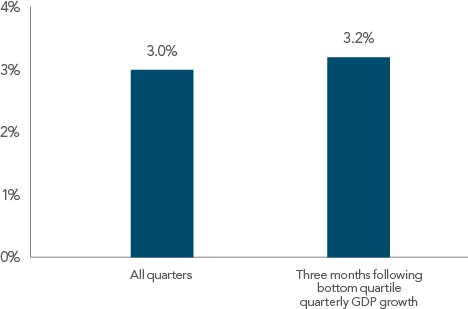
The following chart shows that the average quarterly return for the S&P 500 Index from 1948-2016 was 3%. In quarters following lowest quartile GDP growth, the average quarterly return was 3.2%! So is this a buy signal?

Quarterly S&P 500 Index Returns, 1948–2016

Sources: S&P Dow Jones Indices, Bureau of Economic Analysis.Past performance is not a guarantee of future results. Indices are not available for direct investment; therefore, their performance does not reflect the expenses associated with the ma…

Sources: S&P Dow Jones Indices, Bureau of Economic Analysis.

Past performance is not a guarantee of future results. Indices are not available for direct investment; therefore, their performance does not reflect the expenses associated with the management of an actual portfolio. 

Not if you believe, as I do, that current stock prices reflect all current information. With the average quarterly returns following poor GDP being very close to the average of all quarters, perhaps we can move on to more interesting reading next time we can't sleep!

The Long and Short of it

Hardly a week goes by that I'm not approached by a salesperson about including their "alternative" strategy in the Accountable Portfolios. The pitches are sometimes very compelling. Higher returns, lower volatility, with little correlation to more traditional assets. Some of these alternatives undoubtedly offer some benefit, but are those benefits superior to methods such as those that ATX Portfolio Advisors embraces? More to the point, are they worth the extra expense?

Eugene Fama and Ken French explore two such type of alternative approaches on the Fama/French Forum. Long/Short Strategies in the May 10th entry and Portable Alpha on May 5th answer those questions.

Can Negative Rates be Positive?

With countries like Japan and Germany experiencing negative interest rates on their bonds as a result of market forces and/or central bank policies, it is reasonable to wonder why anyone would willingly buy a bond that is going to pay back less than you put in.

In the last piece, I've linked an Issue Brief from Dimensional Funds, Finding Positive Expected Returns in a Negative Rate Environment. It discusses that hedging the currencies of foreign bond issuers can not only control volatility but may also lead to positive expected returns, even when rates are negative.

That's enough for this week. If any of it sticks with you, get in touch if you would like to discuss!