

Accountable Update

4 Letters Worth Repeating, T-I-M-E

This week, there was a story on a major "financial" network that predicted not only that the US stock market would peak on a particular day in March, but that it would happen after lunch. Appropriately, that network refers to itself with a 4-letter word.

But really, how considerate of them? With that level of detail, we should all be able to ride our unicorns down to Wall Street after sleeping late and enjoying a nice brunch, with time to spare to put in our sell orders before the bottom falls out.

I can think of a couple of 4-letter words for that kind of "news".

John Maynard Keynes is credited with uttering, “The market can stay irrational longer than you can stay solvent.” The famous (or infamous to some) economist made that observation after he had lost most of his money in ill-timed currency trades using borrowed money in early 1920. He was supposedly betting against the German Deutschmark as Deutschland struggled to recover after The Great War. Of course, in hindsight, he was right to see the black clouds building over the Weimer Republic that ultimately ended in hyperinflation and the rise of the National Socialist German Workers' Party (also known as the Nazis).

It turns out he was right about everything but, WHEN.

Decades later, investing legend Peter Lynch observed, "Far more money has been lost by investors preparing for corrections, or trying to anticipate corrections, than has been lost in corrections themselves." I suppose, though, that practical advice is much less likely to keep you glued to your TV set.

The reason it is so hard to know in the short run how any asset may perform is that the market reflects the aggregate expectations of all market participants, all the time. Folks that are willing to buy an asset are competing with folks who want to sell. When they agree on a price, they both feel that they are making the best deal. The buyer anticipating the asset will increase in price faster than other investment alternatives, the seller that the money will be more effectively invested elsewhere.

At ATX Portfolio Advisors, we believe that while the market incorporates all available information to drive stocks to fair value, we also believe that stocks may have different expected returns. In other words, there are certain characteristics that have resulted in returns that are greater than average that have persisted over time and across markets.

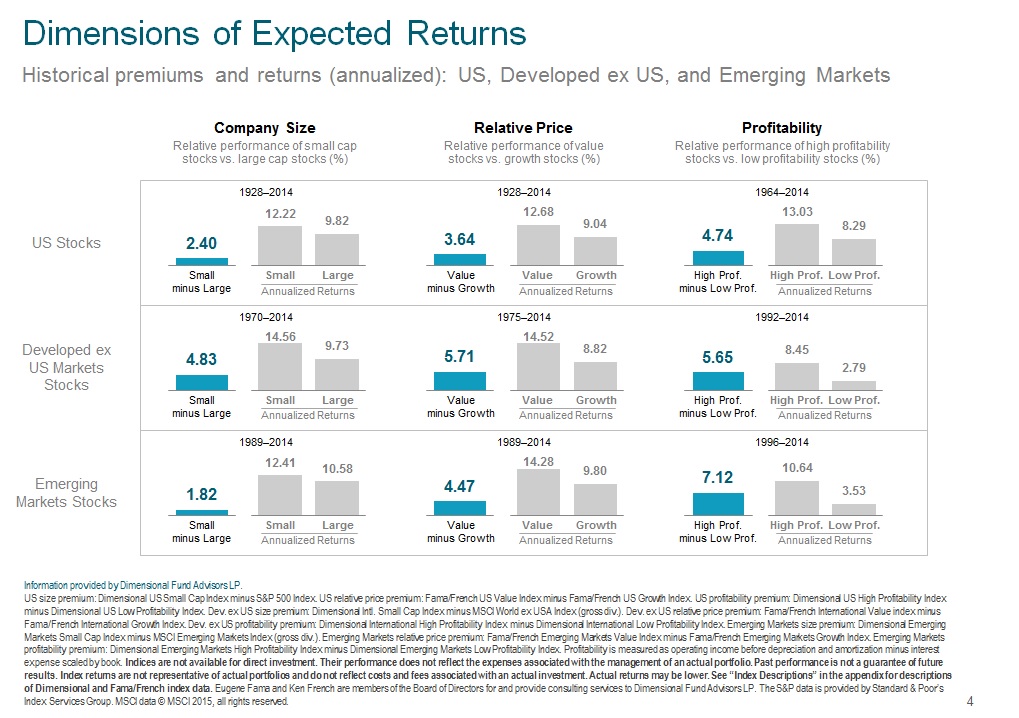
For stocks, there are four characteristics, or dimensions, that compelling evidence shows persistently over time. First is the market itself—stocks have higher expected returns than T-bills. Other characteristics include—company size (small vs. large), relative price (value vs. growth), and profitability (high vs. low).

The chart below documents the historical premiums that the size, relative price, and profitability dimensions have produced over time frames that reliable data is available. As you can see, the premiums have persisted over long time frames across different types of markets.
The next chart shows the yearly relative performance of dimensions in US stocks. The blue bars indicate years in which the market, small cap, value, and profitability premiums were positive. The red bars indicate years in which the premiums were negative. A positive premium indicates out-performance (e.g., small cap stocks outperform large cap stocks); a negative premium indicates under-performance (e.g., small cap stocks under-perform large cap stocks).

Over these periods, positive premiums have occurred more frequently than negative premiums across all dimensions. BUT, the premiums can and do vary widely from year to year and can experience extreme and prolonged negative relative performance. In other words, there is no free brunch.

This is why we say you should take a longer-term view and stay disciplined during periods of volatility or under-performance of any premium. Over longer periods however, we have observed a higher frequency of positive premiums.

This next chart documents the relative 5-year annualized performance of return dimensions in the US equity market. When looking at longer time spans, observations of premiums are more consistent compared to one observation in any given year.

As you can see, there are fewer negative (red bars) 5-year periods versus positive (blue bars) periods. The difference is even more pronounced in historical observations of 10-year premiums as illustrated below.
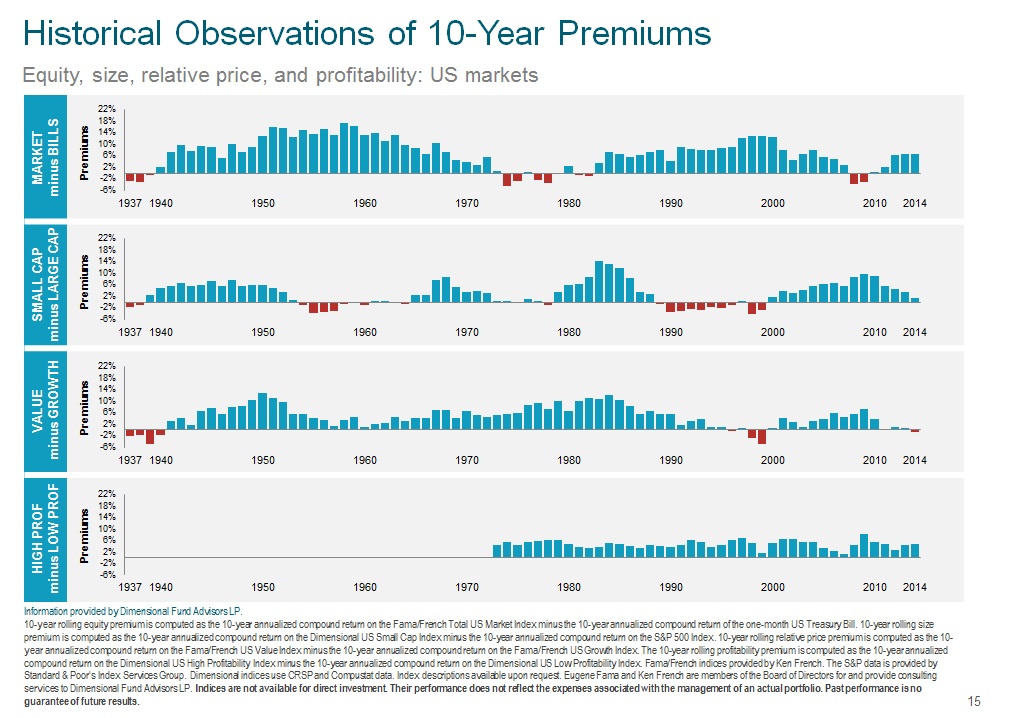
Please remember that despite the higher frequency of positive premiums, outperformance may not be consistent, even over longer periods of time. Long-term investors should consider that premiums are never guaranteed and can undergo periods of negative returns in both relative and absolute terms.

All we have to do is look at the last 10-year period to remind ourselves of these facts, as many of the premiums have been smaller than historical averages.

10 Yr Dimension Performance.jpg

If the first several slides show why we stick to our strategy of indexing the total market with weightings tilted to those dimensions that have demonstrated historical premiums. It is this last chart that illustrates why our philosophy isn't likely to change when short term divergences from historical averages occur. It suggests strongly that the longer our investment period was, the more likely we were to see a premium in all of the dimensions. That's not nearly as exciting as screaming about market tops or bottoms, but it is pretty compelling evidence to stay the course no matter how loud the carnival barker chorus.

If nothing else, all of this reminds us of the old adage, “Time in the market is more important than timing the market.” T-I-M-E, now that's a 4-letter word worth worth repeating.

If you or someone you know lacks the time to plan and manage your portfolio, let's get acquainted.

Obama's Budget - Indecent Proposals or Glimpse of the Future?

Photo by frankieleon

Photo by frankieleon

This week, President Obama presented a $4 Trillion budget proposal to Congress for the 2017 fiscal year. Considering this is the final year of the Obama administration, it being an election year, and both houses currently being controlled by Republicans, it is unlikely that many (or any) of the tax reforms contained in this budget will be implemented in the upcoming year.

Nearly three-quarters of the budget is committed to expenses such as servicing the national debt, Social Security, Medicare, and Medicaid. The reality is that these “mandatory” expenditures will continue to increase due to demographics over the next few decades, leaving our leaders little wiggle room between the unpleasant choices of raising revenue (taxes) or cutting spending.

The “easy” tax hikes are the proposed closing of some of the “loopholes”. Unfortunately, many of our clients look at these “loopholes” as common sense incentives for saving and investing and use them to be Accountable to themselves and their families for financial security. This is why we pay attention to proposals, even those that are unlikely to be enacted today, as they may signal changes on the horizon that could result in stealth tax increases and fewer incentives to invest.

If nothing else, some of these proposals remind us that we shouldn’t take anything for granted when it comes to politicians writing checks that we ultimately will be asked to cash by paying our “fair share”.

Following is a quick summary of some of the provisions that are being proposed and lessons we should take from them:

CLOSING THE “BACK DOOR” ROTH IRA CONTRIBUTIONS

The “Back Door” Roth IRA contribution strategy has been around since 2010, when income limits on Roth conversions were removed. Before that, high-income earners couldn’t make a Roth IRA contribution, nor convert a traditional IRA into a Roth. Under the current rules, it is possible for high earners that exceed eligibility thresholds for contributing to a Roth IRA to contribute to a non-deductible traditional IRA and complete a Roth conversion of those dollars – effectively achieving the goal of a Roth IRA contribution through the “back door”.

The proposal would limit a Roth conversion to only the pre-tax portion of an IRA. Thus, a non-deductible contribution to a traditional IRA would no longer be eligible for a Roth conversion. The “back door” will effectively be closed.

The lesson – If you are above the income thresholds for a deductible Traditional IRA and/or Roth IRA, you should look into the “back door” technique while you can.

LIMITING CONTRIBUTIONS FOR RETIREMENT ACCOUNTS OVER $3.4 MILLION

The budget proposes a rule that would limit any new contributions to retirement accounts (IRAs, 401ks, 403bs, etc) once the balance across all of your retirement accounts exceeds $3.4 million. This is the amount the government estimates that a 62 year old needs today to purchase a joint-and-survivor annuity producing $210,000 a year of income. The proposal allows for inflation indexing and adjustments for annuity costs over time, so these dollar amounts would change over time.

The lessonIn addition to having some insight into what is considered “enough” by some in the government, it should encourage you to maximize those retirement contributions now.

ELIMINATION OF TAX LOT ACCOUNTING FOR SECURITIES AND A REQUIREMENT TO USE AVERAGE COST BASIS

Under current tax law, investors that hold multiple shares of a stock or mutual fund can choose which lots are sold. In other words, if you bought a share for $10 on day 1, followed by another share purchase for $20 on day 2, you would have two “lots” of shares. If you decide to sell one of those shares when the price is $15, you could elect to declare that you are selling purchase from day 2 which cost $20. The net result being a $5 loss on the sale.

The President’s budget proposes the elimination of the specific lot identification method for “portfolio stock”, along with other techniques currently available such as FIFO and LIFO cost basis. Instead, the proposal would require you to use average cost basis. In the example above, the average cost of the share is $15 so the sale at $15 would result in no gain nor loss.

The impact of this change is limiting the ability to tax-loss harvest, or “cherry pick” the most favorable shares from year to year.

The lessonHarvesting tax losses can reduce tax burdens in current years when it may be most favorable to you. In your taxable accounts, it is a strategy that should be considered while it is a viable option.

Other proposals:

  • Required Minimum Distributions (RMD) for Roth IRAs
  • Changes to IRA distributions for non-spouse beneficiaries
  • Repeal of the Net Unrealized Appreciation (NUA) rules for stock in an employer retirement plan
  • Changes to Estate Planning rules:

o   Elimination of Grantor Retained Annuity Trusts (GRATs), installment sales to Intentionally Defective Grantor Trusts (IDGT), and Dynasty Trusts
o   Limiting the total of Present Interest Gifts through Crummy Powers
o   Replacing Step-Up Basis with a Required-Sale-At-Death rule
o   Limitations on Transfer-For-Value Rules, particularly for Life Settlements transactions

  • Limiting 1031 Like-Kind Exchanges on real estate transactions
  • Subjecting S Corporations to the 3.8% Medicare Surtax

You can read all of 2017 revenue proposals in the Treasury Greenbook.

The lessonEven the best financial plans (investment, retirement, estate, etc) are subject to change, often for reasons out of our control such as new rules or laws. This is why we encourage you to review your plans regularly to ensure they are current and effective. If you need to review your plan, let’s get acquainted.

"Issue Briefs" on Volatility, Oil, and China

So far, the stock market has created more questions than answers in 2016. In this week's Accountable Update  I share three "Issue Briefs" from my friends at Dimensional Fund Advisors that address some of the concerns on investors' minds.

In the first Brief, titled Recent Market Volatility, DFA explores how or if returns in January provide indications about the rest of the year. They also compare the recent downturn to other periods of volatility for historical context.

In the second Brief, Crude Oil and Financial Markets, questions about the historical relationship between crude oil prices and stocks are discussed. They also provide some analysis of the cause and impact of the downturn in oil.

The last Brief, An Update on China, reviews the Chinese equity market and DFA's approach to investing there. They discuss recent events and some of the differences between shares traded on local Chinese exchanges versus shares traded in Hong Kong and other overseas markets.

I hope you find these Issue Briefs helpful in answering questions that may be on your mind. As always, if recent events are keeping you up at night or have you questioning your path, get in touch to review your situation.