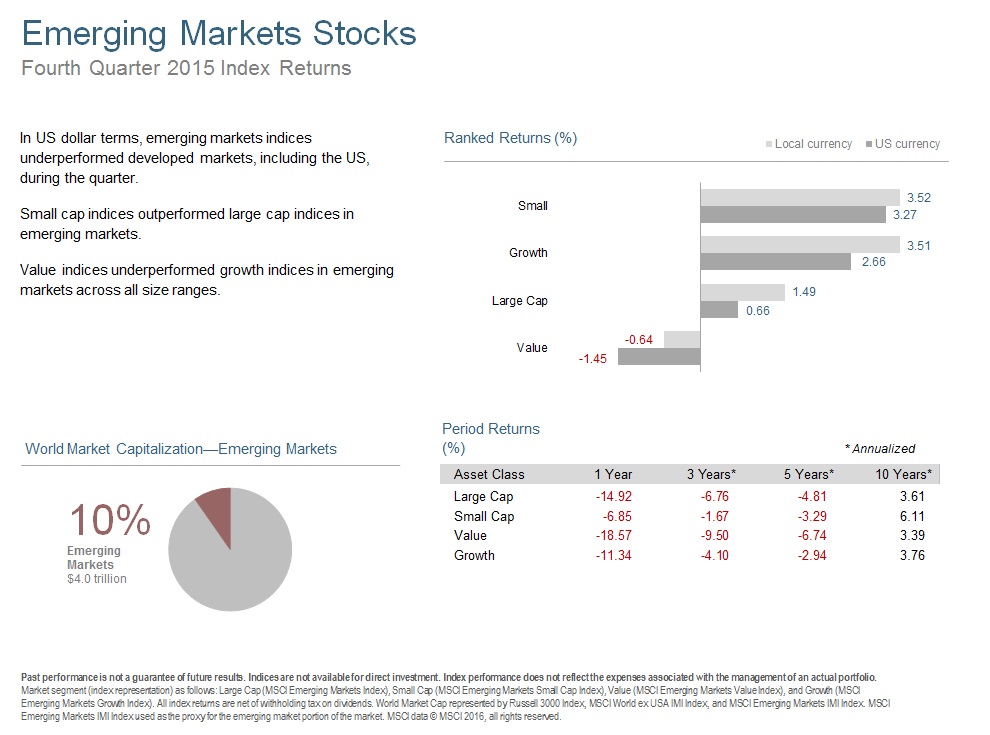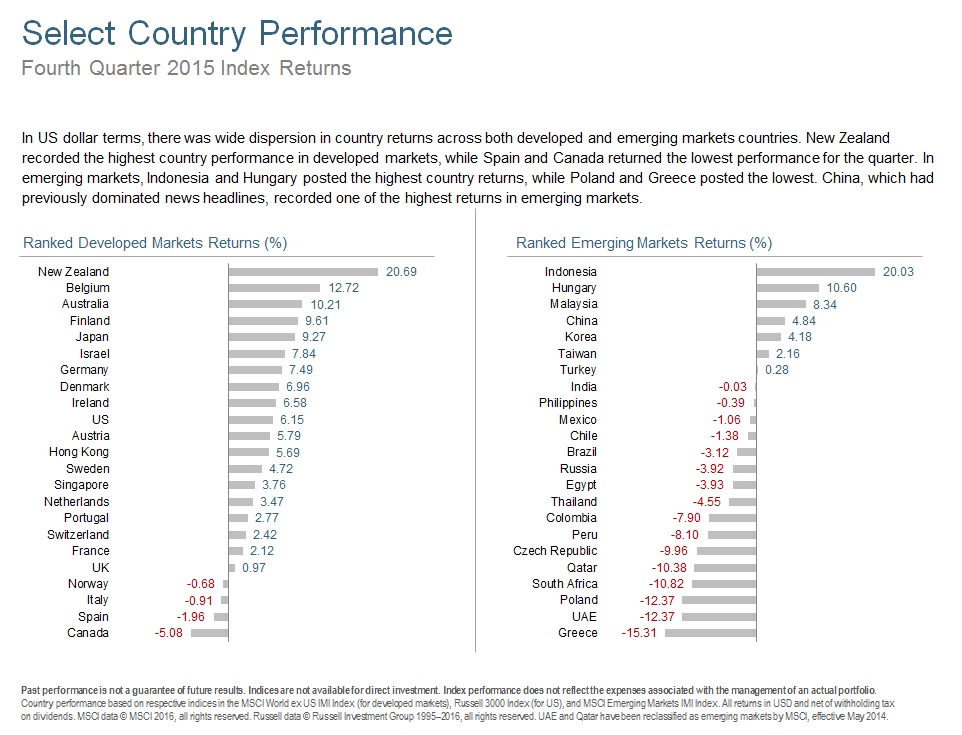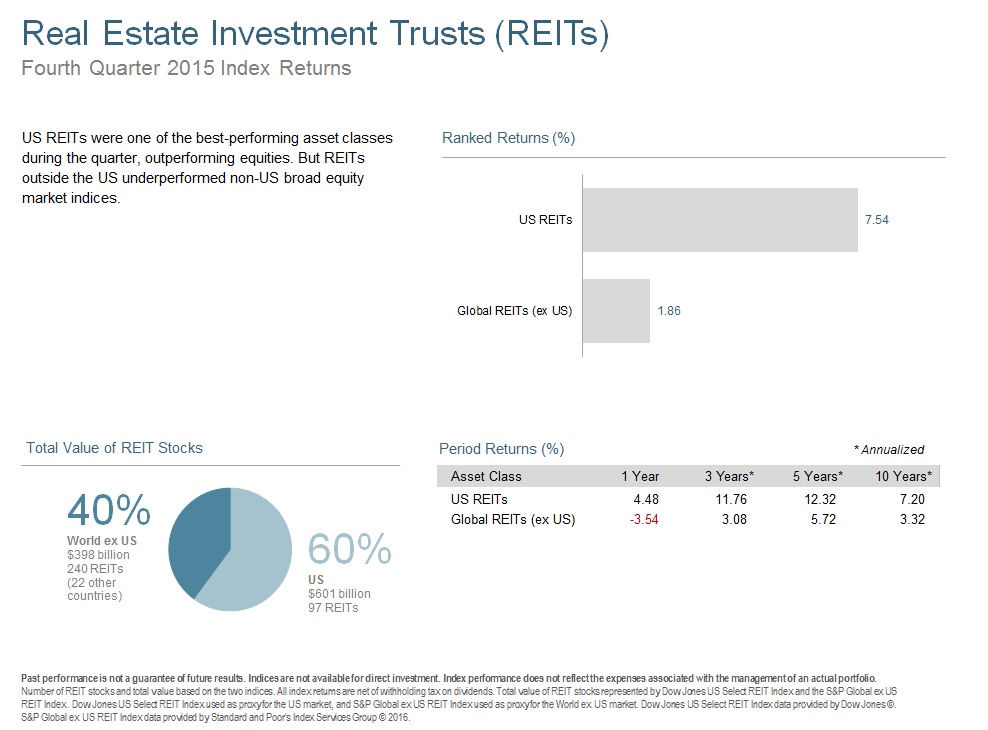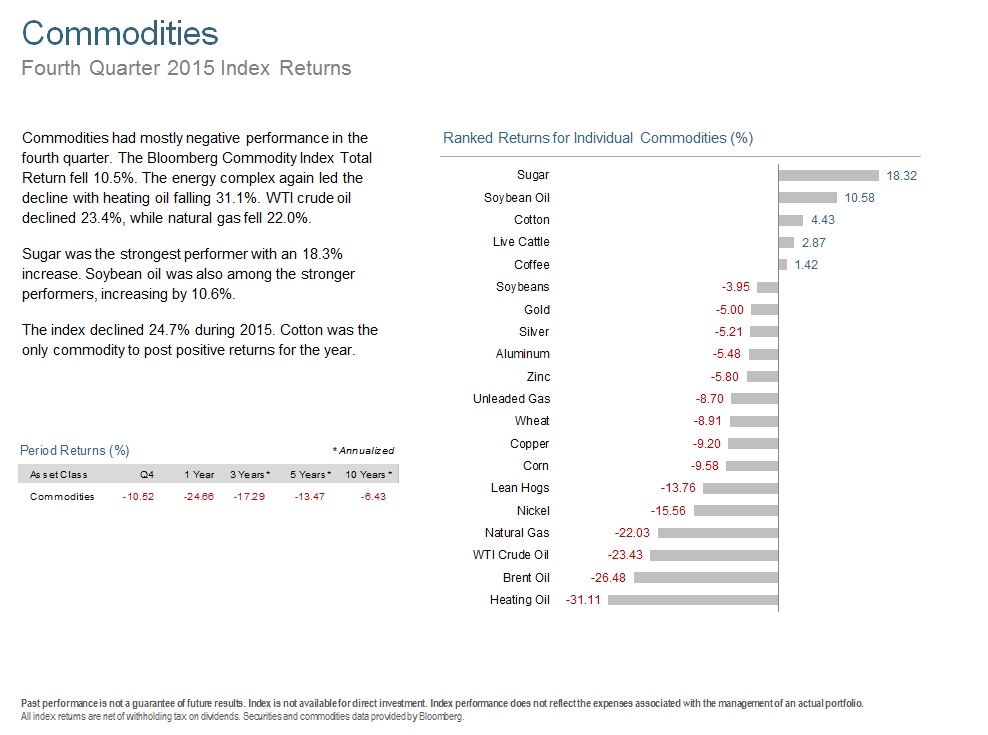

Accountable Update

Q4 2015 Market Review

We Have Liftoff!

In our Q3 Market Review, we asked if it was time for "Liftoff", a.k.a. the rise in short-term interest rates expected when the Federal Reserve raised rates for the first time since 2006. The focus on that event, however, may have obscured the increase in short-term rates that occurred throughout the year.

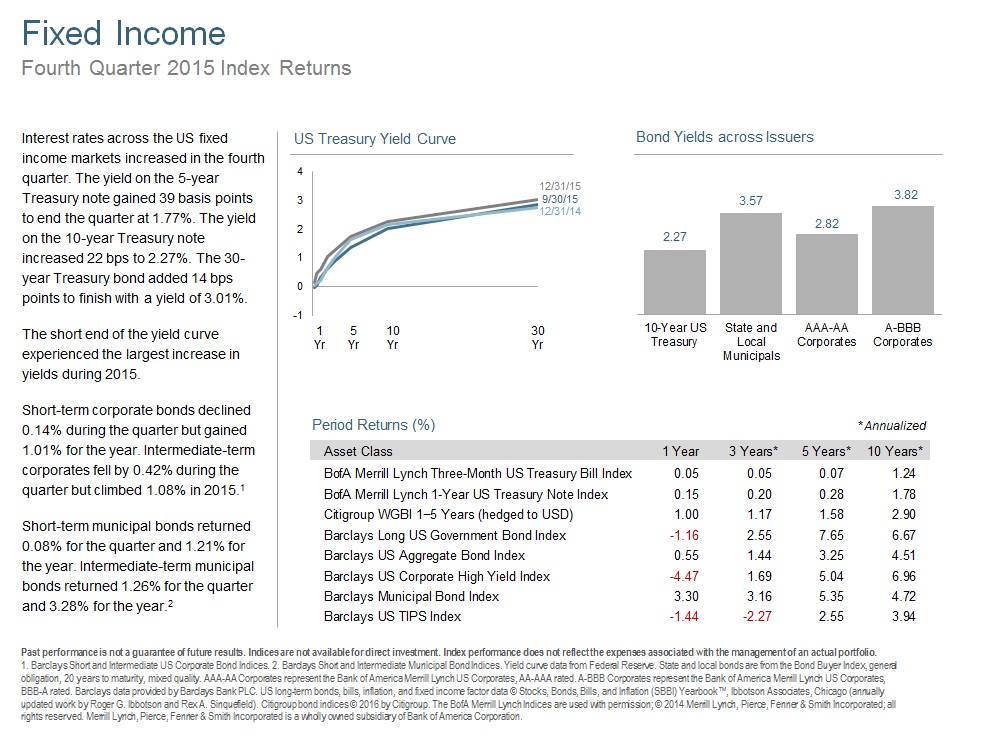
The yield on the 2-Year US Treasury note more than doubled in 2015, rising from 0.45% in January to 1.06% at year end[1].

The yield on the 1-Year US Treasury note more than quintupled, from 0.15% to .65% over the same period. The 6-Month US Treasury bill’s yield rose from a low of 0.03% in May to .49% on December 31. Yet, despite the higher rates, we have not experienced the corresponding financial storm that many predicted in the fixed income market.

The question of how far the Fed will go in raising its overnight target rate is still open. Similarly, we can ask ourselves a more complex question: Is the market leading the Fed or is the Fed leading the market?

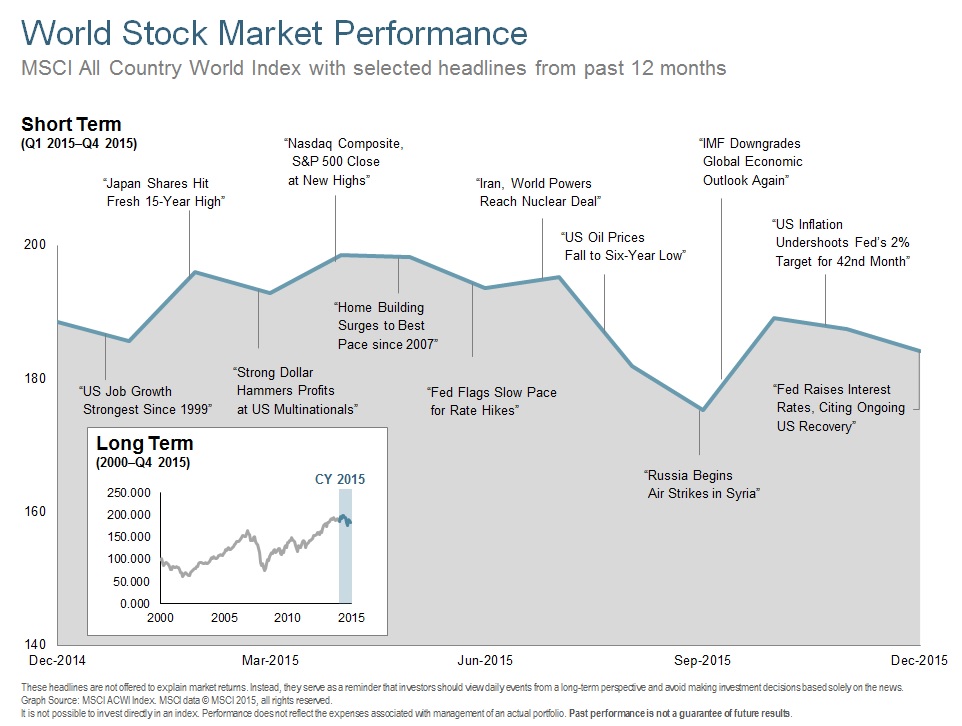
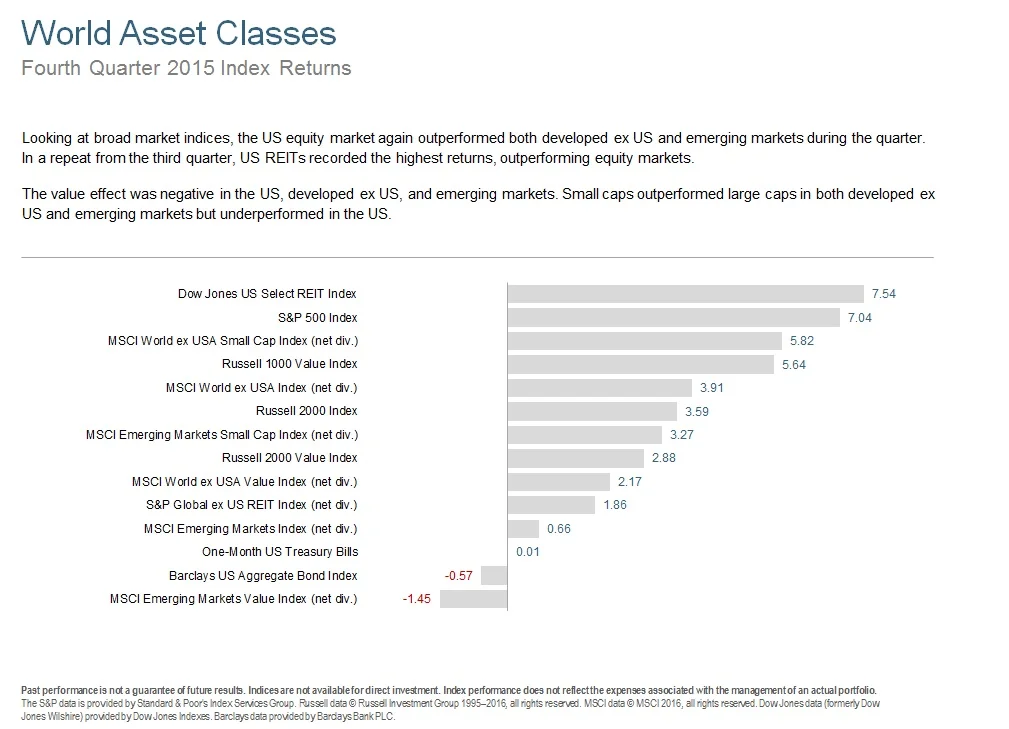
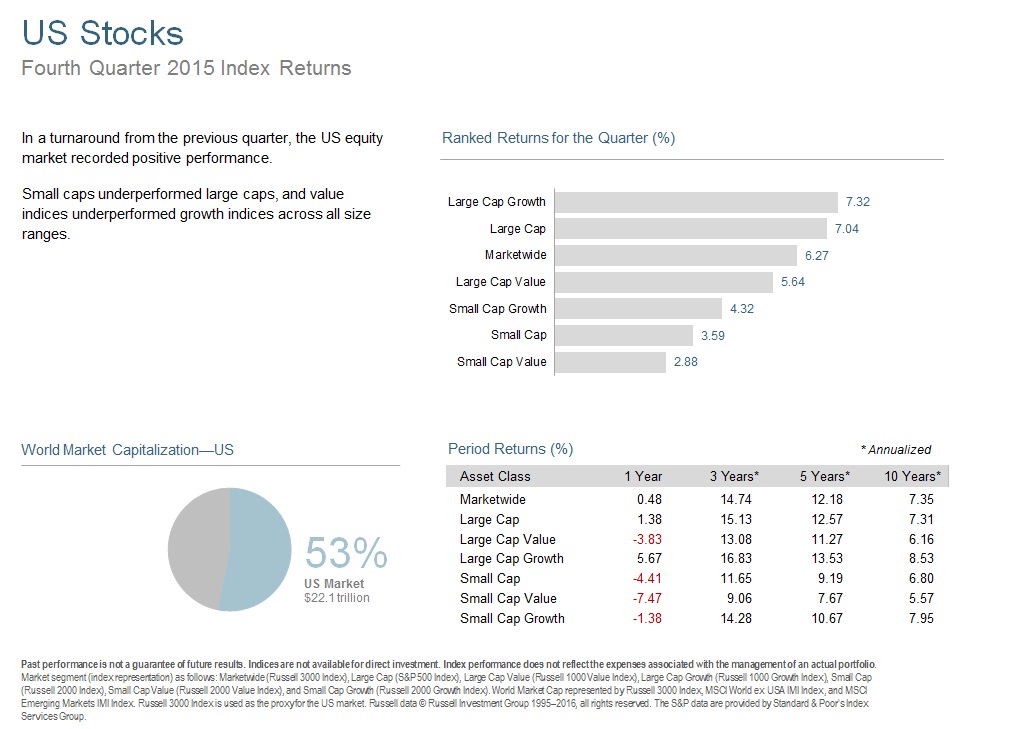
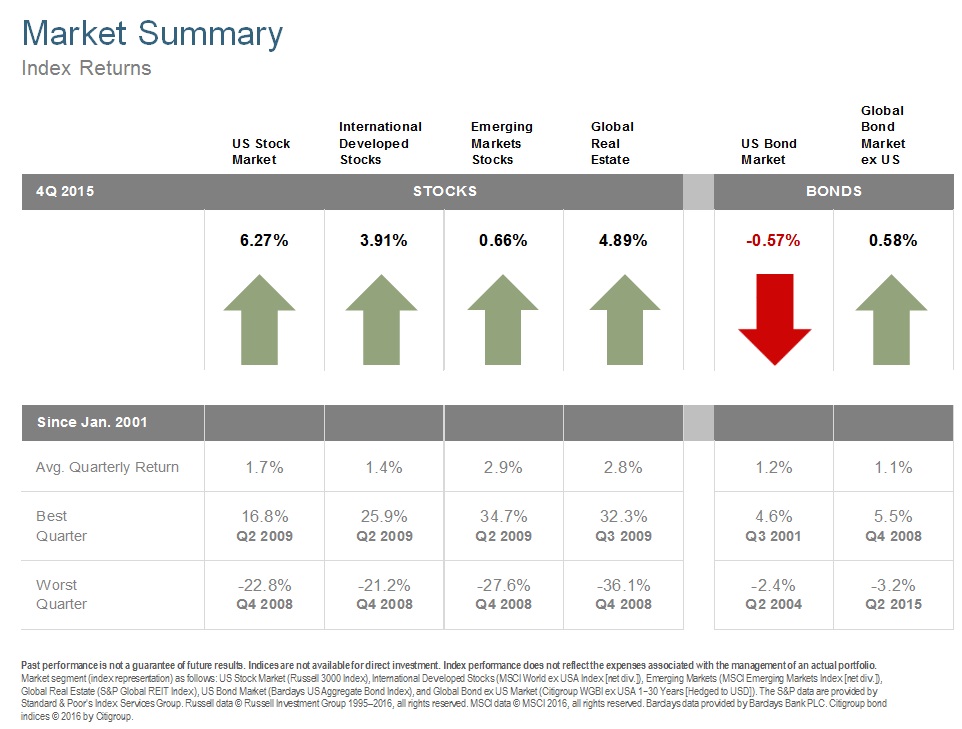
What we do know is that the economy is growing modestly and that inflation remains low in spite of improving labor markets, higher consumer spending, and record vehicle sales. The stock market seemed to acknowledge some of this good news by rallying in October, with the Russell 3000 Index up 6.27% for Q4.

In spite of the rebound, only the first month of the quarter was positive across our models at ATX Portfolio Advisors. The good news for our customers is that our Accountable pricing puts us in your shoes and we only charged advisory fees in the month of October.

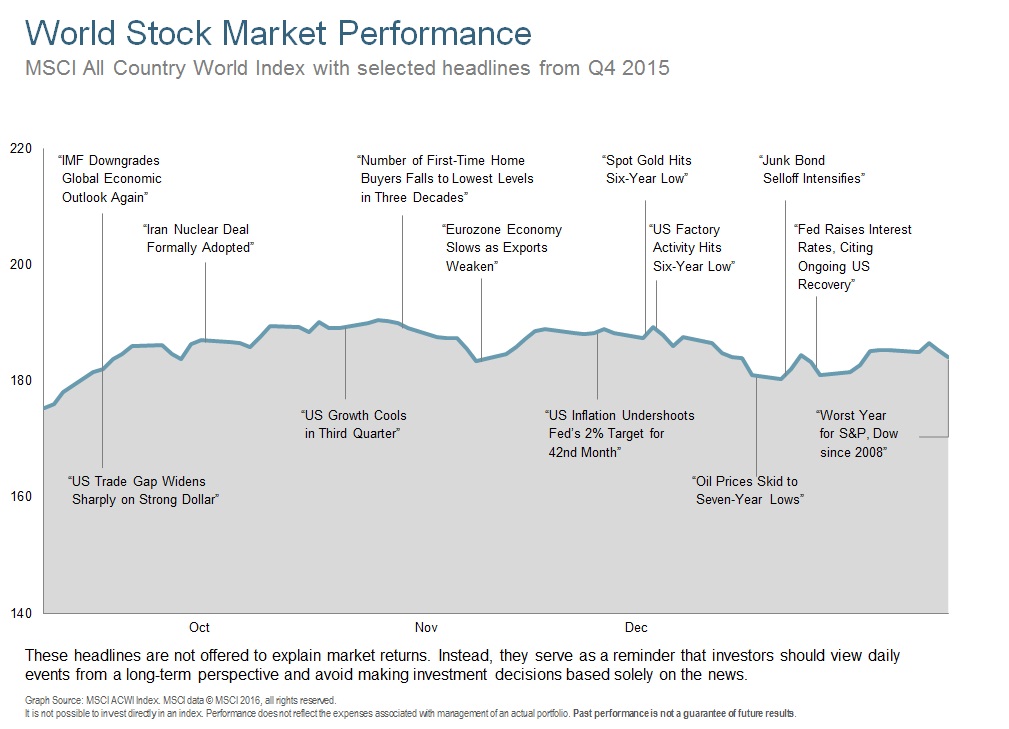
Falling oil prices, the Chinese economy, terrorism, and rising interest rates are just some of the current bricks in the "wall of worry". If you are more worried than normal, it may be a good time to review your plan. Otherwise, have a Happy New Year while you scroll through the Q4 2015 Market Review.
 

[1]As of December 31, 2015. Source: www.treasury.gov
Fixed income securities are subject to increased loss of principal during periods of rising interest rates and may be subject to various other risks, including changes in credit quality, liquidity, prepayments, and other factors. Sector-specific investments can increase these risks.
All expressions of opinion are subject to change. This information is intended for educational purposes, and it is not to be construed as an offer, solicitation, recommendation, or endorsement of any particular security, products, or services. 

Staying Out of Trouble

  Photo by Steve Jurvetson


Photo by Steve Jurvetson

There is a great quote attributed to golfing great, Jack Nicklaus, “The best way to cope with trouble is to stay out of it as much as possible.” I was reminded of this adage recently when speaking to a client about recent events in the financial markets, notably the sell-off of high yield bonds. The decline in these bonds has resulted in the temporary closure of some mutual and hedge funds that invest in them.

If you haven’t been following the news this week, there have been significant losses incurred by investors in "junk bonds", particularly those of companies that deal in energy and energy services. Many of those companies that borrowed money at higher than average interest rates to fund their operations have suddenly found themselves in cash crunches due to the decline in energy prices. While some some of these energy companies have over extended themselves, it's the investment funds that bought the bonds from them are really finding themselves in a pickle, especially if they bought the bonds on margin.

The funds are being forced to sell these bonds to meet their customers' redemptions and margin calls while the rest of the market knows they are in distress, never a good thing if you are a seller. At some point, many of the bonds will become too cheap to pass up and a rally will ensue, but for the time being they seem stuck in a vicious cycle. Lower oil prices are leading to lenders asking for more capital on loans, which leads to redemptions, leading to sale of other securities (like stocks or oil) to raise cash, which leads to lower oil prices, etc. 

Investors chasing higher yields have increasingly ignored risks such as supporting commodity prices and liquidity as we have experienced historically low interest rates for the better part of the last decade. In the last 25 years, junk bonds, collateralized mortgages, credit default swaps, and now maybe junk bonds again have caused financial crisis after crisis. The thing they all have in common is that they seem to offer something for nothing until belatedly the market starts pricing “nothing” accordingly.

In other news, the Federal Reserve raised the target for the fed funds rate by .25%, which is the rate banks lend funds kept at the Fed to other banks. They also raised the discount rate by a similar amount, which is the rate they charge banks to borrow from the Fed. These moves were widely anticipated and thus were largely already priced into the market.

Fed Chairperson, Janet Yellen said, “The economic recovery has clearly come a long way, although it is not yet complete,” she told a press conference following the FOMC’s meeting this week. “The committee currently expects that, with gradual adjustments in the stance of monetary policy, economic activity will continue to expand at a moderate pace and labor market indicators will continue to strengthen.”

Historically, Fed moves to tighten the money supply have been most disruptive when not anticipated by the market. Fortunately, the vast majority expected this move. They even went so far as to announce additional target raises of about another 1% over the next year, which may soften negative impacts of those increases, as well.

At ATX Portfolio Advisors, we believe that most risk should be taken in the equity portion of your portfolio. We spend a great deal of effort figuring out how much “trouble” (risk) someone can withstand to determine their allocation to stocks and invest the balance in high quality short to intermediate term bonds. While the interest rates on these securities aren’t particularly compelling today, it is the buoyancy they provide when the waters get choppy that makes them attractive. It’s just not worth the downside to chase for extra yield by buying lower quality or longer duration bonds, in our opinion.

We also embrace another golf principle, which is to focus on where you want your ball to go and not where it shouldn’t. Goal based planning is the most effective way we know to keep the right perspective when we hit the inevitable errant shot. As Ben Hogan said, “Golf is not game of good shots. It is a game of bad shots.”

If you are having trouble with your shots, year-end may be the perfect time to review your game or get better acquainted with a pro. In the meantime, keep your head down and swing easy.

3 Rules to "Rig the Game"

Photo by Dave Gough

Photo by Dave Gough

“The game is rigged.”

Anybody remember Merrill Lynch CEO, David Komansky, publicly apologizing back in 2002 for Merrill’s analyst, Henry Blodget, publicly hyping a stock called “Infospace,” while privately referring to it as a “piece of junk”? Then NY Attorney General Elliot Spitzer said, “This was the way things worked at Merrill Lynch.”

“The house always wins.”

Dozens of leading brokerage houses, including Bank of America, Citigroup, Goldman Sachs, JP Morgan, Merrill Lynch, Morgan Stanley, Wachovia Capital, Wells Fargo, UBS, and others collectively paid hundreds of millions of dollars in penalties for their roles in defrauding investors through misconduct that led to or arose from the 2008 financial crisis. The transgressions included concealing from investors the risks, terms, and improper pricing of complex structured products and/or making misleading disclosures to investors about mortgage-related risks and exposure.

“They don’t build those big buildings on Wall Street on winners.”

In 2014, ten of the biggest brokerage firms payed $43.5 million dollars in fines according to FINRA.org, “for allowing their equity research analysts to solicit investment banking business and for offering favorable research coverage in connection with the 2010 planned initial public offering of Toys"R"Us.”

At times, it can seem that the fat cats have stacked the deck against the average investor. However, if you follow a few simple rules, you can swing the odds in your favor in spite of so many of the brokerage companies putting profits ahead of their customers.

Rule #1 - Have a long-term perspective. Imagine you were a recent college graduate in December 1972 and you received congratulatory gifts totaling $1000. Avoiding the temptation of applying your windfall towards a new car with an average price of $3200, you are able to invest the entire amount in the S&P 500® index. That wasn’t actually possible then, nor is it now, but we’re imagining. Vanguard was still a couple of years from opening their doors, so you probably couldn’t have even approximated this feat without incurring substantial commissions or sales charges, but for the sake of imagination let’s pretend that you could.

Here is how your hypothetical $1,000 investment made on 12/31/1972 would have looked at the end of subsequent years, along with what may have been some typical thoughts:

1973  $853    “I knew I should have waited.”
1974  $627    “I wonder if I’m the only fool still invested in stocks?”
1975  $860    “I should have bought a car!”
1977  $990    “I could be earning 10% a year in CDs!”
1982  $1,913 “Time magazine said stocks are dead?”
1992  $8,509 “I’m glad I didn’t put it all in CDs!”
2002  $21,107 “The bubble has burst!”
2008  $23,769 “How much have we lost this year?”
2012  $42,082 “Glad I didn’t panic in 2008!”
2014  $61,400 “I am an investing genius!”

You should know that the past can’t predict the future, and that expenses and taxes would have led to these results being somewhat lower, but this is a powerful example of the benefits of patience and compounding.

Rule #2 – Keep it simple. “Listen, here’s the thing. If you can’t spot the sucker in your first half hour at the table, then YOU are the sucker,” said the character, Mike McDermott in the 1998 film, Rounders. The investment industry thrives on selling products that are profitable to them and confusing to you. If it sounds too good to be true, it probably is.

Similar to advice suggesting you stop smoking, exercise more, and eat your vegetables, we practice and preach diversification, keeping costs down, and disciplined rebalancing. If someone is pitching an approach much more complicated than that, start looking for the sucker at the table.

Rule #3 – Be courageous. Warren Buffet famously shared, "I will tell you the secret to getting rich on Wall Street. You try to be greedy when others are fearful. And you try to be fearful when others are greedy." To muster the necessary courage to follow this advice, it can be helpful to remember that courage is only possible if you are scared.

Comprehensive financial planning coupled with psychometric risk profiling can help you better understand what may be necessary to achieve your goals, from a resources as well as a risk perspective. That’s why we offer these services to all ATX Portfolio Advisors’ clients.

There is no certainty year to year that any investment approach will beat another, but by following these three rules you can “rig the game” in your favor, no matter what junk the fat cats are peddling this year.