


Accountable Update

Step Out of Your Shadow - Recognizing Investment Bias

Imagine you have spent your entire life chained to a wall in a dark cave. The chains constrain you in such a way that you are unable to turn around to see anything but the cave wall directly in front of you. There is a fire that burns behind you, providing your only source of light. When people, creatures, or objects pass between you and the fire, all you can see are their shadows on the wall. Over time, you recognize certain shapes and associate them with what you think cast the shadows. Eventually, you interpret them into a perception about how the world works.

But what would your view be of “reality” if you were suddenly released from this prison. How strange, or wrong, might the world then appear? This was a question posed long ago by Plato in the Allegory of the Cave. Plato used this story to illustrate how a philosopher, when freed from the shackles of bias, can better understand reality.

In some ways, we are all bound by our bias. Look no further than your social media feeds to see what many of your friends’ “reality” is tied to. These days, it has become almost impossible to keep up with friends’ and relatives’ latest game scores, lost teeth, or birthdays as Facebook has become a forum for sharing “fake” news. Which news is fake? It largely depends on your perception.

If you support immigration reform, you may be more likely to feel emboldened when you see a news story about an undocumented immigrant who has committed a crime. On the other hand, if a news outlet runs a story about how much more expensive some food crops would be if there weren’t migrant laborers, you may stop paying attention or change the channel. This is what is known as confirmation bias, where you have reached a conclusion and then seek out facts that support your belief while ignoring those that don’t.

Investors do this all the time. Many that believe the market is going to fall may give more credence to indicators that fit their bearish narrative. Bulls, however, may cherry pick any good news that bolsters their confidence. The ability to keep an open mind, even to facts that don’t support your world view, can make us better investors and more tolerable “friends”.

Do you feel moved by any of the recent highly publicized and attended protests? Perhaps you were experiencing some herding bias. Investors face similar experiences when there are significant market selloffs, where the tendency is to believe you are the only sucker left that hasn’t sold. Recently, some may be feeling left out as the stock market is hitting new highs seemingly every day.

Following the latest trends, social pressure to conform, or the mistaken belief that a large group must be right are all reasons herd bias happens. Recognizing the tendency to follow the crowd may help you avoid getting trampled.

Excited about making America great again? It’s not unusual to believe we are more likely to be successful (or less likely to fail) than probabilities or ultimate results suggest. For example, a 1977 survey of college professors showed 94% believed their work was above average.[i]  Many other studies have shown similar overconfidence, from college students believing they will outlive their peers[ii], business leaders that their company is more likely to succeed[iii], to people avoiding flu shots due to the belief they are less likely to contract the bug.[iv]

This is known as optimism bias, and similarly, investors suffer from it as well. Overconfidence in dot com stocks in the late 90’s and financials in the mid-2000’s led to two of the worst bear markets in generations. In fact, studies have shown that stock pickers commonly believe their purchases will do better than average.[v] 

Confidence can be a great thing when you are stepping into the batter’s box or going in for a big job interview. Failing to recognize when that optimism has risen to excess can lead to expensive mistakes and failures.

What all of this tells us is that we’re all biased, it’s how we’re wired. By being aware that we are inclined to act in ways that are counter to our intellect, judgment, and even our values, we can come out of the shadows and actually see the light.


[i] Cross, P. (1977). Not can but will college teaching be improved? New Directions for Higher Education

[ii] Weinstein, N.D. (1980). Unrealistic optimism about future life events. Journal of Personality and Social Psychology

[iii] Cooper, A.C., Woo, C.Y., & Dunkelberg, W.C. (1988). Entrepreneurs’ perceived chances for success. Journal of Business Venturing; Larwood, L., & Whittaker, W. (1977). Managerial myopia: Self-serving biases in organizational planning. Journal of Applied Psychology

[iv] Larwood, L. (1978). Swine flu: A field study of self-serving biases. Journal of Applied Social Psychology

[v] Odean, T. (1998). Volume, volatility, price, and profit when all traders are above average. Journal of Finance

Would You Like Insurance? A Look at the Cost of Hedging

Have you ever played blackjack when the dealer flips over an Ace and asks, “Would you like insurance?” It seems like a reasonable wager. The dealer, with an Ace showing, only needs a 10 or a face card to complete an unbeatable hand. By wagering half of the amount of the bet you already have placed, you are assured that if the house hits blackjack, you will at least break even.

But the odds against the dealer hitting blackjack are 9:4. In other words, for each 4 dollars you wager, you should win 9 dollars if the house’s next card is a 10, Jack, Queen, or King. Put another way, the dealer has a 69.23% chance of NOT hitting blackjack and collecting your insurance premium. But remember, the payout is just 2:1. Paying out 2:1 when the odds are 9:4 are a great business model for a casino, but not so much for a bettor, or an investor.

Clients frequently ask about insurance. Life, disability, and long-term care are probably the most common topics of conversation. But when the market is roaring, such as been the case since the end of the Great Recession, an increasingly popular question has centered on methods of insuring, or hedging, against portfolio declines.

There are a couple of ways to approach this topic. One is to look at statistical models to try and understand what the odds of a particular market outcome may be.  I discussed models in last week's Accountable Update. I also found a couple of 2016 articles, one in Forbes magazine and another on the blog Six Figure Investing, that discuss specific statistical models for calculating probabilities of different market outcomes.

For those that find the finer points of statistics more helpful for curing insomnia than finding your next investment, perhaps some real life examples of the cost of insurance will be helpful. We already looked at the raw deal a blackjack player receives at a casino, but another concept that just about anyone with a car probably understands, auto insurance, may provide a better comparison.

I shopped around on the internet and determined that insuring a $30,000 car with a good driving record in Texas will run about $1500 a year with a $500 deductible. While this was by no means a comprehensive study on those rates, it can provide us a guideline for how much insurance costs. In this case, it’s about 5% of the value of the vehicle to cover damages that exceed $500.

One of the most common ways of “insuring” an investment portfolio is to buy a put option. A put option, in simplest terms, is a contract that allows you to buy the right to sell a stock or index at a predetermined (strike) price at some point in the future. In other words, you can “put” it to the person who sold it to you, sort of like you put the body shop bill to the insurance company after a fender bender.

Say you have a $1,000,000 stock portfolio invested in a S&P 500® index fund that you wanted to hedge. The index closed yesterday at 2307.87. Let’s say you are concerned about a greater than 10% drop in market value over the next month or so.  A 10% drop would result in the index dropping to around 2078. Think of the 10% as your deductible, it is the losses in excess of 10% that we are concerned with protecting against. For the purposes of this example, I selected a put option at the 2080 level that expires on March 10.

To hedge a $1,000,000 position, you would first need to determine the number of contracts necessary to insure potential losses. The formula is to take your market value of your portfolio divided by the notional value of the index contract (Strike price x 100). An S&P 500® put option at 2080 x 100 = $208,000. $1,000,000/$208,000 = 4.8, which we’ll round up to 5 contracts.

5 contracts of the SPX 2080 Mar 10 Put would have cost about $1250 each, or $6,250 for the next 28 days of protection. If you repeated that each month over the next year, you would spend approximately $75,000 to insure your portfolio for a drop of more than 10%. In this example, the current cost of insuring your portfolio against greater than a 10% drop is about 7.5% on an annualized basis.

The difference between insuring your car versus your portfolio is that you can’t get around if your car isn’t working. If you aren't planning on touching your portfolio for a while, then you generally can withstand some volatility in exchange for higher expected returns.

On the other hand, if you will need to use your money in the near term, it likely is much less expensive to keep those funds in cash or bonds that are much less volatile. The tradeoff is that they earn less, but the net result is likely to be less expensive than buying protection on a stock portfolio.

This is why we advocate allocating enough of your portfolio to those less volatile assets to allow you to weather the occasional inevitable volatility. A 2.5% return may sound unappealing, until you compare it to the cost of portfolio insurance. Then, it doesn’t sound so bad.

Insurance is a necessary and useful tool to help manage risks in the right circumstances, but casinos and investors typically don't get rich by paying out more than they earn. Keep that in mind the next time you are pondering a hedge to your bets. Even better, get in touch to discuss your situation.

Armadillo Day Forecast: Heat

Thursday morning on Gobbler's Knob in Punxsutawney, PA, the groundhog known an Punxsutawney Phil supposedly saw his shadow. "Six more weeks of winter, it shall be!" the large marmot supposedly proclaimed. While that may be the case for those in the Keystone State, us Texans may be better served to see what a more indigenous critter has to say. Luckily we have Bee Cave Bob, an armadillo, on the job.

Not surprisingly, Bob predicted that, "Spring is right around the corner." Now that we have settled that, we can start worrying about how hot it will get in 2017.

Even back in the days before the climate change debate raged, Anne Dingus described in a Dec 1969 Texas Monthly article some of the colorful ways Texans referred to the swelter. She said, "And all over the state, it’s hot—darned hot. How hot, you ask? Hotter than a stolen tamale. Hotter than a honeymoon hotel. Hotter than a fur coat in Marfa."

A few other good similes from Anne, "It’s hot as the hinges of hell; hot as a two-dollar pistol; hotter than whoopee in woolens; hot as a billy goat in a pepper patch; so hot the hens are laying hard-boiled eggs; and hot as a summer revival."

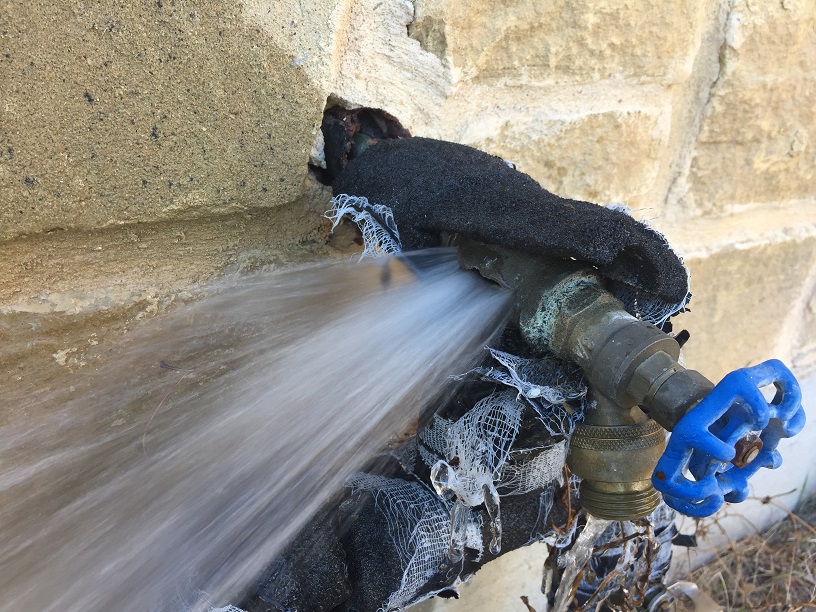
Yes, the heat is something that just about all Texans can agree on, except of course, when it's "cold as a cast-iron commode" (See even more sayings in this Dec 1994 Texas Monthly). Just a couple of weeks ago, I had a pipe burst when the temperature dropped below freezing for a couple of nights. Perhaps a similar cold snap is why someone coined the old adage, "Texas has two seasons. Summer, and Winter. Usually they alternate days within the same week." 

In that sense, Texas weather is a lot like the stock market. The overall prediction that it will heat up this Spring is akin to suggesting that the S&P 500® will rise in the long term. However, attempting to determine what day in March will be best for a picnic, or to buy or sell stocks, is essentially a guess. A couple of years ago, I wrote an Accountable Update article titled Predicting Snow and Stocks that looked into the flawed business of forecasting.

Also, this month, the folks over at Dimensional put out an Issue Brief titled, "The Reality of Models." The brief looks at the benefits and drawbacks of using forecasts to guide our decision making. In addition, DFA's Marlena Lee wrote a Research Matters piece in January titled, "Models, Uncertainty, and the Importance of Trust", that shows that models can be useful for gaining insights that help us make good decisions. But they can also be dangerous if someone is overconfident and does not understand their limitations. 

Keep cool and enjoy the reading.


The Reality of Models

February 2017

Checking the weather? Looking at a map of the world to plan your next vacation? Guess what—you’re using a model. While models can be useful for gaining insights that can help us make good decisions, they are simplifications of reality.

One example of a model is a weather forecast. Using data on current and past weather conditions, a meteorologist makes a number of assumptions and attempts to approximate what the weather will be in the future. This model may help you decide if you should bring an umbrella when you leave the house in the morning. However, as anyone who has been caught without an umbrella in an unexpected rain shower knows, reality often behaves differently than a model predicts it will.

In investment management, models are used by investors to gain insights that can help inform investment decisions. Financial researchers are frequently looking for new models to help answer questions like “What drives returns?” These models are often touted as being complex and sophisticated and incite debates about who has a “better” model. Investors who are evaluating investment strategies can benefit from understanding that the reality of markets, just like the weather, cannot be fully explained by any model. Hence, investors should be wary of any approach that requires a high degree of trust in a model alone.

THE MODEL, THE USER, AND THE APPLICATION

Just like with the weather forecasts, investment models rely on different inputs. Instead of things like barometric pressure or wind conditions, investment models may look at variables like the expected return or volatility of different securities. For example, using these sorts of inputs, one type of investment model may recommend an “optimal” mix of securities based on how these characteristics are expected to interact with one another over time. Users should be cautious though. The saying “garbage in, garbage out” applies to models and their inputs. In other words, a model’s output can only be as good as its input. Poor assumptions can lead to poor recommendations. However, even with sound underlying assumptions, a user who places too much faith in inherently imprecise inputs can still be exposed to extreme outcomes.

Nobel laureate Robert Merton offered some useful insights on this topic in an interview with David Booth, Chairman and Co-CEO of Dimensional Fund Advisors. “You’ll often hear people say, during the [financial] crisis or something, ‘There were bad models and good models.’ And someone will say, ‘Is yours a good model?’ That sounds like a good question, a reasonable question. But, actually, it isn’t really well-posed. You need a triplet: a model, the user of the model, and its application. You cannot judge a model in the abstract.” Here's a video of the interview:

We believe bringing financial research to life requires presence of mind on behalf of the user and awareness of a model’s limitations in order to identify when and how it is appropriate to apply that model. No model is a perfect representation of reality. Instead of asking “Is this model true or false?” (to which the answer is always false), it is better to ask, “How does this model help me better understand the world?” and “In what ways can the model be wrong?”

“THE EARTH IS ROUND,” INVESTING, AND THE JUDGMENT GAP

Consider the shape of the earth. One simple model describes the earth as a round sphere. While this is a good approximation, it is not completely accurate. In reality, the earth is an imperfect oblate spheroid—fatter at the equator and more squashed at the poles than a perfect sphere. Additionally, the surface of the planet is varied and changing: There are mountains, rivers, and valleys—it is not perfectly smooth. So how should we judge the model of “the earth is round”? For a parent teaching their child about the solar system or for a manufacturer of globes, assuming the earth is a perfect sphere is likely a fine application of the model. For a geologist studying sea levels or NASA engineers launching an object into space, it is likely a poor model. The difference lies in the user of the model and its application.

In investing, one should pay similar attention to the details of user and application when a model informs real-world investment decisions. For example, for investors in public markets, the efficient market hypothesis (EMH) is a useful model stating that asset prices reflect all available information. This model helps inform investors that they can rely on prices and that it is not worth trying to outguess the ones set collectively by millions of market participants. This insight has been confirmed by numerous studies on investment manager performance.[1] In applying this model to real-world investment solutions, however, there are several nuances that a user must understand in order to bridge the gap between theory and practice. Even if prices quickly reflect information, one should not assume that the EMH protects investors from making investment mistakes. Rigorous attention must be paid to trading costs and to avoid trading in situations when there may be asymmetric information or illiquidity that might disadvantage investors. To quote Professor Merton again, successful use of a model is “10% inspiration and 90% perspiration.” In other words, having a good idea is just the beginning. Most of the effort is in implementing the idea and making it work. In the end, there is a difference between blindly following a model and using it judiciously to guide your decisions. By employing sound judgment and thoughtful implementation, we believe it is more likely that outcomes will be consistent with a user’s expectations.

So what is an investor to do with this knowledge? When evaluating investment approaches, understanding a manager’s ability to effectively test and implement ideas garnered from models into real-world applications is an important first step. An investor who hires an investment manager to bridge this gap is placing trust in the judgment of that manager. The transparency offered by some approaches, such as traditional index funds, requires a low level of trust because the model is quite simple and it is easy to evaluate whether or not they have matched the return of the index. The tradeoff with this level of mechanical transparency is that it may sacrifice the potential for higher returns, as it prioritizes matching the index over anything else. For more opaque and complex approaches, like many active or complex quantitative strategies, the requisite level of trust required is much higher. Investors should look to understand how these managers use models and question how to evaluate the effectiveness of their implementation.

By selecting an investment manager that has experience in effectively putting financial research into practice and executing an approach that balances transparency with value-added implementation, investors should increase the probability of having a positive investment experience.


Source: Dimensional Fund Advisors LP.

Past performance is no guarantee of future results. There is no guarantee an investing strategy will be successful.

All expressions of opinion are subject to change. This article is distributed for informational purposes, and it is not to be construed as an offer, solicitation, recommendation, or endorsement of any particular security, products, or services.

Robert Merton provides consulting services to Dimensional Fund Advisors LP.

[1]. For example, see Fama and French (2010), “Luck vs. Skill in the Cross Section of Mutual Fund Returns.”