
Accountable Update

Money For Nothing and College For Free?

$37,172

That is the AVERAGE student loan debt for a college graduate this year.[i] Considering that 71% of students graduating from four-year colleges carry some student loan debt,[ii] it is little wonder that an avowed socialist promising free college for everyone almost became the Democratic Party’s nominee for President.

Maybe we don't all agree on the policies for how to pay for anything, but it is hard to dispute the value of a secondary education. Researchers say college grads earn about $1 million more than those without degrees over their lifetimes.[iii] For that reason alone, we should try and encourage as many qualified folks as we can to go to college, right? If more students go to college, they in turn would earn more income. Earn more income, pay more taxes, take less public support, and generally feed a virtuous cycle.

The idea was so appealing to the masses that the Democrats have adopted free college and student loan relief into the party’s platform. Free college and no more debt. How could that be controversial? If you're getting the benefit, it sounds like a great deal.

Who isn't in favor of a government program that pays you money? I took the GI Bill and a paycheck from the US Army Reserves in college to help ends meet (with some strings attached). Just to be clear, I view taxes as a reasonable cost of living in a country that affords me and my family the freedoms and security we enjoy, albeit I sure wouldn’t mind if someone out there would like to pay mine. 

While we wait for that to be sorted out, I propose a more Accountable approach. One that doesn’t rely upon someone else paying their "fair share". 

Most of the time, when I discuss college planning with a client, we look at the cost of attending the schools that we think may be most appropriate based on Junior’s grades, ambitions, and preferences. We consider the type of school most likely to admit the prospective student along with the estimated costs of attending said institution. The average costs for college, according to my financial planning software MoneyGuidePro®, are $96,244 for an In-State Public College (4 years, including books, tuition, room/board) and $191,324 for a Private University.

Neither option is particularly cheap, but being flexible can result in dramatically different outcomes, financially speaking. Let’s look at a couple of scenarios that I’ve discussed with clients recently. Both had kids accepted into multiple public and private schools

The first student, we’ll call him Ken, wants to attend Baylor University. MoneyGuidePro® says it will cost $52,834 per year. Mom and Dad have saved up about $100,000 in a 529 plan, but figured they could contribute another $15,000 per year from current income. The difference of $51,336 over four years will have to come from either scholarships, Ken's earnings (yes, working through college is still legal), or loans. Because of their income level, they almost certainly will receive no tax credits or grants. It’s not hard to see how a loan balance approaching $40k for a typical student is easy to accumulate by graduation.

Let’s say Ken graduates in four years with $40K in debt. If he then pays it off over the following 10 years at an average interest rate of @ 6.5%, he’ll spend about $5,564 per year in principal and interest retiring the burden. 

The second student, Barbie, wants to attend Texas Tech University. Instead of going directly to Lubbock, she is open to staying home to attend Austin Community College for her first two years. The cost for ACC is about $10k per year, if Barbie lives at home. If she then transfers to Tech for her junior and senior years, her costs will increase to about $19k per year. Mom and Dad had been thoughtful enough and able to put away about $60,000 in college savings, so in this scenario, it looks very likely that Barbie will be able to graduate with no debt as long as she does her part academically.

Since she won’t have a student loan to pay off, she could spend the 10 years after graduation maxing out a contribution to a Roth IRA (currently $5,500 per year) instead of paying off a loan. Even if she decides to stop contributing at the end of that decade at age 31, those 10 years of Roth IRA contributions growing at 8% per year would be worth $1,272,281 at the current Social Security Full Retirement Age of 67. In other words, figuring out a way to pay for college with no debt could easily result in having $1,000,000+ more than Ken, all things being equal with earnings, by retirement age.

You know what they say? A $1,000,000 here (from being a college grad), a $1,000,000 there (from planning and discipline), and by retirement you could have some real money to Bern. 

At ATX Portfolio Advisors, we believe that education is one of the best investments we can make. To that end, when we manage college savings through a 529 Plan, we do not charge an advisory fee on those assets. If you would like to discuss college cost for a child or grandchild, get in touch.


[i] newyorkfed.org here and here and clevelandfed.org here

[ii]  Ticas.org

[iii] https://www.newyorkfed.org/medialibrary/media/research/current_issues/ci20-3.pdf

Hard Work, Optimism, and Good Cheer

Softball.jpg

It may have not been noticed by many, but I just took a couple of weeks off from the Accountable Update. The break was primarily due to a competing obligation, coaching my daughter's softball team. If you had tried to tell me when we started tryouts back in February that we would still be playing in mid-July at the PONY World Series in Lafayette, LA, I probably would have asked for your keys or at least checked to see if you had a designated driver. But as my daughter reminds me every time she overhears me talking about this group of overachievers, the hard working young ladies that made up our team believed from the beginning that they could earn a trip to the Bayou State as long as they kept working and believing. 

It would have been easy to point out that last year, we didn't even have enough players in her age group to field a team, or that we lacked depth and experience at key positions, or that we were plagued by injuries and scheduling conflicts. Instead, they totally bought in to our motto that "hard work pays off" and showed up in the Texas heat 3-4 days a week to work on getting better.

They went through drills and repetitions of the basics of defense, pitching, and putting the ball in play at every practice. Throwing, catching, ground balls, fly balls as well as hitting cutoffs and running the bases were repeated over, and over, and over, etc. Batting practice always included laying down bunts. After all of that, we worked on conditioning to end each practice.

Then we went out and lost the only game we played in our first tournament, mainly because we didn't do many of the things we had been practicing very well. But something clicked at the next tournament, and kept clicking all the way to Lafayette. Once the girls started to see the evidence that through focusing on the basics they were getting better and stronger, it helped them to stay enthusiastic when the ball took a bad bounce or an umpire made a bad call. 

If you've never witnessed a fast-pitch softball game, then you may not appreciate the value of enthusiasm. But hearing a dozen 12 year old girls doing LOUD chants ranging from the adorably cute to the absolutely cutthroat, can be extremely motivating or intimidating, depending on your perspective. That enthusiasm was infectious and would keep us in games that otherwise looked like big mismatches. It also offered a great lesson for all of us, especially in the investment world.

Enthusiasm can be difficult to maintain when the chips are down. With a seemingly never ending stream of horrible headlines, charlatans masquerading luck as skill, the echo chambers of social media, and divisive rhetoric from political "leaders" that often makes us feel pessimistic about our future, it's a wonder that any of us can view a glass as anything other than empty. 

All it took was a week in Lafayette with a fabulous, hardworking, overachieving group of 12 year old girls to remind me that focusing on the basics and being optimistic can take us to unexpected heights.

If you still aren't feeling it, the following article by DFA's Jim Parker in his recent “Outside the Flags” column offers some other reasons to be optimistic that we may actually, somehow, be headed in the right direction.

Like Lafayette.


10 Reasons to Be Cheerful

Do you ever listen to the news and find yourself thinking that the world has gone to the dogs? The roll call of depressing headlines seems endless. But look beyond what the media calls news, and there also are a lot of things going right.

It’s true the world faces challenges in many areas, and the headlines reflect that. Europe has been grappling with a flood of refugees; as of May, the Chinese local A-share market declined by almost 20 percent1; and the US is in the middle of a sometimes rancorous election campaign.

More recently, citizens of the United Kingdom voted to leave the European Union, creating significant uncertainty in markets over the long-term implications.

But it’s also easy to overlook the significant advances made in raising the living standards of millions, increasing global cooperation on various issues, and improving access to healthcare and other services across the world.

Many of the 10 developments cited below don’t tend to make the front pages of daily newspapers or the lead items in the TV news, but they’re worth keeping in mind on those occasions when you feel overwhelmed by all the grim headlines.

So here’s an alternative news bulletin:

  1. Over the last 25 years ending May 2016, one dollar invested in a global portfolio of stocks would have grown to more than five and a half dollars.2
  2. Over the last 25 years, 2 billion people globally have moved out of extreme poverty, according to the latest United Nations Human Development Report.3
  3. Over the same period, mortality rates among children under the age of 5 have fallen by 53%, from 91 deaths per 1000 to 43 deaths per 1000.
  4. Globally, life expectancy has been improving. From 2000 to 2015, according to the World Health Organization, the global increase was 5.0 years, with an even larger increase of 9.4 years in parts of Africa.4
  5. Global trade has expanded as a proportion of GDP from 20% in 1995 to 30% by 2014, signaling greater global integration.5
  6. Access to financial services has greatly expanded in developing countries. According to the World Bank, among adults in the poorest 40% of households within developing economies, the share without a bank account fell by 17 percentage points on average between 2011 and 2014.6
  7. The world’s biggest economy, the US, has been recovering. Unemployment has halved in six years from nearly 10% to 5%.7
  8. The world is exploring new sources of renewable energy. According to the International Energy Agency, in 2014, renewable energy such as wind and solar expanded at its fastest rate to date and accounted for more than 45% of net additions to world capacity in the power sector.8
  9. We live in an era of innovation. One report estimates the digital economy now accounts for 22.5% of global economic output.9
  10. The growing speed and scale of data is increasing global connectedness. According to a report by McKinsey & Company, cross-border bandwidth has grown by a factor of 45 in the past decade, boosting productivity and GDP.10

No doubt many of these advances will lead to new business and investment opportunities. Of course, not all will succeed. But the important point is that science and innovation are evolving in ways that may help mankind.

The world is far from perfect. The human race faces challenges. But just as it is important to be realistic and aware of the downside of our condition, we must also recognize the major advances that we are making.

Just as there is reason for caution, there is always room for hope. And keeping those good things in mind can help when you feel overwhelmed by all the bad news.

Notes

1. As measured by the MSCI A Share Net Dividends Index in CNY. 
2. As measured by the MSCI All Country World Index (gross dividends) in USD. 
3. “Human Development Report 2015: Work for Human Development," United Nations. 
4. “World Health Statistics 2016,” World Health Organization. 
5. “International Trade Statistics 2015,” World Trade Organization. 
6. “The Global Findex Database 2014: Measuring Financial Inclusion Around the World,” World Bank. 
7. US Bureau of Labor Statistics, 15 March 2016. 
8. “Renewable Energy Market Report 2015,” International Energy Agency. 
9. “Digital Disruption: The Growth Multiplier,” Accenture and Oxford Economics, February 2016. 
10. “Digital Globalization: The New Era of Global Flows,” McKinsey & Company, March 2016.

About Jim Parker
Jim Parker is a Vice President for DFA Australia Limited, a subsidiary of Dimensional Fund Advisors. As head of the communications and marketing team in Australia, Jim helps create strategies to communicate Dimensional's philosophy and process in ways that engage clients, prospects, regulators, and the media. He does so through presentations, books, papers, and articles, including his "Outside the Flags" column and, more recently, his weekly "Coffee Break" links to interesting articles. 

Jim joined Dimensional in 2006 after 25 years working as a journalist in newspapers, television, radio, and online media. His specialty was financial journalism, particularly in relation to economics and financial markets. Jim holds a bachelor of arts in social and economic history from Deakin University and a journalism certificate from Auckland Technical Institute.

Q2 2016 Market Review

The Q2 2016 Market Review may be easier to navigate directly on www.atxadvisors.com than through the RSS feed email version. I apologize for any inconvenience the formatting may cause for our email subscribers.

The Q2 2016 Market Review may be easier to navigate directly on www.atxadvisors.com than through the RSS feed email version. I apologize for any inconvenience the formatting may cause for our email subscribers.

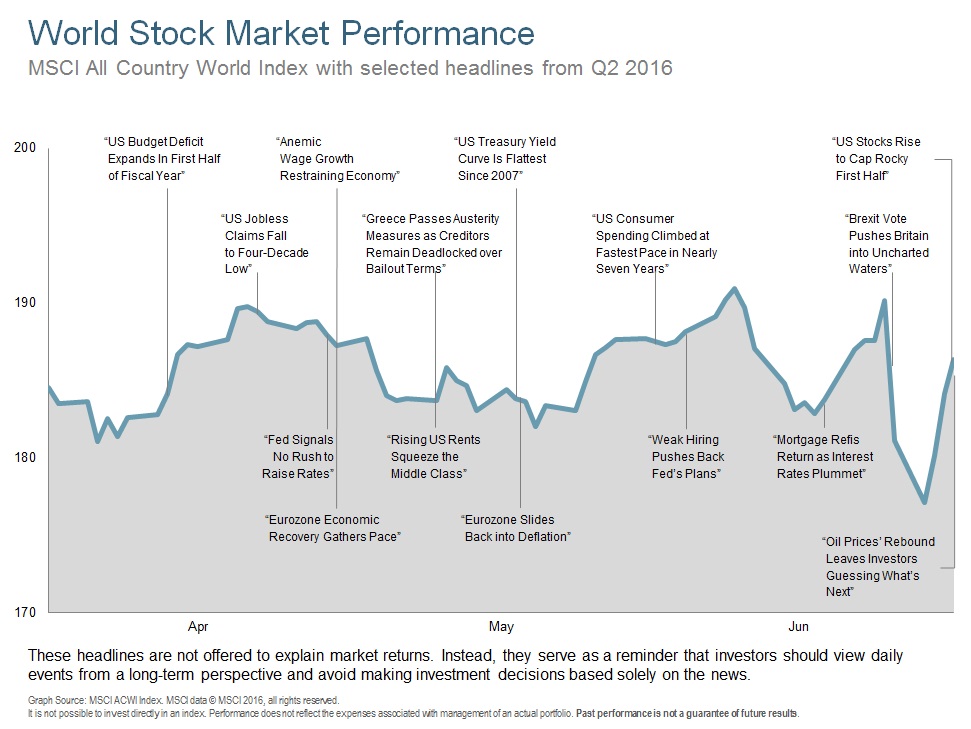
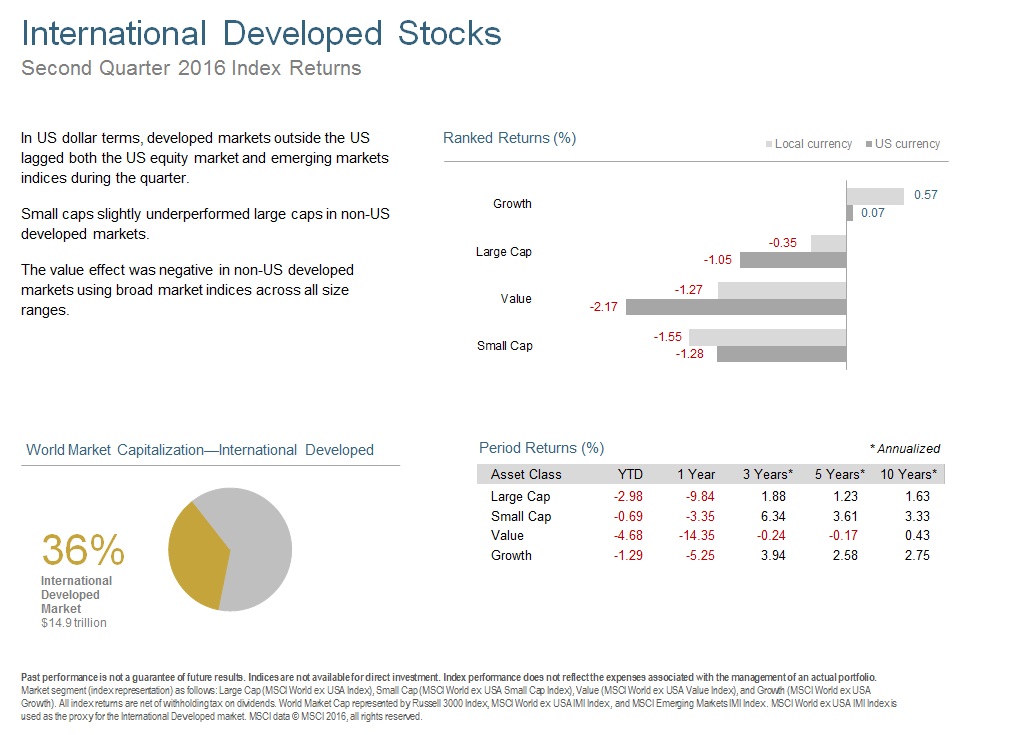
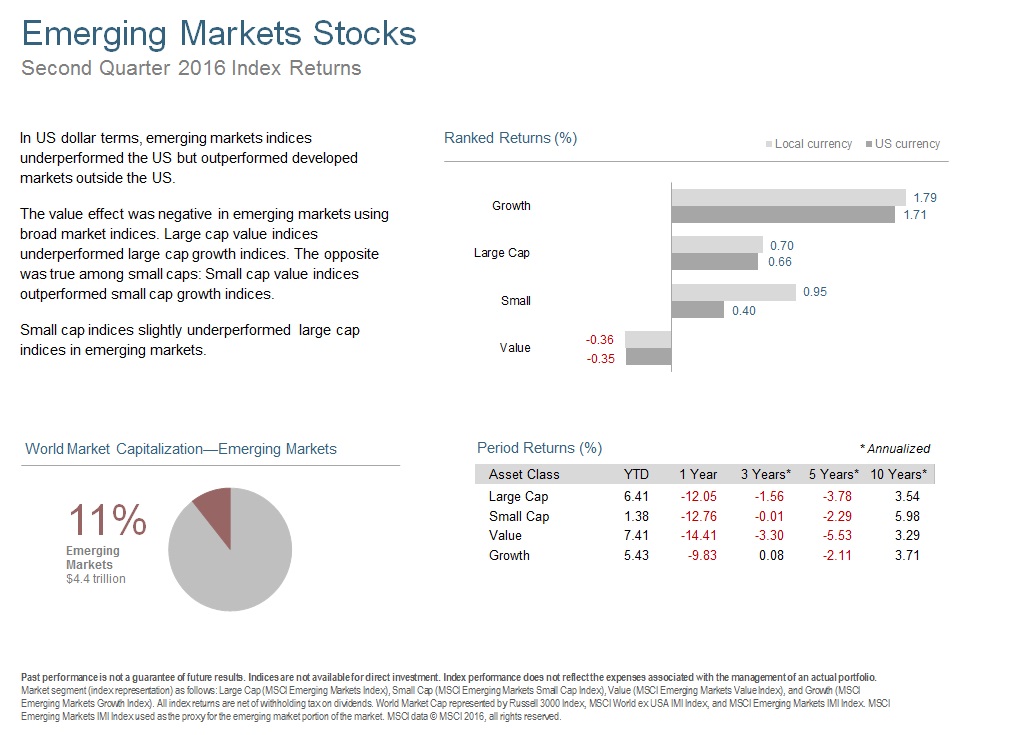
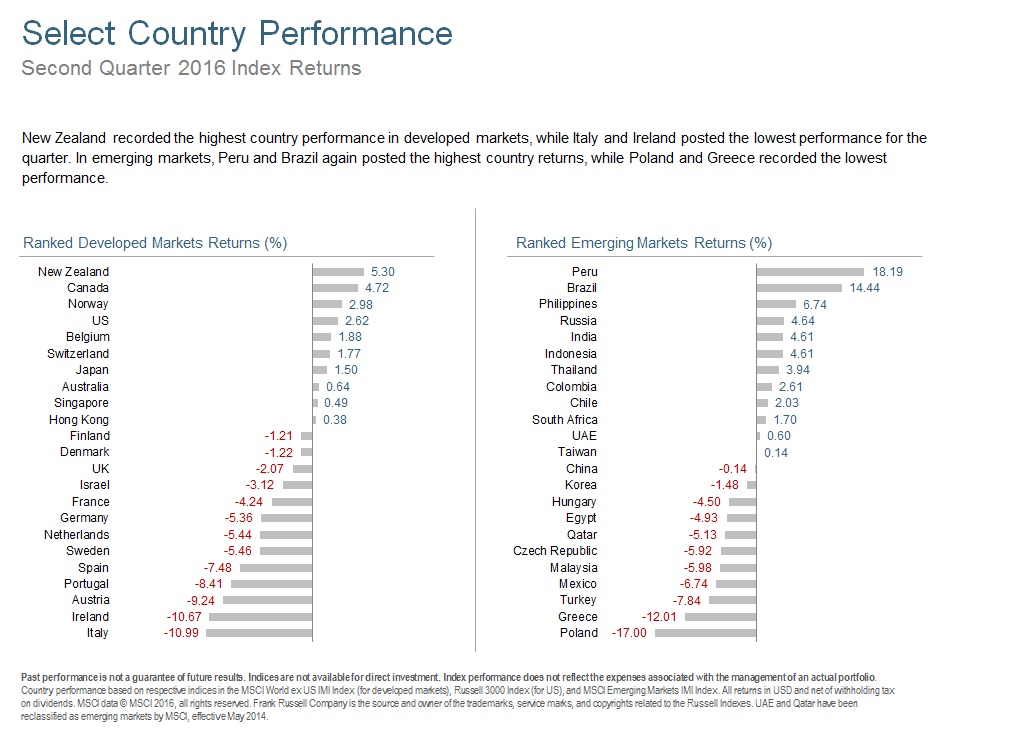
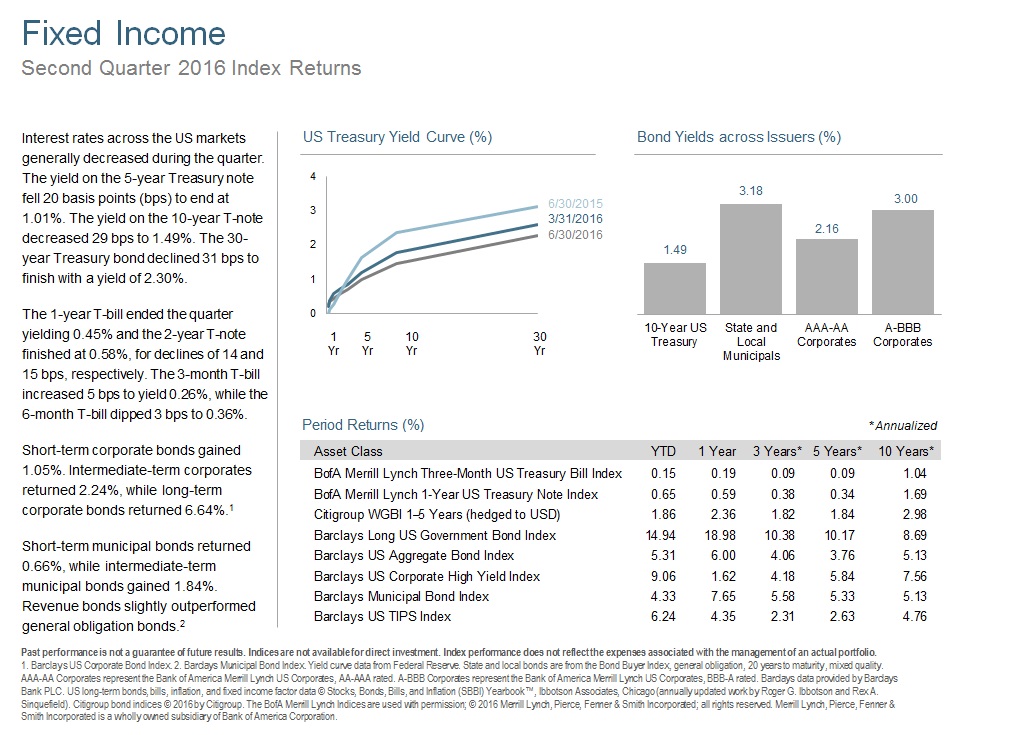
Those crazy Brits shocked just about everyone by voting to leave the EU back on June 23. Stock markets fizzled, bond markets sizzled, and cash suddenly looked like a very attractive safe haven. Leading up to the vote, most domestic, international developed, and emerging equity markets were up quarter to date. The initial selloffs in these markets signaled that Brexit was not priced into the markets’ expectations and that the ensuing uncertainty may be the beginning of the end and not the end of the beginning of the bull market (apologies to Sir Churchill). Then we rallied into the end of the quarter, recovering the Brexit losses, suggesting that perhaps the risk to world markets created by the possible reordering of the EU may not be the end of the world. Maybe those Brits ARE crazy, like a fox?

Does it make you wonder if our own elections in Q4 may hold similar unexpected outcomes? It could make for an entertaining fall, like from a bridge with a piece of elastic tied to your ankles. Now on to the review.

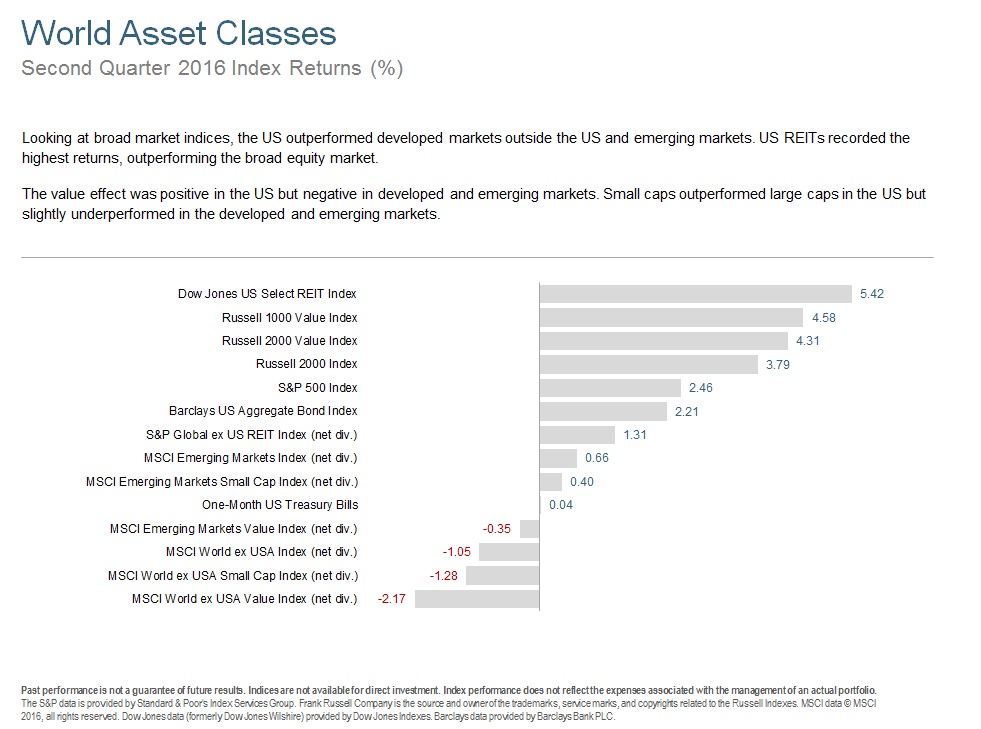
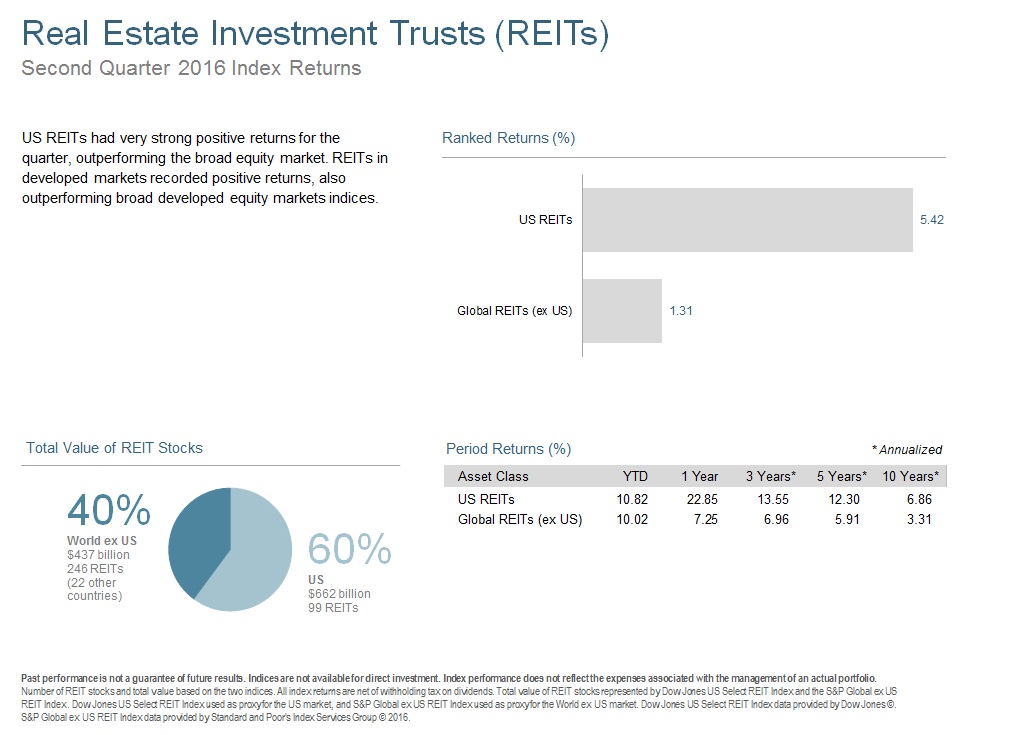
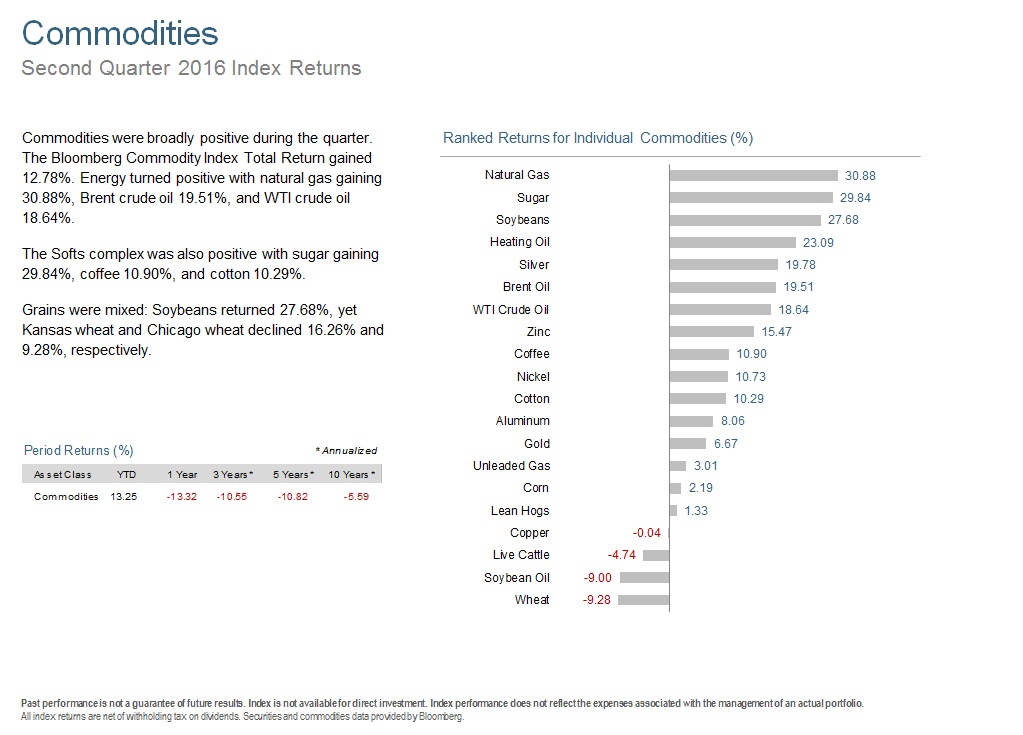
REITs and bonds were the star performers in Q2, which many attribute to the bond market forecasting an economic slowdown. Commodities have also shown signs of life, with the Bloomberg Commodity Index up 12.78% for the quarter, with oil and gas leading the way.

For the time being, however, the US economy is showing some resiliency. Job reports have generally been good, with the unemployment rate around 4.9% and wages actually ticking up as shortages of skilled workers strengthen the bid for those jobs. Also, the housing market keeps chugging along as the low interest rates encourage refinancing and purchases.  Rising rents, stronger consumer confidence, and the aging Millennial generation are all factors that continue to be positives for housing.   

The wind in our sails from the cheaper dollar in Q1 moved to our bow in Q2 with the “flight to quality” created by Brexit. There also is mounting evidence that near zero interest rates are encouraging stock buybacks and dividend increases more so than capital investments envisioned by policy makers. Just a little more evidence that markets will always find their way, in spite of what the politicians or bureaucrats want to happen.

All of this leaves me to ponder the same questions posed in Q1.

Will we remain bound to a "trade range" where the market bounces back and forth from a previous low and high as it continues a “time correction”? Or, are we due for a major bull or bear move? The fact is, it is impossible to know in the short term. If the market moves up, you can expect us to re-balance your portfolio by taking some profits from the winners. If it goes down we will likely buy more of the losers, even if we have to hold our noses while doing so.

As always, we look for opportunities to incorporate evidence backed approaches to managing our clients’ wealth to increase expected returns. When we encounter the inevitable occasional selloff, our Accountable pricing helps demonstrate that we sit on the same side of the table as our customers.

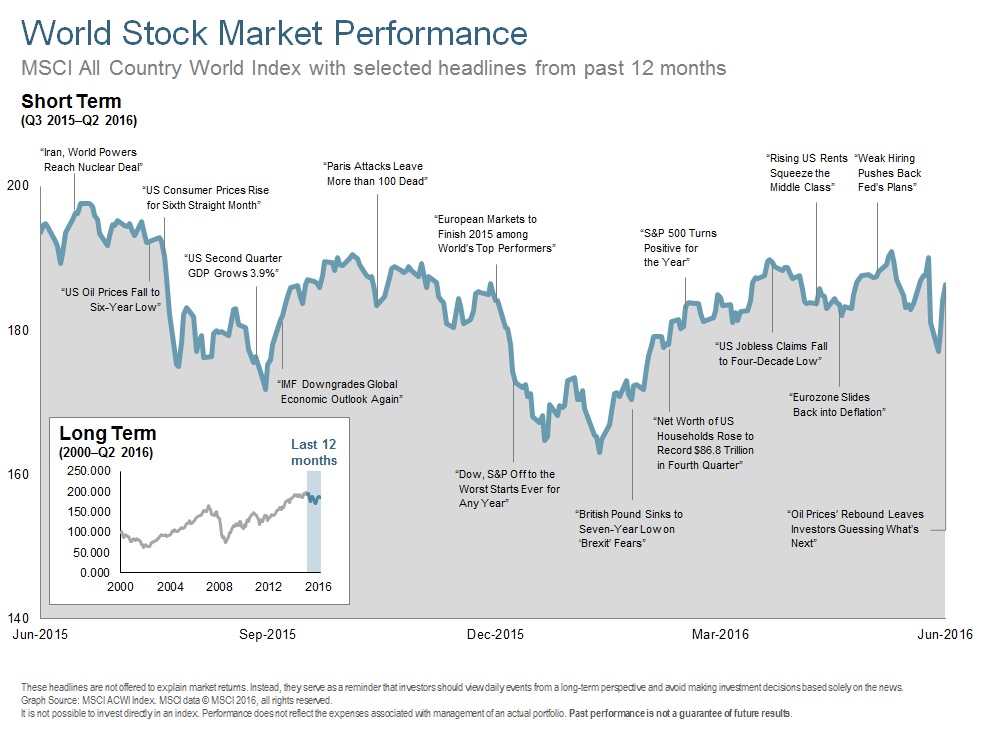
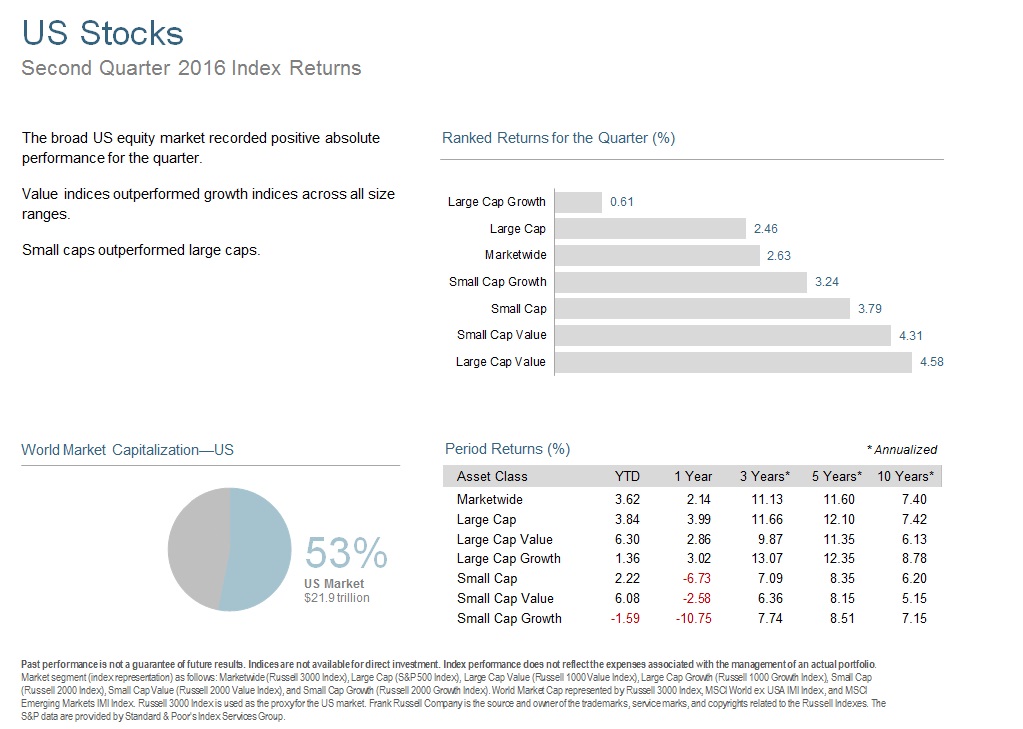
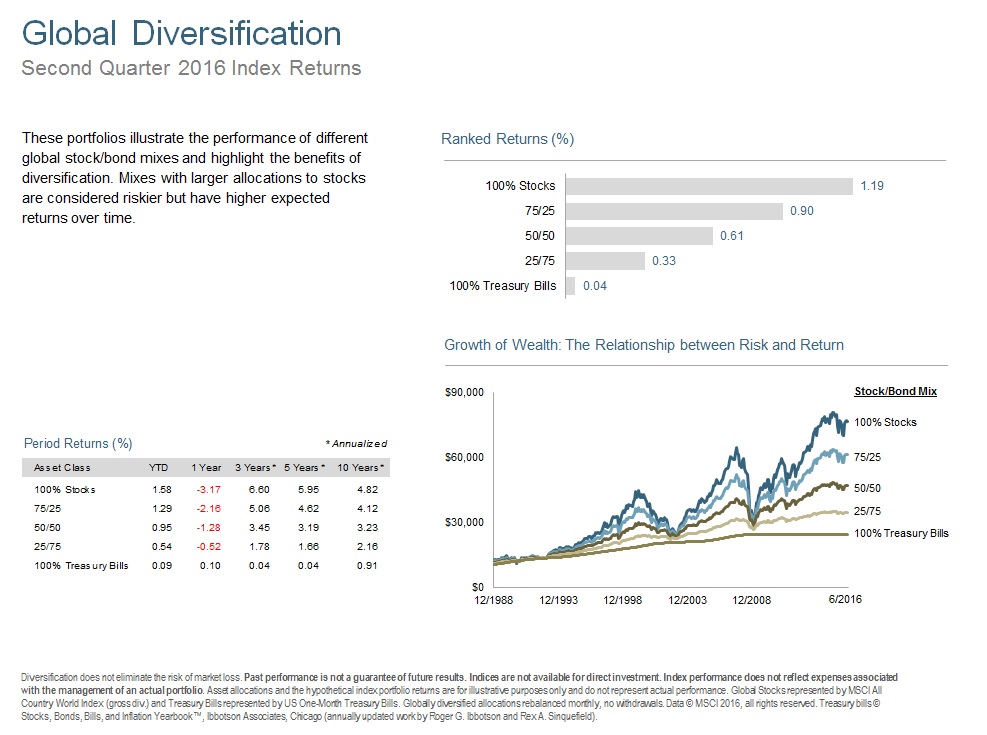
The Q2 2016 Quarterly Market Review features world capital market performance and a timeline of events for the past quarter. It begins with a global overview, then features the returns of stock and bond asset classes in the US and international markets. The report also illustrates the performance of globally diversified portfolios.