
Accountable Update

Issue Brief - What Is Fiduciary Advice?

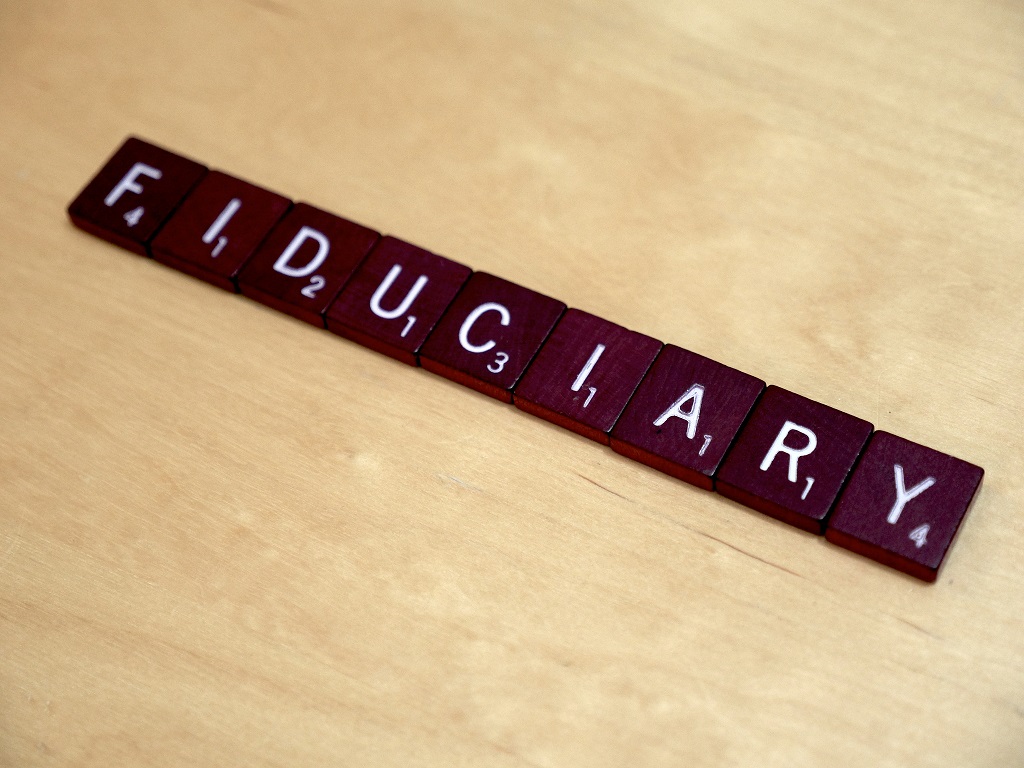
Photo by Simon Cunningham 

Photo by Simon Cunningham 

Last fall, I wrote about the Department of Labor's proposed Fiduciary Rule for retirement advice in the October 30 edition of the Accountable Update. Since then, they have released new rules governing the $7 trillion that individual investors have invested in IRAs. The rules go into effect next year, but if you are an ATX Portfolio Advisors' client, not much changes. We already put your interests first and even make a Fiduciary Pledge to our customers. However, if you would like to have a better understanding of what fiduciary advice is, the following "Issue Brief" from Dimensional Funds does a nice job of summarizing the differences between two different standards that currently apply to investment professionals.

Once you understand the difference, you may be asking two questions:

  1. Why would I ever want anything BUT fiduciary advice?
  2. Would I rather work with someone that voluntarily chose a fiduciary standard, or someone forced to by the government?

What Is Fiduciary Advice?

Dimensional Fund Advisors
May 2016

Anyone searching for investment advice is undoubtedly confronted with many choices of service providers operating under titles such as certified financial planner, financial consultant, registered investment advisor, stockbroker, and insurance agent.

These titles can be confusing because on the surface it is not clear whether these professionals are legally required to have a client’s best interest in mind when making investment recommendations.

Many investors may have read that the Department of Labor (DOL) announced a substantial overhaul in the regulation of financial advice given on retirement savings. Central to this discussion are two terms: fiduciary and suitability. What does it mean for an advisor to operate on a fiduciary standard, and how does this differ from a suitability standard?

THE FIDUCIARY STANDARD

The DOL has described a “fiduciary” as someone who is required to put their clients’ best interest before their own profits. Fiduciaries include registered investment advisors, advisors to mutual funds (like Dimensional), and others who hold themselves out to be fiduciaries (like trustees and certain retirement plan consultants).

Fiduciaries are required to act impartially and provide advice that is in their clients’ best interest, and in doing so, must act with the care, skill, prudence, and diligence that a prudent person would exercise based on the current circumstances. A fiduciary must avoid misleading statements about fees and must avoid conflicts of interest.

Fiduciaries are typically compensated by payment of a fee rather than a commission. Fiduciaries to retirement plans, plan participants, and IRAs are also prohibited from receiving payments that create conflicts of interest unless they comply with the terms of certain exemptions issued by the DOL.

Probably most importantly, clients can expect that a fiduciary will act with transparency and avoid prohibited conflicts of interest. For example, given two comparable investment choices for a client, a fiduciary should typically recommend an option with lower management fees.

Fiduciaries are personally liable for breaches of their fiduciary duties. For example, if there is a loss caused by a breach of fiduciary duty, the fiduciary must make the plan or IRA whole by restoring any losses caused by the breach and restoring to the plan or IRA any profits made through the use of plan or IRA assets. Civil actions to obtain appropriate relief for a breach of fiduciary duty may be brought by a participant, beneficiary, fiduciary, or the US Secretary of Labor, and the fiduciary may be subject to excise tax penalties.

THE SUITABILITY STANDARD

Historically, representatives of a broker-dealer are required under the securities laws to judge the suitability of a product for a prospective investor, based primarily on that person’s financial goals, income, and age. Unless agreed otherwise, under this standard the rules do not legally require a recommendation of the most cost-effective product, a disclosure regarding conflicts associated with the investment, or disclosure of the compensation received when making that recommendation. Under the new DOL rule, it may mean that common forms of broker compensation, such as commissions and revenue sharing, will be restricted.

A SINGLE STANDARD OF ADVICE

As many financial advisors are dual registered as both brokers and investment advisors, it can be difficult to determine under which standard investment advice is given. A primary goal of the recent regulatory changes was to create a single standard for retirement financial advice based on a fiduciary model. Many clients already receive fiduciary advice, and for those clients the change in rules will not have much impact. Following the new DOL rule, it may be the case that professional financial advice for retirement assets (whatever the source) is subject to a level fiduciary standard.1 However, as with any investment advice, clients should conduct their own research, ask questions, and learn more about the reputation and philosophy of an advisor.2


1.     Note that in certain circumstances, information provided by advisors or brokers may not be treated as fiduciary advice. Some examples of these exceptions from the new DOL rule are providing general investment education, simple “order-taking” (executing an order to buy or sell without providing a recommendation), or certain “robo-advice.”

2.     For informational purposes only and not for the purpose of providing tax or legal advice. You should contact your tax advisor or attorney to obtain advice with respect to any particular issue or problem.

Source: Dimensional Fund Advisors LP.

All expressions of opinion are subject to change. This information is intended for educational purposes, and it is not to be construed as an offer, solicitation, recommendation, or endorsement of any particular security, products, or services.

This information should not be misconstrued or otherwise interpreted as legal advice. Please consult with qualified legal or tax professionals regarding your individual circumstances.

PSAT and an O$#!+ Moment

Photo by Luftphilia

Photo by Luftphilia

"PSATs are in," read the text.

"Huh?" I replied.

"Your son's PSAT score is in," said my wife.

"Oh, cool. How did he do?" 

"Pretty good. His score plus his GPA gives him a 60% chance of getting into Stanford!"

"Great! Wait. What?"

The preceding conversation is a not very fictionalized version of a text conversation between me and my wife earlier today. For maybe the first time, the thought of the cost of college became a very real and present concern in my household, versus the concept it had been (like retirement) up to now. 

As a financial planner, I have access to a wealth of information about the cost of different things. The planning software I use with clients, MoneyGuidePro®, provides very specific information, even at the individual college level, for planning purposes. Today, I opted to look at the cost of some individual schools versus the "average" categories I typically used for my personal planning. The results were a little unnerving.

First of all, my typical default has always been in-state tuition at a place like my alma mater, Texas A&M University. The current estimate for a public in-state college in the US starting in 2016 is $24,061 per year. That is right in line with what we have been saving for his college expenses. However, today was an epiphany.

First, I looked at the specific estimates of attending Texas A&M University. Here is how it broke down:


$ 9,428
$10,330
$ 1,194

$20,952

Tuition
Room & Board
Books & Supplies

Total


I felt pretty good about that, particularly given my previous assumptions using public school averages. I also looked at a few other Texas schools.

I started with the hated (at least in my house) University of Texas, a fine second choice if a kid can't get into A&M. It wasn't too daunting of a figure, just a little more than the flagship in College Station. Total costs = $22,016 per year.

Other Lone Star choices were Baylor ($52,834), Rice ($56,703), TCU ($53,570), and Texas Tech ($19,172).That's enough of sample size for me to use the following rule of thumb for Texas schools. $25,000 a year for public and $50,000 for private colleges.

Then for the moment of truth. Stanford University has always been a school that my son has said he may be interested in attending. With today's news that his PSAT coupled with his GPA gives him at least a coin flip's chance of getting in, I decided it was time to plan for the worst. The tally? 

 $61,261. Oh $#!+!

That's about 3X more than Texas A&M. (Caution, there is some Aggie math being used here.) For even a little more reality, the inflation rate for colleges has been about 5% over that past decade according to The College Board®. That means the current estimates would be about double for a four year old today if that rate holds true going forward.

So what does it all mean? For me, probably a little more belt tightening and discipline about where our money goes for the next few years. For ATX Portfolio Advisors clients, it means I will do what I can to help: whether it is forecasting the cost of college for your children or grandchildren, developing a plan to get there, or managing assets that are earmarked for that goal.

One of ATX Portfolio Advisors' values is to not kick someone when they are down. Thus, we don't pile on fees when your account balance falls from one month to the next, with the hope that our clients will be more likely to stay the course when they know they have a partner on the same side of the table.

I also believe that anything I can do to encourage better education and less debt for graduates is a small investment in all of our futures. To encourage more savings for those goals, ATX Portfolio Advisors will manage money invested in a low cost 529 plan for FREE if you have other assets being managed by me. (Note that 529 plans have costs associated with them that are levied by the plans and underlying investments.)

It's not free college for everyone, but it's a start. If you would like to discuss college planning or management of your assets, please get in touch.


Allergies and April 18

Photo by Nimai Malle

Photo by Nimai Malle

Remember being young and wanting nothing more than to be a grown-up? Your parents would tell you not to be in a hurry because, before you know it, you will be grown up wondering where all the time went.

Just turn on the radio for further proof that time flies. Musicians as varied as Kenny Chesney (“Don‘t Blink”), Bowling for Soup (“1985”), and Fleetwood Mac (“Landslide”), make regular fare of the fact that we grow old too fast. As I get older, it seems that more and more songs, sights, and experiences cause my allergies to flare up as I think of days long ago that seem just like yesterday.

One of those days was when my 16 year old (pictured above) recently became licensed to operate a motor vehicle. I flashed back to my mid teen years and the multiple fender benders or worse that I somehow walked away from. Those vivid memories (or are they nightmares?) keep me awake any time he is out on the road. It seems like yesterday that he was learning to ride a bike with me running alongside in case he lost his balance. If only I could always be looking right over his shoulder to warn of impending hazards.

Another was during practice for my 12 year old daughter’s softball team. On an adjacent field, a tee-ball game was underway for 6 year olds'. If you’ve ever been to one of these games, then you are familiar with the drill. There are 12-15 kids in the field while the other team bats. Twice that many parents and grandparents are in the stands screaming at the top of their lungs every time a ball is put into play. Usually the entire throng of fielders will converge on the ball at once, with one emerging, ball in hand, to chase the baserunner around the bases. It has got to be one of the greatest scenes in sports.

I glanced over at my daughter and couldn’t fathom how she had seemingly gone from that plodding huddle of first graders' to the rapidly maturing adolescent that can throw a ball as hard as her old man. Those damn allergies were really bad that day, must have been the cedar.

It has gotten to the point that I can’t do anything without feeling the need for a couple of antihistamines. TBT pics on Facebook, listening to the “oldies” by Journey or Garth Brooks, or just recognizing a familiar smell can prompt me to reach for a box of tissues. Maybe it’s all just a consequence of growing old when you start realizing that days that once seemed limitless are actually in short supply. Or, that you better make every one count.

Another thing that can make you teary eyed, but not for the warm and fuzzy feelings evoked by Steve Perry, are taxes. Next Monday, April 18, is the deadline for filing yours unless you get an extension. Also, Monday is the last day for making your 2015 IRA contributions. You will never have the opportunity to put away IRA money for 2015 after Monday. Don’t regret not taking action.

Traditional IRA’s allow you to put away up to $5,500 a year (or $6,500 if you are 50 or older) in a tax advantaged way. If your income is under certain levels, you may be able to deduct the contribution from your taxes or even qualify for a tax credit. If you don’t qualify for the deduction or credit, but have earned income, you can still defer taxes on the growth of your after-tax contribution until you withdraw the funds.

There is also a Roth IRA alternative, which has some income limitations for contributions, but allows you to make after-tax contributions that allow for TAX FREE growth. The tax code even allows for a “Back Door” for people that exceed the income eligibility limits. The current code allows you to make an after-tax Traditional IRA contribution, but convert to a Roth IRA to enjoy the tax free growth. If you are converting an “after-tax” contribution before it has any earnings, the net result is the same as being able to make a Roth IRA contribution.

It may not seem like that big of a deal to skip this year’s contribution, but once you do, all you can do is think about “what if” later on. Depending on how old you are, consider just how expensive of a mistake you may be making by not making this one count. (Warning, the following illustration may cause serious allergic reactions!)

IRA’s have penalties for withdrawals before age 59.5, but look at how much ONE $5,500 contribution today can potentially grow to at age 65 with a hypothetical 10% return based on different ages:

Age        What if $5500 @ 10%
Today    Until Age 65

25           $248,926
35           $ 95,972
45           $ 37,000
55           $ 14,266

If you are self-employed, there are options that may allow you to put even more away, but April 18th still looms as an important date.

If you would like some help in planning for or managing your retirement savings, get in touch for a (allergy) free Retirement Review. You’ll be retired before you know it!

By the way, if you put it off until Monday April 18th and want my help, better call early in the morning. In the afternoon I’ll be at the Westlake Chap Club Golf Tournament at Lost Creek CC. You can find me on the 8th Tee manning the ATX Portfolio Advisors Sponsorship Table where I’ll be giving away cold waters and a golf membership to Lost Creek CC. Hope to see you by Monday one way or the other!