


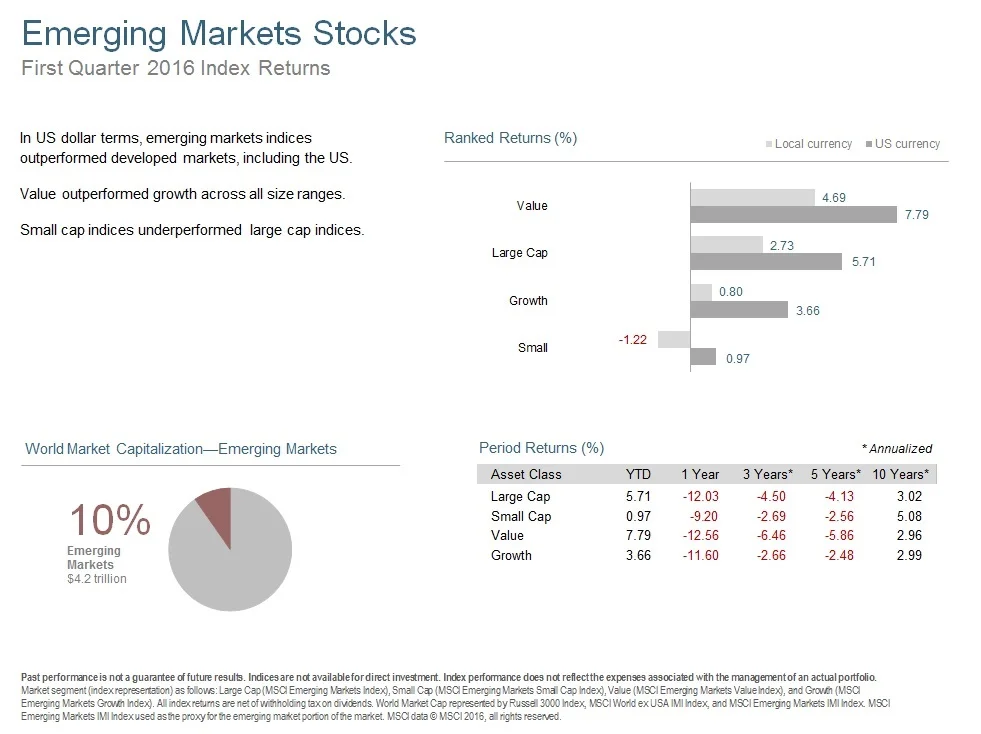
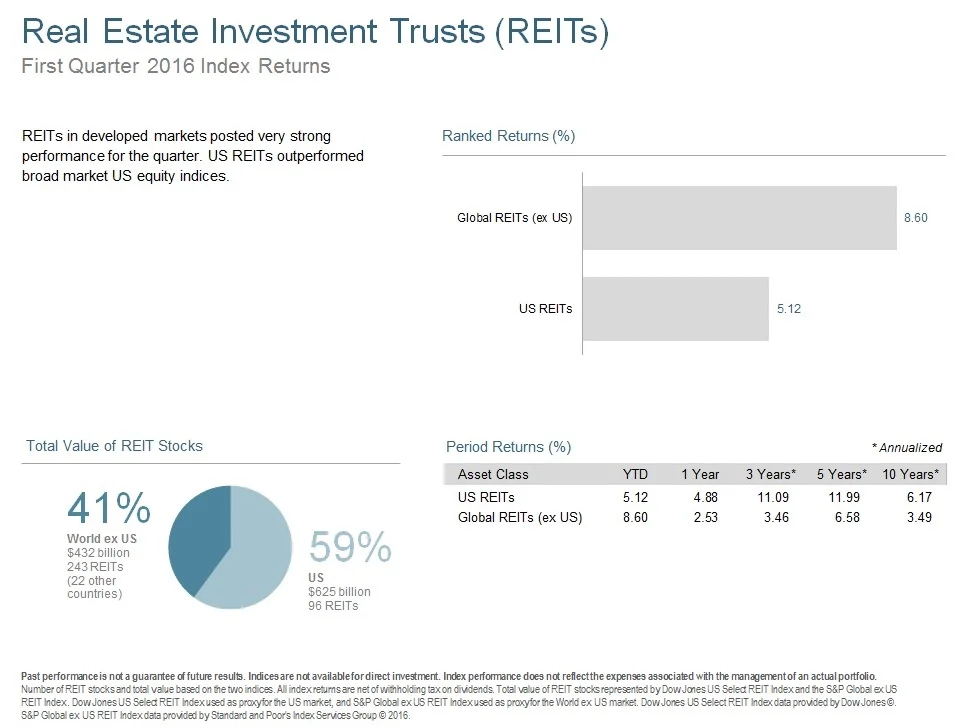
Stocks, bonds, REITs, and commodities have rallied since bottoming in mid-February. Just about every index, except international developed stocks, finished Q1 with positive returns. This was in conjunction with a rally in energy, where the price for a barrel good old West Texas Intermediate Crude has risen from a low of around $26. A selloff in the US dollar has further contributed to the rally.
In my Q4 2015 Market Review, I observed the significant increases in bond yields preceding the Fed’s widely anticipated bump of short term interest rates in December. The idea that the Fed will increase rates up to four times this year was treated harshly by the markets, which priced in the economic slowdown those increases may cause.
The good news is that the weaker dollar resulting from a (for now) suddenly more dovish Fed has increased market liquidity. The bad news is that earnings growth is tepid, even though much of that is attributed to the slowdown in the energy sector. So what is going to happen next?
Will we remain bound to a "trade range" where the market bounces back and forth from a previous low and high as it continues a “time correction”? Or, are we due for a major bull or bear move? The fact is, it is impossible to know in the short term. If the market moves up, you can expect us to re-balance your portfolio by taking some profits from the winners. If it goes down we will likely buy more of the losers, even if we have to hold our noses while doing so. As always, in the event of a selloff, our Accountable pricing helps demonstrate that we sit on the same side of the table as you.
The Q1 2016 Quarterly Market review features world capital market performance and a timeline of events for the past quarter. It begins with a global overview, then features the returns of stock and bond asset classes in the US and international markets. The report also illustrates the performance of globally diversified portfolios
Finally, I've included an article by Dave Butler that talks about how the discipline necessary to be successful in sports when the game is on the line is similar to that needed to be a winning investor. As always, if the current markets are making you anxious, get in touch to review your plan.





Free Throws
Dave Butler
Dimensional Fund Advisors
Head of Global Financial Advisor Services and Vice President
“What do you regard as the most difficult period in the financial markets during your 25 years in the investment business?"
I am often asked this question, usually by people who already have a framework and opinion as a result of living through one or several market downturns. For example, many older advisors and their clients regard the 1973–1974 bear market as the toughest period in their investment lifetime.
Middle-aged investors may consider the tech boom and bust of the late 1990s and early 2000s to be the bellwether event for a generation of investors who assumed they could get rich on one great stock pick. Today, just about everyone remembers the 2008–2009 global financial crisis, having experienced the anxiety of declining investment accounts themselves or knowing someone who did.
The market decline in early 2016 has much of the same feel as past events. Times like these are never easy for clients or advisors, who must confront their concern that “things just might be different this time.” When in the midst of a market decline, it is natural to sense that the volatility is lasting longer and is worse than anything before. As a result, advisors spend a lot of time talking to their clients in an effort to alleviate elevated concerns and fears.
How do we find the words that might help minimize the fear and anxiety advisors’ clients feel about their investment portfolios and retirement security? As you know, no single word or story can ease their concerns—and certainly not overnight. The more effective course may be for advisors to steadily lead clients down a path from worry to calm through a conversational approach that emphasizes the importance of sticking with their plan.
Linking process to discipline
I had the opportunity a few weeks ago to speak at an advisor’s client event in California. As I was driving to the event, I thought about how to make the presentation conversational and ensure the concepts of process and discipline resonate with the audience.
The audience was a sports-oriented crowd, and I had about 15 minutes to get across one important concept that might help them navigate the choppy markets. Then I remembered an article I read about world-class athletes and their approach to success. The author described how the greatest athletes, from Olympians to all-star professionals, focus on process rather than outcome when competing at the highest level. I thought about this in context of my own college athletic experience, which, although not at the Olympic level, involved the same need for calm and focus during high-pressure moments in a basketball game.
Imagine yourself playing in a championship basketball game. Your team is trailing by one point. You are fouled just as the game clock goes to zero. You have two free throws. Make both and you win. Miss them and you lose.
What do you do to contain the pressure and focus on the task? The great athletes look to process. While each process may be different, each one reflects a personal routine a player has performed thousands of times in practice. For instance, you start your routine as you approach the free throw line; you take a deep breath and imagine the ball going through the hoop; you step to the line and find the exact spot (usually a nail right behind the painted line) where your right foot will anchor; you look at the back (or front) of the rim and notice the paint peeling or the net missing a connecting loop—or anything else to help you concentrate and calm your mind; and you take the ball from the referee and continue your routine. You dribble twice and flip the ball in the air, take a couple of knee bends, find the grooves on the ball, and spread your fingers across it. You feel the texture of the ball, the rough orange leather and the smooth black rubber on the grooves, and finally time the motion so that your body, the release of the ball, and the follow-through of your hand are all in perfect synch as the ball elevates and descends to the basket.
The effective athlete does not hope for an outcome or get nervous or scared as the moment approaches. He or she immediately falls back on the tried and tested routine performed countless times in a more serene environment (practice). Following the routine dulls the noise of the crowd and brings clarity of mind.
The same lessons apply to the seasoned investor. A chaotic market is akin to what the visiting team experiences in a gym, where opposing fans and players are doing everything possible to distract you. You stay focused on a routine burned into your nature through coaching and repetitive practice.
The components of the seasoned investor’s routine are similar: the investment policy statement, the regular review of family goals and liquidity needs, and the regular calls an advisor makes during good and bad markets. These and other actions are all part of the process developed to summon that muscle memory needed in stressful times. Just as the great athlete navigates through the moments of pressure in any athletic event, the actions are part of the routine that allows the individual to navigate through a chaotic market like we have today.
I believe there are many stories and anecdotes that parallel the basic needs of an investor, but it is up to the advisor to find one that resonates with a particular client or audience. The example could involve a great violinist, a world-class chef, or even a gardener. In each case, there is a story of discipline behind the person who continually works to perfect the craft and a reminder of how a successful investor can do the same.
Statistics and data are the bedrock for the insights we gain about the capital markets, but it is often the conversational story that can help clients of advisors focus on the simplest and most important tenets of investment success. Regardless of the market or time period, advisors can encourage their clients to maintain the discipline needed to follow a process, which can lead to a great investment experience.
Past performance is not a guarantee of future results. There is no guarantee an investing strategy will be successful. Investing risks include loss of principal and fluctuating value.
This information is for educational purposes only and should not be considered investment advice or an offer of any security for sale. All expressions of opinion are subject to change.
Dimensional Fund Advisors LP is an investment advisor registered with the Securities and Exchange Commission.

