
Accountable Update

Guest Article - Unhealthy Attachments

By Jim Parker, Outside the Flags
VP, Dimensional Fund Advisors

Have you ever made yourself suffer through a bad movie because, having paid for the ticket, you felt you had to get your money’s worth? Some people treat investment the same way.

Behavioral economists have a name for this tendency of people and organizations to stick with a losing strategy purely on the basis that they have put so much time and money into it already. It’s called the “sunk cost fallacy.”

Let’s say a couple buy a property next to a freeway, believing that planting trees and double-glazing will block out the noise. Thousands of dollars later the place is still unlivable, but they won’t sell because “that would be a waste of money”.

This is an example of a sunk cost. Despite the strong likelihood that you’ll never get your money back, regardless of outcomes, you are reluctant to cut your losses and sell because that would involve an admission of defeat.

It works like this in the equity market too. People will often speculate on a particular stock on the basis of newspaper articles about prospects for the company or industry. When those forecasts don’t come to pass, they hold on regardless.

It might be a mining stock that is hyped based on bullish projections for a new tenement. Later, when it becomes clear the prospect is not what its promoters claimed, some investors will still hold on, based on the erroneous view that they can make their money back.

The motivations behind the sunk cost fallacy are understandable. We want our investments to do well and we don’t want to believe our efforts have been in vain. But there are ways of dealing with this challenge. Here are seven simple rules:

  1. Accept that not every investment will be a winner. Stocks rise and fall based on news and on the markets’ collective view of their prospects. That there is risk around outcomes is why there is the prospect of a return.

  2. While risk and return are related, not every risk is worth taking. Taking big bets on individual stocks or industries leaves you open to idiosyncratic influences like changing technology.

  3. Diversification can help wash away these individual influences. Over time, we know there is a capital market rate of return. But it is not divided equally among stocks or uniformly across time. So spread your risk.

  4. Understand how markets work. If you hear on the news about the great prospects for a particular company or sector, the chances are the market already knows that and has priced the security accordingly.

  5. Look to the future, not to the past. The financial news is interesting, but it is about what has already happened and there is nothing much you can do about that. Investment is about what happens next.

  6. Don’t fall in love with your investments. People often go wrong by sinking emotional capital into a losing stock that they just can’t let go. It’s easier to maintain discipline if you maintain a little distance from your portfolio.

  7. Rebalance regularly. This is another way of staying disciplined. If the equity part of your portfolio has risen in value, you might sell down the winners and put the money into bonds to maintain your desired allocation.

These are simple rules. But they are all practical ways of taking your ego out of the investment process and avoiding the sunk cost fallacy.

There is no single perfect portfolio, by the way. There are in fact an infinite number of possibilities, but based on the needs and risk profile of each individual, not on “hot tips” or the views of high-profile financial commentators.

This approach may not be as interesting. But by keeping an emotional distance between yourself and your portfolio, you can avoid some unhealthy attachments.


Diversification does not eliminate the risk of market loss. There is no guarantee investing strategies will be successful.
Dimensional Fund Advisors LP ("Dimensional") is an investment advisor registered with the Securities and Exchange Commission. 

All expressions of opinion are subject to change without notice in reaction to shifting market conditions. This content is provided for informational purposes, and it is not to be construed as an offer, solicitation, recommendation or endorsement of any particular security, products, or services. 

Q3 2015 Market Review

Time for Liftoff?

The volatility that began to show itself in Q2 increased in Q3, as we experienced the first 10% correction in US markets since 2011. All eyes have been on the Federal Reserve, as their decision to defer raising rates (a.k.a. "Liftoff") from essentially 0% due to global concerns centering on China has led to continuing worries about the ultimate impact on global growth.

At ATX Portfolio Advisors, September was the fourth consecutive month of negative returns across all of our models. Our Accountable pricing puts us in your shoes, as we have not charged any advisory fees as a result.

We all look forward to more profitable periods, and there is good news if you pay attention. The reason the Fed is considering raising rates is because of underlying strength in the US Economy. Through most of history, the first Fed move has proven to be a mid-cycle event. If that is the case, the recent volatility should be a good time to take advantage of the uncertainty being priced into the markets for long term investors.

The recent volatility is well within historical norms, and is the price of taking risk to achieve higher long term returns. If the price is too steep (i.e. loss of appetite, no sleep at night), we should review your personal situation and risk tolerance. That's what you pay me for, at least when the market goes up.

Market segment (index representation) as follows: US Stock Market (Russell 3000 Index), International Developed Stocks (MSCI World ex USA Index [net div.]), Emerging Markets (MSCI Emerging Markets Index [net div.]), Global Real Estate (S&P Globa…

Market segment (index representation) as follows: US Stock Market (Russell 3000 Index), International Developed Stocks (MSCI World ex USA Index [net div.]), Emerging Markets (MSCI Emerging Markets Index [net div.]), Global Real Estate (S&P Global REIT Index), US Bond Market (Barclays US Aggregate Bond Index), and Global Bond ex US Market (Citigroup WGBI ex USA 1−30 Years [Hedged to USD]). The S&P data are provided by Standard & Poor's Index Services Group. Russell data © Russell Investment Group 1995–2015, all rights reserved. MSCI data © MSCI 2015, all rights reserved. Barclays data provided by Barclays Bank PLC. Citigroup bond indices © 2014 by Citigroup. 

Graph Source: MSCI ACWI Index. MSCI data © MSCI 2015, all rights reserved.

Graph Source: MSCI ACWI Index. MSCI data © MSCI 2015, all rights reserved.

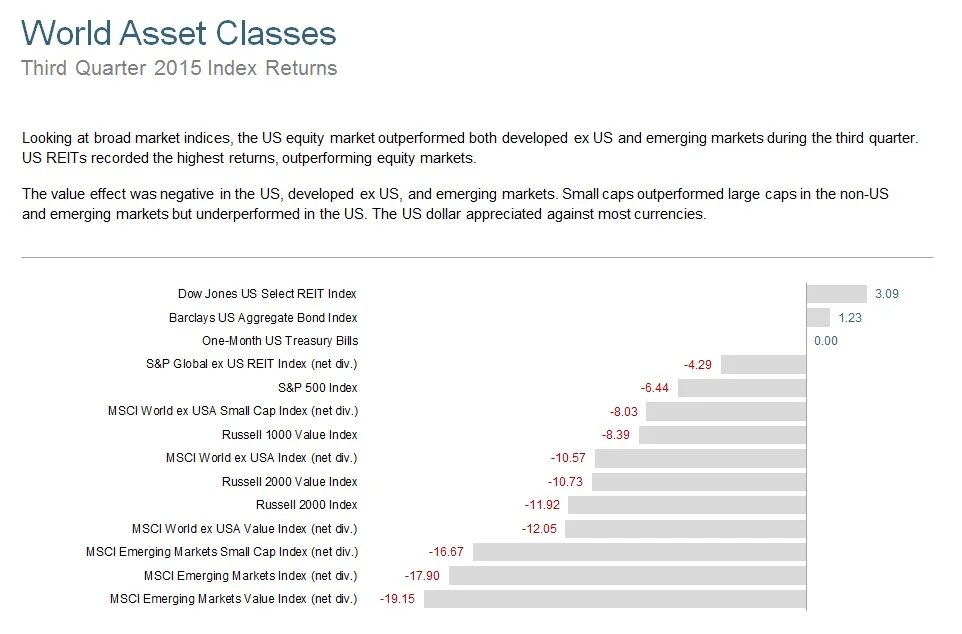
The S&P data is provided by Standard & Poor's Index Services Group. Russell data © Russell Investment Group 1995–2015, all rights reserved. MSCI data © MSCI 2015, all rights reserved. Dow Jones data (formerly Dow Jones Wilshire) provided by …

The S&P data is provided by Standard & Poor's Index Services Group. Russell data © Russell Investment Group 1995–2015, all rights reserved. MSCI data © MSCI 2015, all rights reserved. Dow Jones data (formerly Dow Jones Wilshire) provided by Dow Jones Indexes. Barclays data provided by Barclays Bank PLC. 

Market segment (index representation) as follows: Marketwide (Russell 3000 Index), Large Cap (S&P 500 Index), Large Cap Value (Russell 1000 Value Index), Large Cap Growth (Russell 1000 Growth Index), Small Cap (Russell 2000 Index), Small Cap Val…

Market segment (index representation) as follows: Marketwide (Russell 3000 Index), Large Cap (S&P 500 Index), Large Cap Value (Russell 1000 Value Index), Large Cap Growth (Russell 1000 Growth Index), Small Cap (Russell 2000 Index), Small Cap Value (Russell 2000 Value Index), and Small Cap Growth (Russell 2000 Growth Index). World Market Cap represented by Russell 3000 Index, MSCI World ex USA IMI Index, and MSCI Emerging Markets IMI Index. Russell 3000 Index is used as the proxy for the US market. Russell data © Russell Investment Group 1995–2015, all rights reserved. The S&P data are provided by Standard & Poor's Index Services Group. 

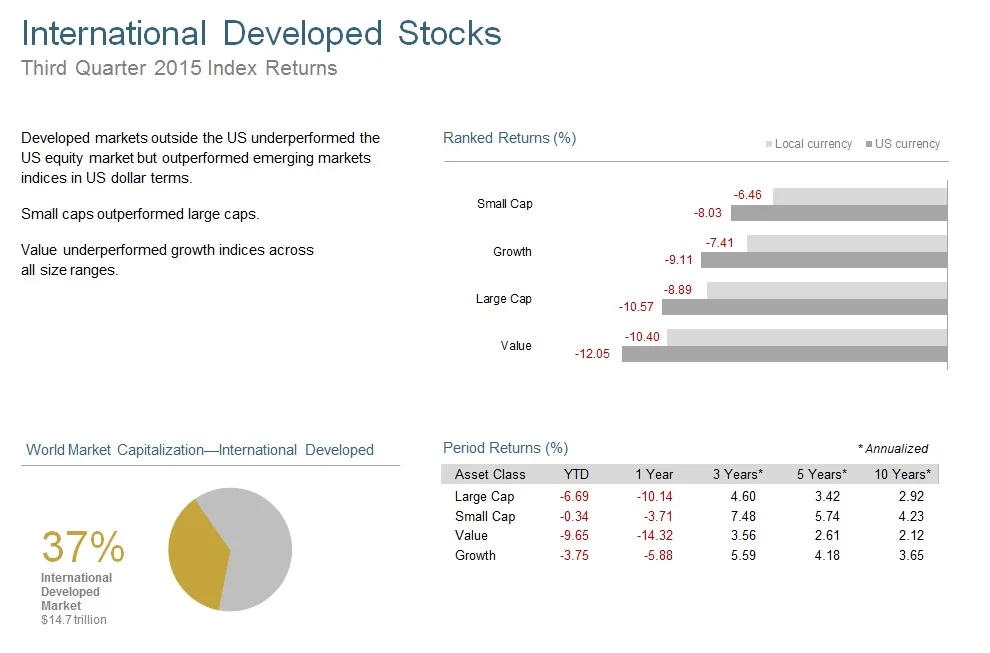
Market segment (index representation) as follows: Large Cap (MSCI World ex USA Index), Small Cap (MSCI World ex USA Small Cap Index), Value (MSCI World ex USA Value Index), and Growth (MSCI World ex USA Growth). All index returns are net of withhold…

Market segment (index representation) as follows: Large Cap (MSCI World ex USA Index), Small Cap (MSCI World ex USA Small Cap Index), Value (MSCI World ex USA Value Index), and Growth (MSCI World ex USA Growth). All index returns are net of withholding tax on dividends. World Market Cap represented by Russell 3000 Index, MSCI World ex USA IMI Index, and MSCI Emerging Markets IMI Index. MSCI World ex USA IMI Index used as the proxy for the International Developed market. MSCI data © MSCI 2015, all rights reserved. 

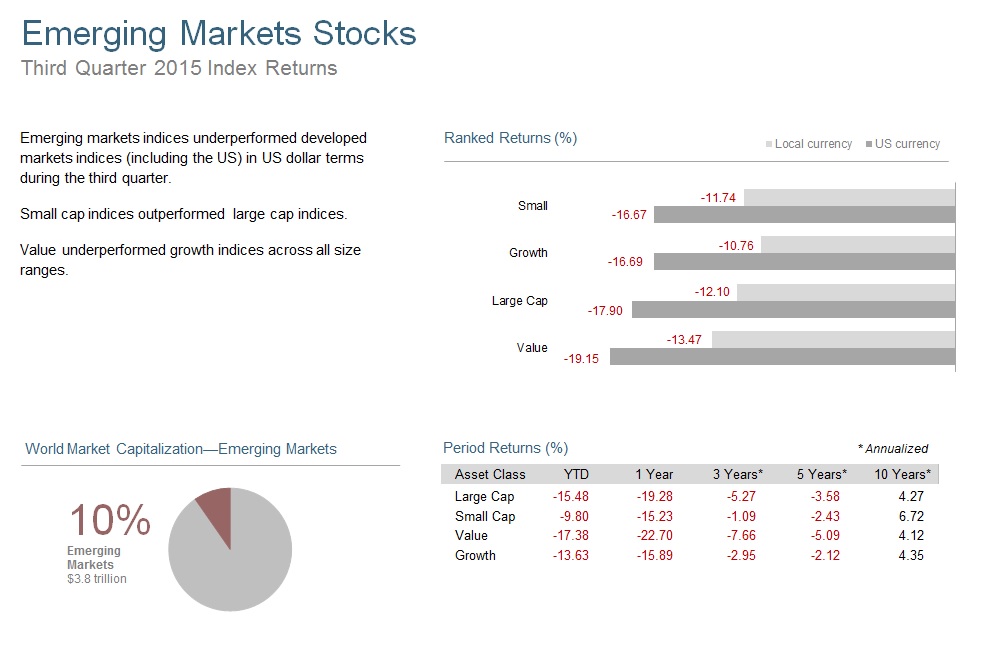
Market segment (index representation) as follows: Large Cap (MSCI Emerging Markets Index), Small Cap (MSCI Emerging Markets Small Cap Index), Value (MSCI Emerging Markets Value Index), and Growth (MSCI Emerging Markets Growth Index). All index retur…

Market segment (index representation) as follows: Large Cap (MSCI Emerging Markets Index), Small Cap (MSCI Emerging Markets Small Cap Index), Value (MSCI Emerging Markets Value Index), and Growth (MSCI Emerging Markets Growth Index). All index returns are net of withholding tax on dividends. World Market Cap represented by Russell 3000 Index, MSCI World ex USA IMI Index, and MSCI Emerging Markets IMI Index. MSCI Emerging Markets IMI Index used as the proxy for the emerging market portion of the market. MSCI data © MSCI 2015, all rights reserved. 

Country performance based on respective indices in the MSCI World ex US IMI Index (for developed markets), Russell 3000 Index (for US), and MSCI Emerging Markets IMI Index. All returns in USD and net of withholding tax on dividends. MSCI data © MSCI…

Country performance based on respective indices in the MSCI World ex US IMI Index (for developed markets), Russell 3000 Index (for US), and MSCI Emerging Markets IMI Index. All returns in USD and net of withholding tax on dividends. MSCI data © MSCI 2015, all rights reserved. Russell data © Russell Investment Group 1995–2015, all rights reserved. UAE and Qatar have been reclassified as emerging markets by MSCI, effective May 2014.

Number of REIT stocks and total value based on the two indices. All index returns are net of withholding tax on dividends. Total value of REIT stocks represented by Dow Jones US Select REIT Index and the S&P Global ex US REIT Index. Dow Jones US…

Number of REIT stocks and total value based on the two indices. All index returns are net of withholding tax on dividends. Total value of REIT stocks represented by Dow Jones US Select REIT Index and the S&P Global ex US REIT Index. Dow Jones US Select REIT Index used as proxy for the US market, and S&P Global ex US REIT Index used as proxy for the World ex US market. Dow Jones US Select REIT Index data provided by Dow Jones ©. S&P Global ex US REIT Index data provided by Standard and Poor’s Index Services Group © 2014. 

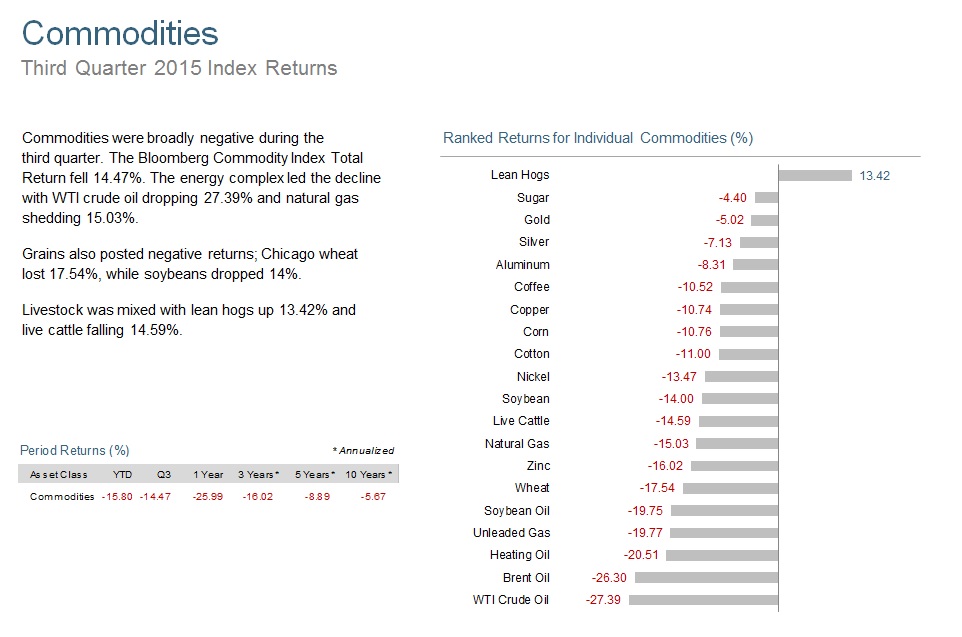
All index returns are net of withholding tax on dividends. Securities and commodities data provided by Bloomberg.

All index returns are net of withholding tax on dividends. Securities and commodities data provided by Bloomberg.

Yield curve data from Federal Reserve. State and local bonds are from the Bond Buyer Index, general obligation, 20 years to maturity, mixed quality. AAA-AA Corporates represent the Bank of America Merrill Lynch US Corporates, AA-AAA rated. A-BBB Cor…

Yield curve data from Federal Reserve. State and local bonds are from the Bond Buyer Index, general obligation, 20 years to maturity, mixed quality. AAA-AA Corporates represent the Bank of America Merrill Lynch US Corporates, AA-AAA rated. A-BBB Corporates represent the Bank of America Merrill Lynch US Corporates, BBB-A rated. Barclays data provided by Barclays Bank PLC. US long-term bonds, bills, inflation, and fixed income factor data
© Stocks, Bonds, Bills, and Inflation (SBBI) Yearbook™, Ibbotson Associates, Chicago (annually updated work by Roger G. Ibbotson and Rex A. Sinquefield). Citigroup bond indices © 2014 by Citigroup. The BofA Merrill Lynch Indices are used with permission; © 2014 Merrill Lynch, Pierce, Fenner & Smith Incorporated; all rights reserved. Merrill Lynch, Pierce, Fenner & Smith Incorporated is a wholly owned subsidiary of Bank of America Corporation.

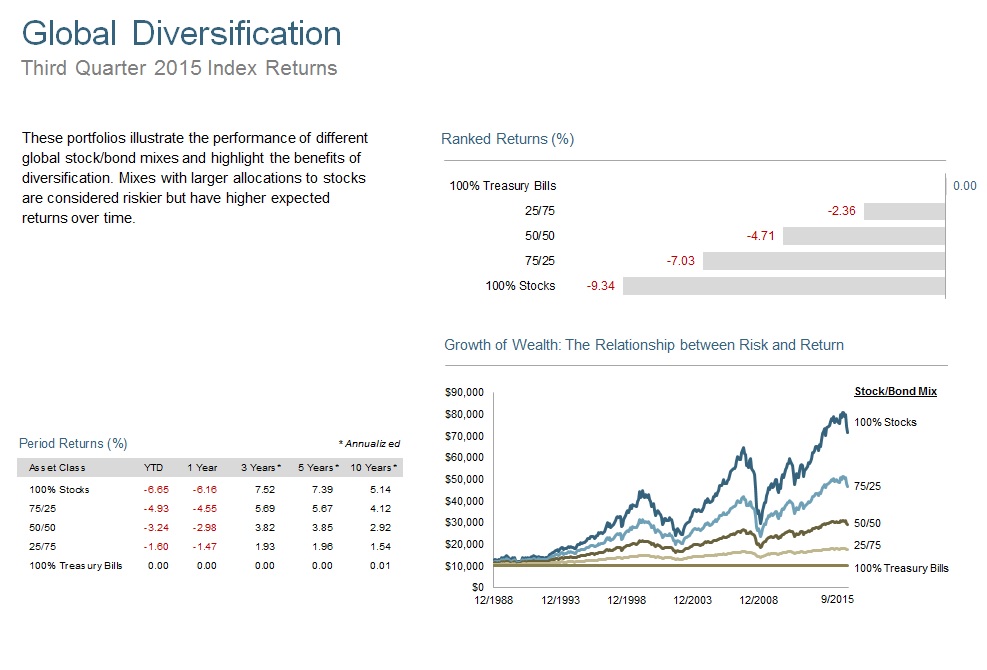
Asset allocations and the hypothetical index portfolio returns are for illustrative purposes only and do not represent actual performance. Global Stocks represented by MSCI All Country World Index (gross div.) and Treasury Bills represented by US On…

Asset allocations and the hypothetical index portfolio returns are for illustrative purposes only and do not represent actual performance. Global Stocks represented by MSCI All Country World Index (gross div.) and Treasury Bills represented by US One-Month Treasury Bills. Globally diversified allocations rebalanced monthly, no withdrawals. Data © MSCI 2015, all rights reserved. Treasury bills © Stocks, Bonds, Bills, and Inflation Yearbook™, Ibbotson Associates, Chicago (annually updated work by Roger G. Ibbotson and Rex A. Sinquefield). 

Past performance is not a guarantee of future results. Indices are not available for direct investment. Index performance does not reflect the expenses associated with the management of an actual portfolio. 

Finance Is Not a Sport

Photo by My Army Reserve

I love college football season. The pageantry, energy, and traditions are, in my opinion, unrivaled in the world of sports. The 12th Man at Texas A&M, calling the Hogs at Arkansas, Auburn’s War Eagle, tailgating in “The Grove” at Ole Miss, and the Michigan band playing “The Victors” over and over and over and over are just a few examples of what makes the experience so enjoyable.

But science has started to explain why that may be. Watching your favorite team win can increase your testosterone level according to some studies. Some people see their dopamine levels increase when their team does well, which literally increases the feeling of pleasure. Other hormones such as adrenaline, cortisol, and oxytocin have also been shown from endocrinology to increase in sports fans.

This may help explain why my family leaves me alone on Saturdays to watch my favorite team in solitude. I am not truly alone as inevitably up to a dozen college friends will engage in a group text or chat with the season seemingly riding on each play.

Just this last weekend, I received messages that alternately suggested the coach of my favorite team is grossly over rated and should be fired to being a genius deserving of a raise, all in the span of a couple of hours from the same person. Referees were accused of being biased until they were celebrated for making the right call. 

While my family may disagree while I’m screaming at the TV, it is the thrill ride of vicariously experiencing the ups and downs of my team that make watching sports so enjoyable. Unfortunately, mainly due to the proliferation of media into all areas of life, investing has taken on a similar dynamic.

It wasn’t that long ago that financial news and information were delivered in much less timely and dynamic ways. Closing stock prices were found in the back of the business pages of the newspaper. If you wanted an actual quote, if you didn’t work on Wall Street in New York, you either called your broker or went to his office.

On those days that the Dow Jones Industrial Average (DJIA) reached a milestone, such as breaking 1,000 for the first time in 1972, it may have warranted a small headline, below the fold, in major newspapers. During precipitous declines, like Black Monday in 1987 when the DJIA fell 22.61% (508 points to 1,738.74), Dan Rather led his 5:30 PM broadcast with the bad news, but then turned the page to other items such as the American response to an Iranian missile attack on US tanker in the Persian Gulf.

Compare that to today, when you can get real time quotes of virtually any stock in any market around the clock. Turn on the business channel in the morning and immediately see what the futures markets are doing. A headline this morning, for example, “BREAKING: Dow futures fall 150 points as Street digests jobs.”

Is that really any different of a feeling than if your team just fumbled the opening kickoff? If we do have a big selloff, rest assured that there will be at least 4 talking head “experts” on screen at once all trying to talk over one another to deliver us the play by play. All that is missing is a few hundred screaming fans with cleverly written signs in the background.

Much like in sports, you can follow social media for instant analysis, commentary, and even advice on what to buy or sell. You can even play “fantasy” by opening simulated trading accounts with any number of online ventures and compete against other “investors”.

As entertainment, it can be argued whether our addiction to sports as a society is a net positive. When it comes to our investments, allowing our emotions to get the best of us makes about as much sense as deciding to forfeit the game in the 1st quarter because the ball didn’t bounce our way.

Whether your plan is a risk averse approach designed to control the clock with a bruising ground game and strong defense or a wide open passing attack that is primarily worried about outscoring the opponent, successful teams typically have success by staying the course.

Investing is a 4 quarter game that rewards those that keep their cool when the momentum swings to the other team. Understanding the tendencies of the opponent, such as stocks tend to outperform bonds over time, help us keep perspective and stick with our game plan.

It’s a long season, do yourself a favor and watch more football and less CNBC.