

Accountable Update

Last Day of Summer, Football, and Homework

Photo by frankieleon

Photo by frankieleon

“7th round! That's five players from Westlake in “The League” next year!”

That was a text from a buddy shortly after the NFL’s draft last spring. Westlake is the Austin, TX community in which my family and I reside. Our school district is frequently ranked among the best performers in just about everything. Whether its academics, athletics, or other extra-curricular activities, the achievements of our children are a source of pride throughout the community.

With summer coming to a close and fall football practice already underway, I was reminded of that text message and was curious just how impressive of a feat producing that many professional players really was.

According to the NCAA 2013-14 High School Athletics Participation Survey, there were 1,093,234 participants in high school football in 2013-14. This year, there were 255 draft slots in the National Football League. Since those participants range across four classes, about 1020 will ultimately be drafted over the four year period starting in 2018. That’s around .009%, or in this case, 1 out of 1072.

Those are pretty low odds, but how much better are the chances at a high school that has had arguably one of the best records around of producing NFL talent? I looked up the biographies of those five current players and determined that they graduated high school between 1997 and 2011. Then I looked at last year’s rosters for the Westlake High School teams (Freshman, Junior Varsity, and Varsity) and counted 280 total players. Extrapolated over the fourteen year period of 1997-2011, I estimated 3,920 had suited up for the Chaps in that timeframe. Five of those making it to the pros equates to 1 out of 784, or about .01%.

Now that is better than the national average, but still ample reason to encourage our young athletes to study hard after practice.

You are probably wondering what does this have to do with investing? For the same reasons we encourage our children to plan to make a living with their brains, statistics suggest we should do the opposite with our investments. That's right, less time and thought about what we buy and sell.

Over the ten years ending in 2014, only 18% of actively managed stock funds (the ones where really smart people spend a lot of time studying what to invest in) outperformed their respective benchmarks. Looking at it from a slightly different angle, in the year 2000 there were 2,711 actively managed equity funds, according to CRSP Survivor-Bias-Free Us Mutual Fund Database. 682 of those (25%) beat their respective benchmarks over the ten years ending in 2009. So certainly, your odds would improve if you just focused on buying the last decade’s winners, right?

Barely! Of those 682 “winners”, only 28% beat their respective benchmarks over the following five years ending in 2014.
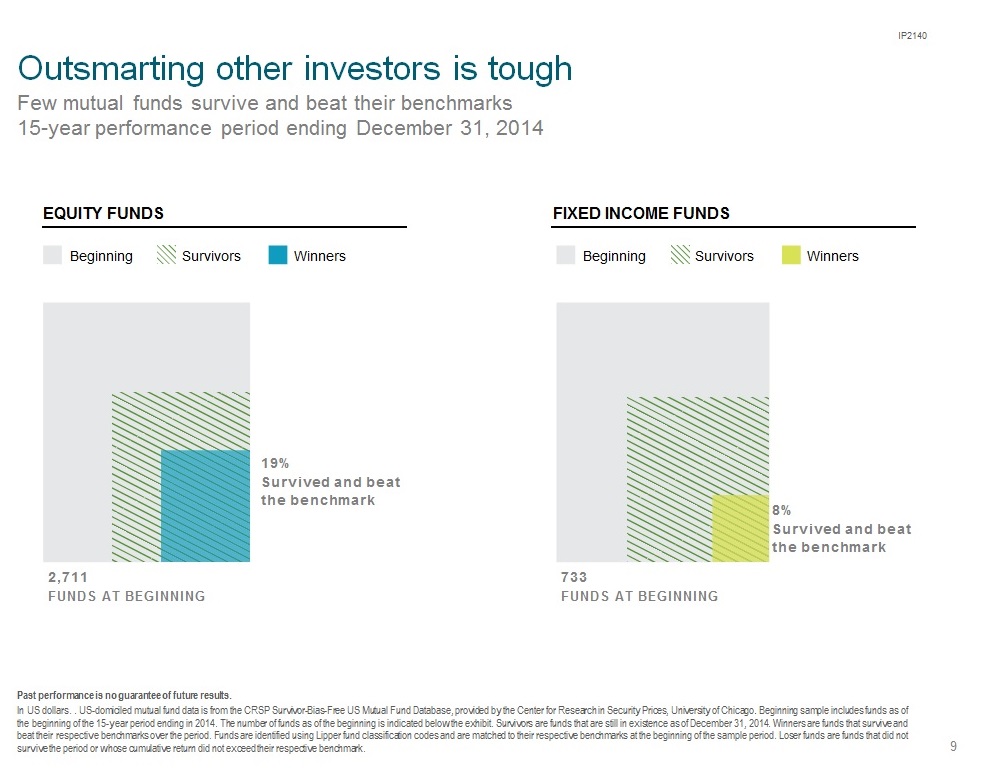
The next ten years won’t necessarily look like the last but even if active managers have twice as much success as they had over the past decade, the odds would still be about the same as a coin flip. While that’s substantially greater than Junior’s chances of suiting up with pads and helmet on Sundays, it’s not enough evidence to convince us to try and outguess the market. 

That should leave plenty of time for homework and watching football.

El Niño! Explosions! Beneficiaries?

El Niño”, “Explosions!”, and “Trump says…” lead today's headlines.

Headlines such as those are virtually guaranteed to draw eyeballs. On the other han, "Check Your Beneficiaries!” probably would rank just below “See What Vegetables are Best For You” above tips for making paint dry faster.

Mundane topics may not create much ad revenue, but ignoring or misunderstanding them can blow up even the best laid plans.

Free Food, Expensive Indigestion

“Where are y’all going to eat?” asked TJ (name changed to protect the innocent), my boss. He was addressing a group of us young brokers as we were headed out the door around noon. “The Lodge,” one of us replied.

My co-workers and I were mostly twenty something males that, for the most part, had never outgrown the frat house culture of college. “The Lodge” was a “club” that was close to our office that offered a “free” lunch buffet on Wednesdays. TJ, being about 10 years older than us, was somewhat of a big brother figure that frequently offered advice that he had primarily acquired knowledge of the hard way.

“Want to join us?” one of us asked. “Sure, I’ll drive,” he said, “but first we need to hit the ATM."

"But, it's free!" someone said.

“There ain’t no such thing as a free lunch,” replied TJ.

Whether it’s a free buffet at a casino, parasailing at a timeshare resort or a meal at an “educational seminar” put on by an insurance salesman, the end result is almost certainly that someone there is going to pay. If you find yourself in one of these situations thinking you somehow owe it to the lunch provider to reciprocate or make a hasty decision, it will serve you well to remember TJ’s advice to us young knuckleheads.

Even FINRA has gotten into the act of warning investors to beware of the “free meal” seminar. They found in a 2007 study that, “In half the cases, the sales materials—including the invitations and advertisements for the events—contained claims that appeared to be exaggerated, misleading or otherwise unwarranted. And 13 percent of the seminars appeared to involve fraud, ranging from unfounded projections of returns to sales of fictitious products.”[i]

Any of the aforementioned scenarios are pretty easy to spot and if you go in with the understanding that they are trying to sell you something, you can avoid making expensive mistakes. But what if the scenario isn’t so evident?

Investment firms, in addition to offering free lunch seminars, also offer “free” meals in much more subtle ways. There are a myriad of schemes that unethical or uninformed advisors use to market themselves. The one thing they have in common, is that they offer something (higher returns) for nothing (lower risk).

Even some of my colleagues in the “Evidence Based” advisor world sometimes make the mistake of suggesting that investing in value or small company stocks somehow provides higher returns than the market overall with less risk. In fact, significant periods of time can go by where any particular factor such as size or valuation under or over performs.

The key is to match your tolerance for risk with the right allocation to asset classes and factors within those asset classes. Then maintain the discipline necessary to stick with the strategy during the worst times.

It is said that the stock market climbs a wall of worry, but if those concerns keep you up at night you are probably taking too much risk with your portfolio. At ATX Advisors, we believe that understanding a client’s risk profile involves determining how much risk is required to achieve their goals, how much capacity they have for risk, and finally what their tolerance for risk may be. After that, we check in frequently and test to insure that not only was the initial assessment accurate, but if anything has changed over time. If you would like to take a risk tolerance test for yourself, schedule a “Get Acquainted” conversation at www.atxadvisors.com.


Something for nothing sounds great, especially when food is involved. I haven’t had much success finding “free lunch", but there are some great lunch deals out there. One of my favorites is the Thursday & Saturday Special at Sandy’s Hamburgers on Barton Springs Rd. $4.59 + tax for a ¼ lb. hamburger, fries, and medium Coke®.

What’s your favorite ATX lunch deal? Let me know on Twitter @atxadvisor.


[i] https://www.finra.org/investors/alerts/free-lunch-investment-seminars%E2%80%94avoiding-heartburn-hard-sell