
Accountable Update

Preparing to Get Hit by Life

Life is what happens to you while you’re busy making other plans,” John Lennon sang in a verse of Beautiful Boy. Mike Tyson put it more bluntly, “Everybody’s got plans…until they get hit.”[i]

I think back to my early 30’s when the .com bubble was expanding. Business was good in the financial trades, with stocks rising 20% every year and customers literally standing in line to invest. Retirement seemed a certainty by the time I was 40. Along the way, a new baby, a move to California, a “once in a generation” bear market, another baby, a move back to Texas, another “once in a generation” bear market, and a foolish notion to start a new business now have me approaching 50 and planning to work for the foreseeable future.

While some may argue differently about the bear markets, most would probably agree that none of those life events were catastrophic. But what if something had happened that truly altered my plans, or those of my family?

Probably the most obvious catastrophe that most people think of is an untimely demise. The odds of that happening are pretty low when you are in your 30’s. For example, according to the Social Security Administration's cohort life tables, a 30-year-old male has a 98.5% chance of living to age 40, 95.5% chance of making it to 50, and a 90.5% probability of reaching his 60th birthday. Ladies have even higher odds of reaching the golden years, with nearly a 94% chance. With odds that high, it isn’t surprising that term life insurance is relatively affordable.

Insurance works best when it is used to protect against low probability but high impact events, such as premature death. Nevertheless, paying an insurance company for 20-30 years of protection that is very unlikely to be used isn’t high on the list of expenses most folks look forward to paying. But the thought that our families would have to move because they can’t afford the mortgage or that the kids would be forced into debt to pay for college are enough to motivate me to write that check each year.

But there are other risks that are more likely to impact you than an early death. According to the SSA’s Disability and Death Probabilities, a male born in 1996 has about a 20% chance of becoming disabled before retirement age. Unlike death, with a disability you not only lose your earning potential but continue to need to support your family AND yourself.

Both life and disability insurance are important tools for protecting yourself from a knockdown blow, but they will cost you. How much you should buy can vary based on your personal goals, attitude towards risk, and family situation. An independent financial advisor may be your best resource for helping you answer the question of how much and then find solutions that suit you.

In addition, other steps to protect you and your family from a potential KO are:

Establish liquidity. An emergency fund with several months’ worth of expenses set aside is the easiest solution, but establishing credit before it is needed can also be effective. A line of credit or a credit card may be difficult to obtain or more expensive to use if you wait until the primary breadwinner has stopped winning bread.

Review the beneficiaries on your accounts and insurance policies. These designations work very efficiently to transfer assets after death without going through probate. However, failing to name them, or having the wrong ones (i.e. ex-spouses, minor children) can complicate or ruin your plans.

Write a will. Clearly state who should inherit your property and take care of your minor children, pets, etc. Appoint an executor that is willing and able to execute the will when the time comes.

Consider trusts. There is a myriad of trust types that accomplish different objectives. They can help avoid probate, protect assets from creditors, and insure they ultimately pass to the heirs or causes of your choosing.

Set up health care directives. Living wills, medical power of attorney, and HIPPA authorizations spell out your desires, who can make decisions, and who can even talk to doctors about your condition. These tools can insure that your wishes are followed in the event you aren’t able to communicate and help avoid emotional conflicts between well-meaning family members.

Establish durable power of attorney. In case you are unable to make financial decisions, having a trusted person (spouse, child, etc.) appointed as your attorney-in-fact that can handle your affairs can make life much easier on your family.

Title your assets correctly. All the steps previously mentioned can be voided or made more complicated by not titling assets correctly. On a financial statement, it is helpful to list the registration of all your assets so that your financial planner or attorney can help identify potential disconnects with your plans.

Finally, it’s also a good idea to put a recent copy of your financial statements, wills, trusts, insurance policies, deeds, and other important documents in a place where they can easily be accessed by your attorney-in-fact or executor.

Don’t know where to start? Get in touch to discuss your plans.


[i] https://www.brainyquote.com/quotes/quotes/m/miketyson379007.html?src=t_plans

Is the Market Due for a Wrench?

July marked the ninth consecutive month of positive returns in US stock markets. Rising tides lift all boats, but that hasn’t stopped some from taking credit.

Whose fault will it be when the inevitable downturn occurs? There will be plenty of blame offered, but you can be certain that at least one character won’t accept any of it. Believe me!

Since 1987, August has been the worst month for the S&P 500®, according to the Stock Trader’s Almanac. Also noted in the Almanac is that volatility typically picks up around this time of year. Given that the CBOE Volatility Index (also known as the VIX) hit its lowest level since 1990 last month, it wouldn’t be a shock to see some red numbers in the near term.

What also won’t be surprising is that someone will get credit for being the portfolio manager or trader that “predicted the selloff”, even though there is scant evidence of anyone consistently able to outguess the markets. In fact, in his 1973 book, A Random Walk Down Wall Street, Burton Malkiel argued, “A blindfolded monkey throwing darts at a newspaper’s financial pages could select a portfolio that would do just as well as one carefully selected by experts.”

But perhaps Mr. Malkiel was just observing (unknowingly) that expected returns actually increase by using this method to manage a portfolio. Sound crazy? Then check out this month’s Issue Brief from DFA titled Quit Monkeying Around!

Come to think of it, that might also be a suitable response to a certain Tweeter in Chief after his next late-night tirade. Rest assured, if the market wilts in the August heat, it may not be our fault but we’ll be right by your side with our Accountable Wealth Management. Get in touch if you would like to discuss.


Quit Monkeying Around!

August 2017

In the world of investment management there is an oft-discussed idea that blindfolded monkeys throwing darts at pages of stock listings can select portfolios that will do just as well, if not better, than both the market and the average portfolio constructed by professional money managers. If this is true, why might it be the case?

The Dart Board

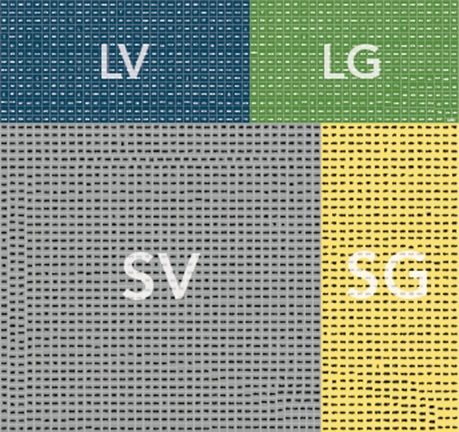
Exhibit 1 shows the components of the Russell 3000 Index (regarded as a good proxy for the US stock market) as of December 31, 2016. Each stock in the index is represented by a box, and the size of each box represents the stock’s market capitalization (share price multiplied by shares outstanding) or “market cap” in the index. For example, Apple (AAPL) is the largest box since it has the largest market cap in the index. The boxes get smaller as you move from the top to the bottom of the exhibit, from larger stocks to smaller stocks. The boxes are also color coded based on their market cap and whether they are value or growth stocks. Value stocks have lower relative prices (as measured by, for instance the price-to-book ratio) and growth stocks tend to have higher relative prices. In the exhibit, blue represents large cap value stocks (LV), green is large cap growth stocks (LG), gray is small cap value stocks (SV), and yellow is small cap growth stocks (SG).

For the purposes of this analogy you can think of Exhibit 1 as a proxy for the overall stock market and therefore similar to a portfolio that, in aggregate, professional money managers hold in their competition with their simian challengers. Because for every investor holding an overweight to a stock (relative to its market cap weighting) there must also be an investor underweight that same stock, this means that, in aggregate, the average dollar invested holds a portfolio that looks like the overall market.[1]

Exhibit 1.       US Stocks Sized by Market Capitalization

For illustrative purposes only. Illustration includes constituents of the Russell 3000 Index as of December 31, 2016, on a market-cap weighted basis segmented into Large Value, Large Growth, Small Value, and Small Growth. Source: Frank Russell Compa…

For illustrative purposes only. Illustration includes constituents of the Russell 3000 Index as of December 31, 2016, on a market-cap weighted basis segmented into Large Value, Large Growth, Small Value, and Small Growth. Source: Frank Russell Company is the source and owner of the trademarks, service marks, and copyrights related to the Russell Indexes. Please see Appendix for additional information.

Exhibit 2, on the other hand, represents the dart board the monkeys are using to play their game. Here, the boxes represent the same stocks shown in Exhibit 1, but instead of weighting each company by market cap, the companies are weighted equally. For example, in this case, Apple’s box is the same size as every other company in the index regardless of its market cap. If one were to pin up pages of newspaper stock listings to throw darts at, Exhibit 2 would be much more representative of what the target would look like.

When looking at Exhibits 1 and 2, the significant differences between the two are clear. In Exhibit 1, the surface area is dominated by large value and large growth (blue and green) stocks. In Exhibit 2, however, small cap value stocks dominate (gray). Why does this matter? Research has shown that, historically over time, small company stocks have had excess returns relative to large company stocks. Research has also shown that, historically over time, value (or low relative price) stocks have had excess returns relative to growth (or high relative price) stocks. Because Exhibit 2 has a greater proportion of its surface area dedicated to small cap value stocks, it is more likely that a portfolio of stocks selected at random by throwing darts would end up being tilted towards stocks which research has shown to have had higher returns when compared to the market.

Exhibit 2.       US Stocks Sized Equally

For illustrative purposes only. Illustration includes the constituents of the Russell 3000 Index as of December 31, 2016 on an equal-weighted basis segmented into Large Value, Large Growth, Small Value, and Small Growth. Source: Frank Russell Compan…

For illustrative purposes only. Illustration includes the constituents of the Russell 3000 Index as of December 31, 2016 on an equal-weighted basis segmented into Large Value, Large Growth, Small Value, and Small Growth. Source: Frank Russell Company is the source and owner of the trademarks, service marks, and copyrights related to the Russell Indexes. Please see Appendix for additional information.

So…Throw Away?

This does not mean, however, that haphazardly selecting stocks by the toss of a dart is an efficient or reliable way to invest. For one thing, it ignores the complexities that arise in competitive markets.

Consider as an example something seemingly as straightforward as a strategy that holds every stock in the Russell 3000 Index at an equal weight (the equivalent of buying the whole dart board in Exhibit 2). In order to maintain an equal weight in all 3,000 securities, an investor would have to rebalance frequently, buying shares of companies that have gone down in price and selling shares that have gone up. This is because as prices change, so will each individual holding’s respective weight in the portfolio. By not considering whether or not these frequent trades add value over and above the costs they generate, investors are opening themselves up to a potentially less than desirable outcome.

Instead, if there are well-known relationships that explain differences in expected returns across stocks, using a systematic and purposeful approach that takes into consideration real-world constraints is more likely to increase your chances for investment success. Considerations for such an approach include things like: understanding the drivers of returns and how to best design a portfolio to capture them, what a sufficient level of diversification is, how to appropriately rebalance, and last but not least, how to manage the costs associated with pursuing such a strategy.


The Long Game

Finally, the importance of having an asset allocation well suited for your objectives and risk tolerance, as well as being able to remain focused on the long term, cannot be overemphasized. Even well-constructed portfolios pursuing higher expected returns will have periods of disappointing results. A financial advisor can help an investor decide on an appropriate asset allocation, stay the course during periods of disappointing results, and carefully weigh the considerations mentioned above to help investors decide if a given investment strategy is the right one for them.

Conclusion

So what insights can investors glean from this analysis? First, by tilting a portfolio towards sources of higher expected returns, investors can potentially outperform the market without needing to outguess market prices. Second, implementation and patience are paramount. If one is going to pursue higher expected returns, it is important to do so in a cost-effective manner and to stay focused on the long term.


Appendix

Large cap is defined as the top 90% of market cap (small cap is the bottom 10%), while value is defined as the 50% of market cap of the lowest relative price stocks (growth is the 50% of market cap of the highest relative price stocks). For educational and informational purposes only and does not constitute a recommendation of any security. The determinations of Large Value, Large Growth, Small Value, and Small Growth do not represent any determinations Dimensional Fund Advisors may make in assessing any of the securities shown.


[1]. For more on this concept, please see “The Arithmetic of Active Management” by William Sharpe.

Time for a New Pickup?

This summer has been a rough one for my old pickup. In early May, as the thermometer starting rising, my air conditioner went kaput. That cost me about $600 to make the repairs. Then, last week, alarm bells starting ringing and a red light shaped like a battery flashed on the dash. Unfortunately, it wasn’t a relatively affordable battery that needed replacing. Rather, it was a much more expensive alternator. After forking out another $500, the thought crossed my mind that it may be time to look for some new wheels.

New vehicles are probably the worst “investments” we make. It is not unusual to see the value decline by 50% in the first four years after driving off the dealer’s lot. That knowledge has led me to adopt a philosophy that I will drive our cars and trucks until “the wheels fall off” before buying a new one. As my unexpected repair expenses have accumulated though, some reminders of how expensive new cars can be helped to scratch that new car (or truck) itch.

I started with a quick visit to Kelley Blue Book® to see roughly what a new 2017 Ford F150 Platinum edition (the same model of my current pickup) would cost. $53,383 was the “Fair Purchase Price” that was indicated. Ouch, that was about all I needed to realize I am probably doing the right thing by continuing to drive my old pickup a while longer. But I can’t write an Accountable Update without analyzing it further, so I started checking out the values of older models, too.

I saw that a used 2013 model in good condition has a trade-in value around $26,000, which would be a pretty good indication of its actual value. Compared to the new price of $46,100 back in 2013, according to an article I found on Autotrader.com, it looks like the value has fallen just under half over the last four years. Of course, when you add in the approximate $3,400 of tax, title, and license costs in Texas (per this calculator on Carmax.com), plus whatever else you let the F&I guy talk you into at the dealership, and a 50% decrease per presidential term appears to be a good estimate.

That translates to a -15.91% annual rate of return. Put in dollar terms, a new $53,383 pickup would drop the following amounts over the next ten years assuming annual depreciation at that rate:

Depreciation.jpg.png

Depreciation Illustration

$53,383 pickup with annual depreciation of -15.91%.


In the first three years, that’s a total of $21,641 of lost value versus only $12,868 over the next three. If you put 12,000 miles a year on the vehicle in this example, the depreciation cost per mile is 60.11 cents in the first three years versus 35.74 cents for the next three.* Consider that the IRS mileage rate in 2017 for business is only 53.5 cents per mile. You could also supplement your income by driving for Uber, but their base mileage rate starts at $1.06 per mile, and you would still need to buy gas! 

Remember that commercial that showed a guy driving an old car that spit change out of the air conditioning ducts? Driving a new car is like that, but exactly the opposite.

Some potential good news, especially if you are in the market for a new car, is that “…millions (of) cars that were leased two or three years ago, many of them used compact and midsized cars with low mileage, are heading toward auction lots and used car dealerships. That surge in supply threatens to depress prices for new and used vehicles…”, according to an Autonews.com article from earlier this month.

Some may be asking if a lease may make more sense than buying, but the lease amount incorporates the expected depreciation, taxes, and interest into the payment. At the end of the lease, you would then start the whole process over again, insuring that you are always paying the highest amount of depreciation. Plus you typically add in mileage penalties and wear and tear charges. 

There is nothing quite like that new car smell, except that you may find adding to your retirement account, the kids’ college, or travel funds are even sweeter. You can certainly reduce the amount of depreciation each year by driving a new vehicle longer, but buying the used pickup in the example above would mean you could add an extra $3,000 per year towards goals that may make you a lot happier.

If you would like to discuss any of those plans, get in touch.

If you are in the market for a car, it looks like your timing could be pretty good. As for me, I think I’ll stick with my old pickup for bit longer.


*Arithmetic error corrected from earlier version