
Accountable Update

Q1 2017 Market Review

The US stock markets posted impressive gains in Q1 2017 as the “Trump Rally” that began the day after his surprise victory in November of last year showed few signs of losing steam. Expectations of lower taxes, less regulation, and increased infrastructure spending have continued to provide the fuel to propel stocks higher.

The Federal Reserve raised its benchmark interest rate a quarter of a point to 1%, the second increase in three months, with indications of further rate hikes to come. Rising rates are generally an impediment to growth and rising stock prices, but the increase also signals improving confidence in the economy. It also was largely in-line with expectations. If anything, the fear has been that the Fed would raise rates even higher or more often.

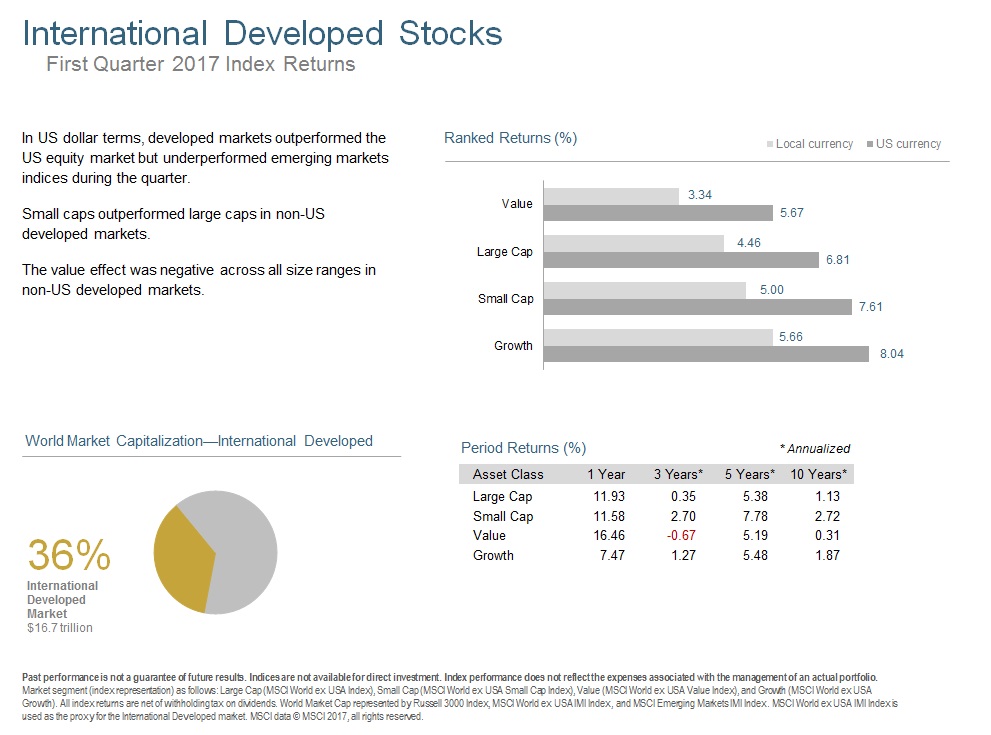
International markets, both developed and emerging, posted even stronger gains while commodities, REITs, and bonds lagged. In the fixed income space, domestic bonds outpaced foreign, and municipals did slightly better than government or corporate bonds.

US Large cap stocks and value stocks outperformed small and growth segments.

If you weren’t paying close attention, you may have missed the significant rally in emerging markets stocks. This is just another example of an out of favor asset class turning when you may have least expected it, given the protectionist tenor and anti-globalist rhetoric coming from Washington DC. Believe it or not, the Mexican Peso was the top performing global currency versus the US Dollar!

This is another reminder of why we practice disciplined asset allocation based on your goals, risk tolerance, and risk capacity instead of trying to outguess the markets. It also serves to illustrate that there is a world of opportunity out there, and staying too close to home can cause us to miss out.

The Q1 2017 Market Review features world capital market performance and a timeline of events for the past quarter. It begins with a global overview, then features the returns of stock and bond asset classes in the US and international markets.

As always, if current markets have you concerned about your portfolio, please get in touch for a free review.

Should You Own International Investments?

“Why should we own ANY international investments,” asked one of my clients while discussing their portfolio recently? Then he followed up, "With globalization, don't we get the benefits of investing internationally by just sticking with the largest US companies that do business worldwide?"

For the past several years, strong performance in the domestic stock markets has led to more of these types of questions being asked. It’s not surprising really, since domestic stocks have significantly outperformed international stock markets since 2010.

That recent outperformance can lead investors to underweight, or completely avoid, many investments that are headquartered in other countries. Too much “Home Bias”, however, can mean lost opportunities to share in the success of thousands of companies representing about half of the world's investment dollars, as seen in Exhibit 1. Many of those companies do a lot of business in the USA. Companies such as Nestle, Shell, Toyota, Anheuser-Busch InBev, Michelin, Honda, and Bayer, are just a few examples of household names that would be excluded from a portfolio comprised solely of US stocks.

Exhibit 1


For some, the question may be more about the current political and/or economic atmosphere than anything else. Keep in mind that just as trying to time the ups and downs of local stock markets is virtually impossible, determining beforehand when domestic stocks will outperform international is a guessing game, at best. As seen in Exhibits 2 and 3, there are few (if any) patterns to the performance of developed or emerging stock markets over the past 20 years.

Exhibit 2


Exhibit 3

The recent outperformance of domestic markets may also be leading to memory loss for some of us that invested during “The Lost Decade” of 2000-2009. As a reminder, that was the S&P 500®’s worst 10 year period ever, losing an average of .95% per year. World markets outside the US did considerably better. For example, the MSCI World ex USA Index averaged 1.62%, and the MSCI Emerging Markets Index had a 9.78% annualized return over that same period.

Being diversified doesn't insure against losses. It actually does guarantee that we don’t have a large percentage of our portfolios in whatever stock, industry, or country that is the big winner, or loser, in a given year. But it can lead to better outcomes overall than trying to guess those winners or losers in advance.

Looking back to 1970, the S&P 500® outperformed a globally diversified portfolio in 18 years, while underperforming 29 times. That’s not to say that we'll see a repeat of that pattern, but by investing in a globally diversified portfolio (domestic + international) such as the Dimensional Equity Balanced Strategy[1] , you may smooth out performance and avoid the extremes of attempting to pick the winner or loser.

Exhibit 4

In fact, over that same timeframe, investing in a global portfolio would have beaten the domestic portfolio over 85% of the time.

Exhibit 5

As markets gyrate, it can be tempting to try and guess what foot will be next to rise or fall. But recent events such as Brexit and the US Presidential Election have shown us that markets can, and often do, act contrary to what the conventional wisdom seems to suggest. Keep that in mind if recent news items or random opinions have you second guessing why diversification matters.

Maybe Dartmouth College’s Ken French put it best, “Diversification is about the closest thing to a free lunch in capital markets, so you may as well get a huge helping of it.”

If you’re concerned about your level of diversification, get in touch for free portfolio review. I'll even throw in lunch.


[1] Rebalanced monthly. The Dimensional Equity Balanced Strategy Index is comprised of commercial and Dimensional indices, 70% US equity indices, and 30% non-US indices.  US: S&P 500, large cap value, small cap, small cap value, Dow Jones REIT; non-US: international value, international small cap and small cap value, emerging markets, and emerging markets value and small cap.  Additional index information is available upon request.

Shaking That Procrastinating Feeling

Hoover Tower Halo, Stanford University (Photo by Jeff Weeks)

Hoover Tower Halo, Stanford University (Photo by Jeff Weeks)

Last week was Spring Break. My family and I spent the week touring colleges on the West Coast that my oldest is interested in attending. After making the flight from Austin to LA, we put nearly a 1000 miles on a rental car, stayed in four hotels plus a friend’s guest room, and learned a lot about the campuses we toured. It also provided a few opportunities to reflect upon just how fast time flies and what the price of a little procrastination can be.

I wrote an Accountable Update article about this time last year titled Allergies and April 18. In it, I showed an example of the cost of waiting to contribute to an IRA. Retirement, though, is an abstract concept to most of us. We all rationalize any delays in building our nest eggs by telling ourselves we can work longer, live more frugally, or just save more later.

With just over a year before my son goes to college, however, the realization has hit that time is just about up for putting away more savings for his tuition, books, room, and board. I’ve written several articles on college savings before, such as Money For Nothing and College For Free, so there is nothing about the amounts of money needed that have caught me off guard. But I can’t shake the feeling that I could have done more when I had the chance.

At least there is a decent chance that my boy will qualify for some scholarships or other forms of financial aid. He also may choose an affordable in-state public school versus a more expensive out of state or private option. But retirement may not offer that level of flexibility. In that spirit, I invite you to read another previous update, 5 Ideas for a More Prosperous “Retirement Season”.

Or, maybe we should all just take the advice from the “Oracle of Omaha” himself, Warren Buffet, “Don’t save what is left after spending, spend what is left after saving.” 

As always, if you would like to discuss your situation, please get in touch.