Accountable Update

Q3 2016 Market Review

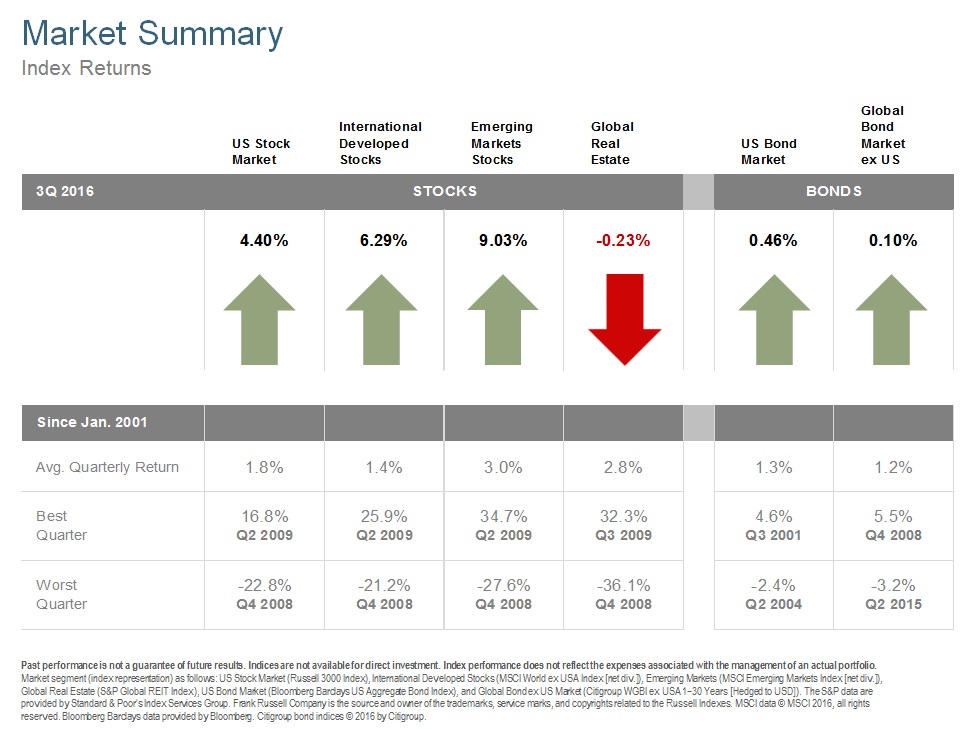
Despite the uncertainty created by the still tight presidential election, stocks and bonds generally had positive returns for the quarter, with the Dow, S&P 500, and NASDAQ all setting record highs. As the quarter was coming to a close, the omnipresent question of when, or if, central banks will end their "do no harm" mode in favor of raising rates here in the US or continuing to ease them in Europe and Japan led to some volatility.

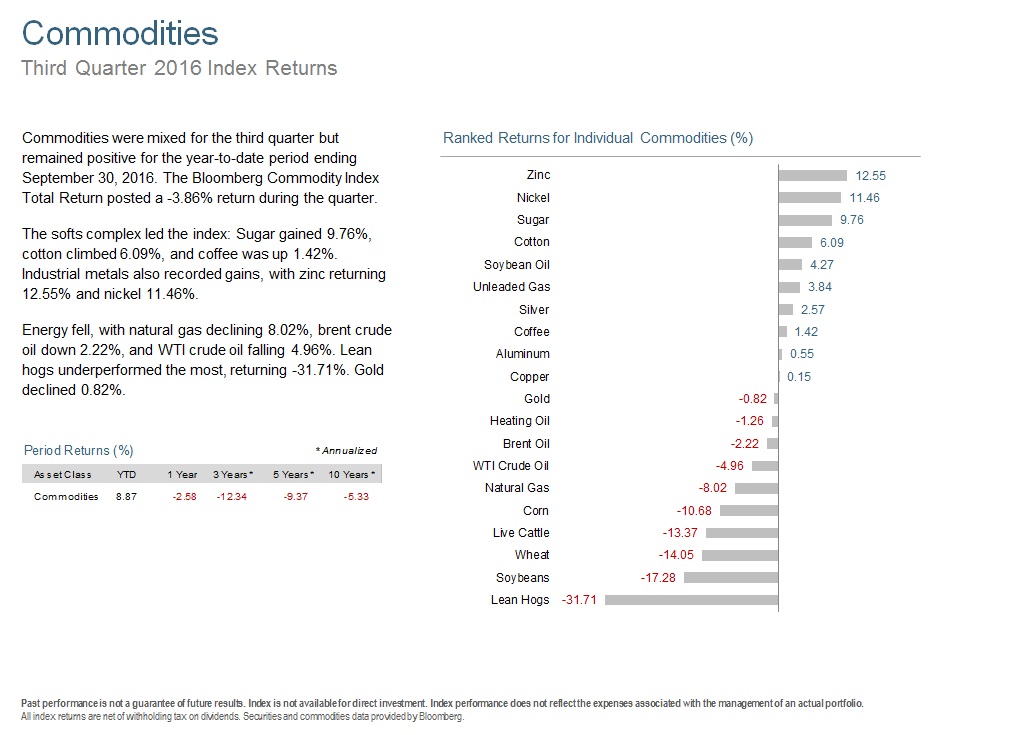
Small cap stocks were the best performing asset class, which usually bodes well for economic growth. Not surprisingly, REITs, which should be sensitive to rising rates, were weaker during the quarter. However, commodities, which you may expect to rise with inflation expectations, were mixed.

As has been the case over the past few years, the guessing game of trying to differentiate temporary reversion to the mean against longer term trends proved to be anyone’s guess. This is why I avoid “tactical” approaches to investing for long term goals, because it is essentially making a guess.

Historically, there are more up days in the stock market than down days. There are also more up months versus down months and more up years versus down years. Betting against the house is a losing proposition. Worse, even if you guess correctly on a short term drop, you have to guess again on the reversal in order to profit.

Just as the odds of the ball landing on red don’t change even if it landed on black each of the last dozen spins, the last eight months of positive returns don’t increase the odds that next month will be down. Be thankful for the string of positive returns and when we see the next downturn, remain steadfast in the knowledge that the odds favor staying the course.

Now, for the Q3 2016  Market Review...


Jump or Ease In? Lump Sum Versus Dollar Cost Averaging

The Water is Fine

The Autumnal Equinox, aka the first day of Fall, was last week on September 22. You may not have noticed, as the high for the day was 94° F here in ATX. Yesterday, though, we woke to the first day in over six months that the thermometer read below 60°. This became VERY apparent when I stuck my toes in the water prior to my morning swim at our neighborhood pool.

Even though most will agree that jumping in and getting the initial shock over with is typically the best way to acclimate to cool water, it can be difficult to convince our minds that a more cautious approach isn’t more prudent after getting cold feet.

Frequently this dilemma also presents itself with investing. The question of whether to “jump in” the market and invest immediately versus employing a more gradual approach such as dollar cost averaging regularly comes up in my conversations with clients that have cash to invest. So what is the best approach?

12 time Olympic medalist, Natalie Coughlin, was once quoted as saying, "I actually love swimming but I just hate jumping in the water." If even the most successful pros face the same mental challenges as the rest of us, maybe the question isn't which approach is best. Rather, what does it take to get you in the pool?

First, let’s not confuse the question of what to do with a lump-sum versus accumulating wealth over time. If you don’t have a lot of money to invest and want to start by taking small amounts from your income (such as in an employer retirement plan like a 401(k)) and investing over time, by all means, do that. It is an effective way to grow your nest egg.

But if you have already saved up a pile of cash or had a liquidity event and want to invest for the long haul, decades of research[i] suggest that investing it all at once, or lump-sum investing, tilts the odds in your favor around 66% of the time. Nonetheless, that 66% is a lot like 66° water for a lot of folks. Some have the fortitude to jump right in, others need to convince themselves through a more cautious approach.

Stocks and bonds have expected returns that are higher than cash, so it stands to reason that the odds favor them to outperform over time. Another way to think about it is that for 2 out 3 investors, increasing stock and bond prices will just lead to higher average prices paid through dollar cost averaging (See exhibit 1). However, volatility is the trade-off for those higher expected returns.

Exhibit 1: For 2 out 3 investors, dollar cost averaging will increase the average price paid as stock and bond prices tend to go up over time.

Exhibit 1: For 2 out 3 investors, dollar cost averaging will increase the average price paid as stock and bond prices tend to go up over time.

If the prospect of being on the short end of the stick about a third of the time is just too uncomfortable of a thought for you to jump right in, then dollar cost averaging may be the way to go. Besides, just as you can always dunk your head in the water to get it over with, you can accelerate your investment schedule if you acclimate sooner than you expected.

Either approach is better than staying in bed while your muscles wither from inactivity or purchasing power is diminished by inflation.  Time for a swim?


[i] Abeysekera, Sarath P., and E.S. Rosenbloom. 2000. “A Simulation Model for Deciding between Lump-Sum and Dollar-Cost Averaging.” Journal of Financial Planning 13 (6): 86–96.

Atra, Robert J., and Thomas L. Mann. 2001. “Dollar-Cost Averaging and Seasonality: Some International Evidence.” Journal of Financial Planning 14 (7): 98–103.

Brennan, Michael J., Feifei Li, and Walter N. Torous. 2005. “Dollar-Cost Averaging.” Review of Finance 9 (4): 509–535.

Constantinides, George M. 1979. “A Note on the Suboptimality of Dollar-Cost Averaging as an Investment Policy.” Journal of Financial and Quantitative Analysis 14 (2): 443–450.

Dichtl, Hubert, and Wolfgang Drobetz. 2011. “Dollar-Cost Averaging and Prospect Theory Investors: An Explanation for a Popular Investment Strategy.” Journal of Behavioral Finance12 (3): 41–52.

Dubil, Robert. 2005. “Lifetime Dollar-Cost Averaging: Forget Cost Savings, Think Risk Reduction.” Journal of Financial Planning 18 (10): 86–90.

Greenhut, John G. 2006. “Mathematical Illusion: Why Dollar-Cost Averaging Does Not Work.” Journal of Financial Planning 19 (10): 76–83.

Knight, John R., and Lewis Mandell. 1993. “Nobody Gains from Dollar-Cost Averaging: Analytical, Numerical, and Empirical Results.” Financial Services Review 2 (1): 51–61.

Leggio, Karyl B., and Donald Lien. 2001. “Does Loss Aversion Explain Dollar-Cost Averaging?” Financial Services Review 10 (1–4): 117–127.

Leggio, Karyl B., and Donald Lien. 2003. “Comparing Alternative Investment Strategies Using Risk-Adjusted Performance Measures.” Journal of Financial Planning 16 (1): 82–86.

Markowitz, Harry. 1952. “Portfolio Selection.” Journal of Finance 7 (1): 77–91.

Milevsky, Moshe A., and Steven E. Posner. 2003. “A Continuous-Time Re-examination of the Inefficiency of Dollar-Cost Averaging.” International Journal of Theoretical and Applied Finance 6 (2): 173–194.

Rozeff, Michael S. 1994. “Lump-Sum Investing versus Dollar-Averaging.” Journal of Portfolio Management 20 (2): 45–50.

Statman, Meir. 1995. “A Behavioral Framework for Dollar-Cost Averaging.” Journal of Portfolio Management 22 (1): 70–78.

Thorley, Steven. 1994. “The Fallacy of Dollar-Cost Averaging.” Financial Practice and Education 4 (2): 138–143.

Trainor, William J. 2005. “Within-Horizon Exposure to Loss for Dollar-Cost Averaging and Lump-Sum Investing.” Financial Services Review 14 (4): 319–330.

Williams, Richard E., and Peter W. Bacon. 1993. “Lump-Sum Beats Dollar-Cost Averaging.”Journal of Financial Planning 6 (2): 64–67.


3 Lessons from Being Self-Employed

44% of new businesses fail in their first three years, according to Statistic Brain.

In spite of knowing the odds, about two years ago I left the steady paycheck, benefits, and general comfort of a corporate job for the world of self-employment. I’ve replaced the predictable paycheck with the potential for big ones, the benefits with freedom and flexibility, and general comfort for sleepless nights worrying if I can provide for my family.

It is very exciting being fully in-charge of my own success, but the thrill is frequently tempered. First there is daily reinforcement that I often don’t know how to do something or even that I don't know there is something that I don't know. Then, once I figure it out, it will probably cost more money than I have budgeted for it. Then, finally, no matter how long I think that something will take, it always takes at least twice as much time.

Today’s update may not eliminate the ever present challenges mentioned above. But there have been some lessons I have learned along the way that may help those of you that are considering making your dreams of self-employment come true. At the very least, perhaps they will help prevent you from waking up to a financial nightmare.

Build a Big Emergency Fund

I had about 12 months of normal expenses in cash the day I left my job. I wish now that I had twice that amount. Things that once weren’t emergencies, such as new HVAC for my home, car repairs, and just the everyday costs of raising two teenagers quickly whittled down my rainy day fund. 

Nearly every successful entrepreneur I have met can tell a story about how short the runway is between starting the business, when they are spending their capital, and getting it off the ground when the enterprise actually turns a profit. No matter how flush you may feel at the beginning, the trees at the end of the runway will rapidly approach as you accelerate while struggling to gain lift.

Whatever you think you need in your emergency fund, double or triple it before taking off.

Take the credit before you need it

No matter how long you’ve been employed, how much money you used to make, or have saved up in your 401(k), the moment you walk away from the steady paycheck is the day the credit river will slow or even run dry. The time to refinance your mortgage, obtain a line of credit, or get your credit limit increased on a credit card or two is before you walk out the door to be the next Bill Gates.

Once you’re your own boss, creditors will want to see sustained success (typically two years) before considering you even a moderate risk. Even if you can find a willing lender, the rates will likely be higher than when you fit in a nice clean credit profile of a gainfully employed borrower.

Throw in the fact that underwriting standards are still pretty stringent following the mortgage meltdown in 2008, and you can almost forget about getting new credit unless you have assets to borrow against.

Don’t be shy about taking as much credit as possible before making the leap to self-employment. You’ll appreciate the flexibility of being able to pay off big expenses with the lowest monthly obligation as possible.

Record it!

“It’s ok, I can deduct it,” may be true, but make sure you can prove it. Being a business owner allows you to offset revenue with expenses for things like office supplies, equipment, mileage, etc. Being sloppy with record keeping, however, can be costly in the event of an audit. According to the IRS 2015 Data Book, returns filed with a Schedule C (Profit or Loss from Business) with income greater than $25,000 are 8 times more likely to be audited than someone with similar income that isn’t filing small business schedules or claiming certain tax credits.

While the chances of being audited are still relatively low (between 2%-3%), you can avoid the headache of having expenses disallowed or additional taxes owed (and penalties) by saving receipts, keeping your calendar records, and tracking your mileage with a phone application like MileIQ.

Create a system, whether it is technology based or just a folder, to keep and track all of those expenses. Your accountant will thank you.

TIP – Cats like to eat receipts left on your desk.

Be Accountable to Yourself

New business owners tend to focus on what they do for a living, and rightly so. There is no doubt that offering a great product or service is a key to success. Many businesses fail, however, in spite of offering a compelling value proposition. The failure isn’t always due to failing to meet the needs of their customers, it often comes from not being accountable to themselves as they focus on what they do best and neglecting the actual business.

Taking these lessons to heart may not guarantee your success as an entrepreneur, but they will go a long way towards helping you avoid becoming a bad statistic.