

Accountable Update

PSAT and an O$#!+ Moment

Photo by Luftphilia

Photo by Luftphilia

"PSATs are in," read the text.

"Huh?" I replied.

"Your son's PSAT score is in," said my wife.

"Oh, cool. How did he do?" 

"Pretty good. His score plus his GPA gives him a 60% chance of getting into Stanford!"

"Great! Wait. What?"

The preceding conversation is a not very fictionalized version of a text conversation between me and my wife earlier today. For maybe the first time, the thought of the cost of college became a very real and present concern in my household, versus the concept it had been (like retirement) up to now. 

As a financial planner, I have access to a wealth of information about the cost of different things. The planning software I use with clients, MoneyGuidePro®, provides very specific information, even at the individual college level, for planning purposes. Today, I opted to look at the cost of some individual schools versus the "average" categories I typically used for my personal planning. The results were a little unnerving.

First of all, my typical default has always been in-state tuition at a place like my alma mater, Texas A&M University. The current estimate for a public in-state college in the US starting in 2016 is $24,061 per year. That is right in line with what we have been saving for his college expenses. However, today was an epiphany.

First, I looked at the specific estimates of attending Texas A&M University. Here is how it broke down:


$ 9,428
$10,330
$ 1,194

$20,952

Tuition
Room & Board
Books & Supplies

Total


I felt pretty good about that, particularly given my previous assumptions using public school averages. I also looked at a few other Texas schools.

I started with the hated (at least in my house) University of Texas, a fine second choice if a kid can't get into A&M. It wasn't too daunting of a figure, just a little more than the flagship in College Station. Total costs = $22,016 per year.

Other Lone Star choices were Baylor ($52,834), Rice ($56,703), TCU ($53,570), and Texas Tech ($19,172).That's enough of sample size for me to use the following rule of thumb for Texas schools. $25,000 a year for public and $50,000 for private colleges.

Then for the moment of truth. Stanford University has always been a school that my son has said he may be interested in attending. With today's news that his PSAT coupled with his GPA gives him at least a coin flip's chance of getting in, I decided it was time to plan for the worst. The tally? 

 $61,261. Oh $#!+!

That's about 3X more than Texas A&M. (Caution, there is some Aggie math being used here.) For even a little more reality, the inflation rate for colleges has been about 5% over that past decade according to The College Board®. That means the current estimates would be about double for a four year old today if that rate holds true going forward.

So what does it all mean? For me, probably a little more belt tightening and discipline about where our money goes for the next few years. For ATX Portfolio Advisors clients, it means I will do what I can to help: whether it is forecasting the cost of college for your children or grandchildren, developing a plan to get there, or managing assets that are earmarked for that goal.

One of ATX Portfolio Advisors' values is to not kick someone when they are down. Thus, we don't pile on fees when your account balance falls from one month to the next, with the hope that our clients will be more likely to stay the course when they know they have a partner on the same side of the table.

I also believe that anything I can do to encourage better education and less debt for graduates is a small investment in all of our futures. To encourage more savings for those goals, ATX Portfolio Advisors will manage money invested in a low cost 529 plan for FREE if you have other assets being managed by me. (Note that 529 plans have costs associated with them that are levied by the plans and underlying investments.)

It's not free college for everyone, but it's a start. If you would like to discuss college planning or management of your assets, please get in touch.


Allergies and April 18

Photo by Nimai Malle

Photo by Nimai Malle

Remember being young and wanting nothing more than to be a grown-up? Your parents would tell you not to be in a hurry because, before you know it, you will be grown up wondering where all the time went.

Just turn on the radio for further proof that time flies. Musicians as varied as Kenny Chesney (“Don‘t Blink”), Bowling for Soup (“1985”), and Fleetwood Mac (“Landslide”), make regular fare of the fact that we grow old too fast. As I get older, it seems that more and more songs, sights, and experiences cause my allergies to flare up as I think of days long ago that seem just like yesterday.

One of those days was when my 16 year old (pictured above) recently became licensed to operate a motor vehicle. I flashed back to my mid teen years and the multiple fender benders or worse that I somehow walked away from. Those vivid memories (or are they nightmares?) keep me awake any time he is out on the road. It seems like yesterday that he was learning to ride a bike with me running alongside in case he lost his balance. If only I could always be looking right over his shoulder to warn of impending hazards.

Another was during practice for my 12 year old daughter’s softball team. On an adjacent field, a tee-ball game was underway for 6 year olds'. If you’ve ever been to one of these games, then you are familiar with the drill. There are 12-15 kids in the field while the other team bats. Twice that many parents and grandparents are in the stands screaming at the top of their lungs every time a ball is put into play. Usually the entire throng of fielders will converge on the ball at once, with one emerging, ball in hand, to chase the baserunner around the bases. It has got to be one of the greatest scenes in sports.

I glanced over at my daughter and couldn’t fathom how she had seemingly gone from that plodding huddle of first graders' to the rapidly maturing adolescent that can throw a ball as hard as her old man. Those damn allergies were really bad that day, must have been the cedar.

It has gotten to the point that I can’t do anything without feeling the need for a couple of antihistamines. TBT pics on Facebook, listening to the “oldies” by Journey or Garth Brooks, or just recognizing a familiar smell can prompt me to reach for a box of tissues. Maybe it’s all just a consequence of growing old when you start realizing that days that once seemed limitless are actually in short supply. Or, that you better make every one count.

Another thing that can make you teary eyed, but not for the warm and fuzzy feelings evoked by Steve Perry, are taxes. Next Monday, April 18, is the deadline for filing yours unless you get an extension. Also, Monday is the last day for making your 2015 IRA contributions. You will never have the opportunity to put away IRA money for 2015 after Monday. Don’t regret not taking action.

Traditional IRA’s allow you to put away up to $5,500 a year (or $6,500 if you are 50 or older) in a tax advantaged way. If your income is under certain levels, you may be able to deduct the contribution from your taxes or even qualify for a tax credit. If you don’t qualify for the deduction or credit, but have earned income, you can still defer taxes on the growth of your after-tax contribution until you withdraw the funds.

There is also a Roth IRA alternative, which has some income limitations for contributions, but allows you to make after-tax contributions that allow for TAX FREE growth. The tax code even allows for a “Back Door” for people that exceed the income eligibility limits. The current code allows you to make an after-tax Traditional IRA contribution, but convert to a Roth IRA to enjoy the tax free growth. If you are converting an “after-tax” contribution before it has any earnings, the net result is the same as being able to make a Roth IRA contribution.

It may not seem like that big of a deal to skip this year’s contribution, but once you do, all you can do is think about “what if” later on. Depending on how old you are, consider just how expensive of a mistake you may be making by not making this one count. (Warning, the following illustration may cause serious allergic reactions!)

IRA’s have penalties for withdrawals before age 59.5, but look at how much ONE $5,500 contribution today can potentially grow to at age 65 with a hypothetical 10% return based on different ages:

Age        What if $5500 @ 10%
Today    Until Age 65

25           $248,926
35           $ 95,972
45           $ 37,000
55           $ 14,266

If you are self-employed, there are options that may allow you to put even more away, but April 18th still looms as an important date.

If you would like some help in planning for or managing your retirement savings, get in touch for a (allergy) free Retirement Review. You’ll be retired before you know it!

By the way, if you put it off until Monday April 18th and want my help, better call early in the morning. In the afternoon I’ll be at the Westlake Chap Club Golf Tournament at Lost Creek CC. You can find me on the 8th Tee manning the ATX Portfolio Advisors Sponsorship Table where I’ll be giving away cold waters and a golf membership to Lost Creek CC. Hope to see you by Monday one way or the other!      

Q1 2016 Market Review

Stocks, bonds, REITs, and commodities have rallied since bottoming in mid-February. Just about every index, except international developed stocks, finished Q1 with positive returns. This was in conjunction with a rally in energy, where the price for a barrel good old West Texas Intermediate Crude has risen from a low of around $26. A selloff in the US dollar has further contributed to the rally.

In my Q4 2015 Market Review, I observed the significant increases in bond yields preceding the Fed’s widely anticipated bump of short term interest rates in December. The idea that the Fed will increase rates up to four times this year was treated harshly by the markets, which priced in the economic slowdown those increases may cause.

The good news is that the weaker dollar resulting from a (for now) suddenly more dovish Fed has increased market liquidity. The bad news is that earnings growth is tepid, even though much of that is attributed to the slowdown in the energy sector. So what is going to happen next?

Will we remain bound to a "trade range" where the market bounces back and forth from a previous low and high as it continues a “time correction”? Or, are we due for a major bull or bear move? The fact is, it is impossible to know in the short term. If the market moves up, you can expect us to re-balance your portfolio by taking some profits from the winners. If it goes down we will likely buy more of the losers, even if we have to hold our noses while doing so. As always, in the event of a selloff, our Accountable pricing helps demonstrate that we sit on the same side of the table as you.

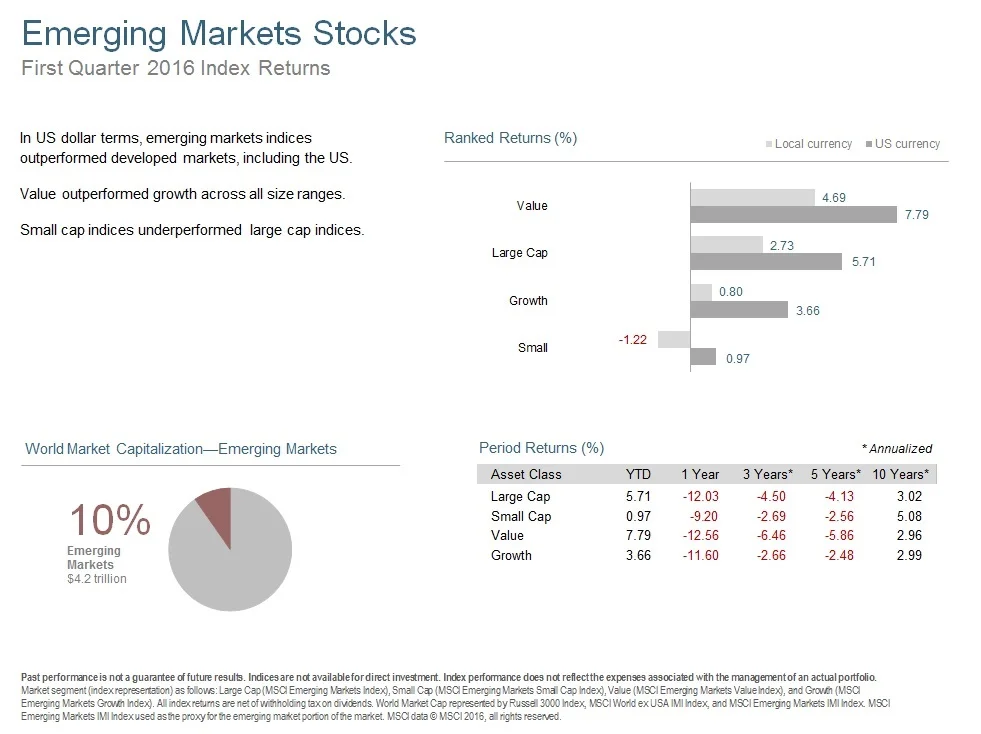
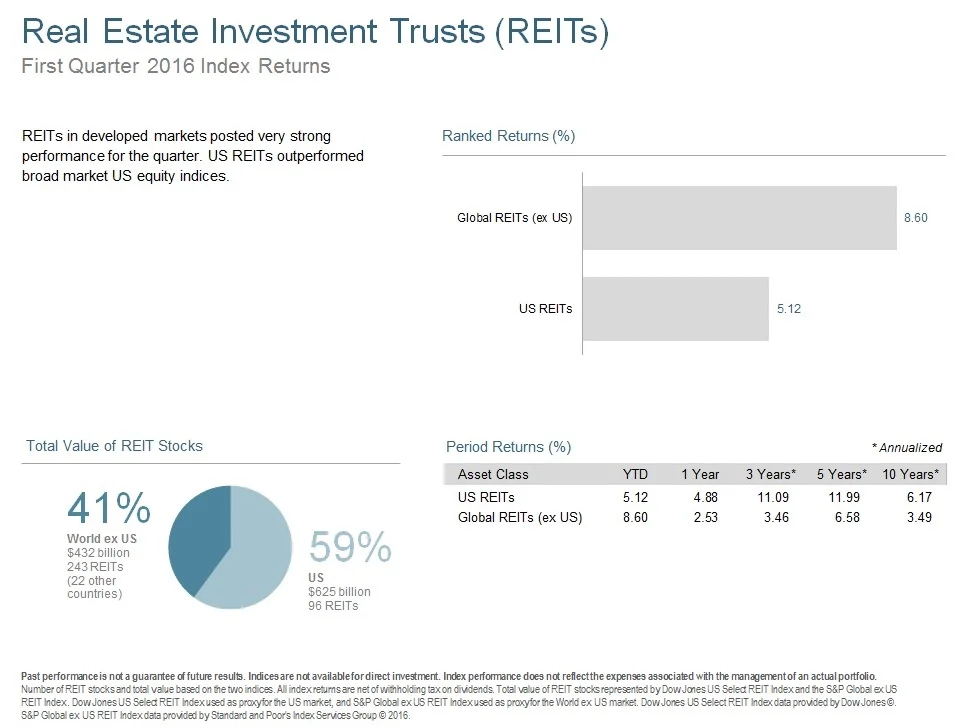
The Q1 2016 Quarterly Market review features world capital market performance and a timeline of events for the past quarter. It begins with a global overview, then features the returns of stock and bond asset classes in the US and international markets. The report also illustrates the performance of globally diversified portfolios 

Finally, I've included an article by Dave Butler that talks about how the discipline necessary to be successful in sports when the game is on the line is similar to that needed to be a winning investor. As always, if the current markets are making you anxious, get in touch to review your plan.


Free Throws

Dave Butler
Dimensional Fund Advisors
Head of Global Financial Advisor Services and Vice President
 

“What do you regard as the most difficult period in the financial markets during your 25 years in the investment business?"

I am often asked this question, usually by people who already have a framework and opinion as a result of living through one or several market downturns. For example, many older advisors and their clients regard the 1973–1974 bear market as the toughest period in their investment lifetime.

Middle-aged investors may consider the tech boom and bust of the late 1990s and early 2000s to be the bellwether event for a generation of investors who assumed they could get rich on one great stock pick. Today, just about everyone remembers the 2008–2009 global financial crisis, having experienced the anxiety of declining investment accounts themselves or knowing someone who did.

The market decline in early 2016 has much of the same feel as past events. Times like these are never easy for clients or advisors, who must confront their concern that “things just might be different this time.” When in the midst of a market decline, it is natural to sense that the volatility is lasting longer and is worse than anything before. As a result, advisors spend a lot of time talking to their clients in an effort to alleviate elevated concerns and fears.

How do we find the words that might help minimize the fear and anxiety advisors’ clients feel about their investment portfolios and retirement security? As you know, no single word or story can ease their concerns—and certainly not overnight. The more effective course may be for advisors to steadily lead clients down a path from worry to calm through a conversational approach that emphasizes the importance of sticking with their plan.

Linking process to discipline

I had the opportunity a few weeks ago to speak at an advisor’s client event in California. As I was driving to the event, I thought about how to make the presentation conversational and ensure the concepts of process and discipline resonate with the audience.

The audience was a sports-oriented crowd, and I had about 15 minutes to get across one important concept that might help them navigate the choppy markets. Then I remembered an article I read about world-class athletes and their approach to success. The author described how the greatest athletes, from Olympians to all-star professionals, focus on process rather than outcome when competing at the highest level. I thought about this in context of my own college athletic experience, which, although not at the Olympic level, involved the same need for calm and focus during high-pressure moments in a basketball game.

Imagine yourself playing in a championship basketball game. Your team is trailing by one point. You are fouled just as the game clock goes to zero. You have two free throws. Make both and you win. Miss them and you lose.

What do you do to contain the pressure and focus on the task? The great athletes look to process. While each process may be different, each one reflects a personal routine a player has performed thousands of times in practice. For instance, you start your routine as you approach the free throw line; you take a deep breath and imagine the ball going through the hoop; you step to the line and find the exact spot (usually a nail right behind the painted line) where your right foot will anchor; you look at the back (or front) of the rim and notice the paint peeling or the net missing a connecting loop—or anything else to help you concentrate and calm your mind; and you take the ball from the referee and continue your routine. You dribble twice and flip the ball in the air, take a couple of knee bends, find the grooves on the ball, and spread your fingers across it. You feel the texture of the ball, the rough orange leather and the smooth black rubber on the grooves, and finally time the motion so that your body, the release of the ball, and the follow-through of your hand are all in perfect synch as the ball elevates and descends to the basket.

The effective athlete does not hope for an outcome or get nervous or scared as the moment approaches. He or she immediately falls back on the tried and tested routine performed countless times in a more serene environment (practice). Following the routine dulls the noise of the crowd and brings clarity of mind.

The same lessons apply to the seasoned investor. A chaotic market is akin to what the visiting team experiences in a gym, where opposing fans and players are doing everything possible to distract you. You stay focused on a routine burned into your nature through coaching and repetitive practice.

The components of the seasoned investor’s routine are similar: the investment policy statement, the regular review of family goals and liquidity needs, and the regular calls an advisor makes during good and bad markets. These and other actions are all part of the process developed to summon that muscle memory needed in stressful times. Just as the great athlete navigates through the moments of pressure in any athletic event, the actions are part of the routine that allows the individual to navigate through a chaotic market like we have today.

I believe there are many stories and anecdotes that parallel the basic needs of an investor, but it is up to the advisor to find one that resonates with a particular client or audience. The example could involve a great violinist, a world-class chef, or even a gardener. In each case, there is a story of discipline behind the person who continually works to perfect the craft and a reminder of how a successful investor can do the same.

Statistics and data are the bedrock for the insights we gain about the capital markets, but it is often the conversational story that can help clients of advisors focus on the simplest and most important tenets of investment success. Regardless of the market or time period, advisors can encourage their clients to maintain the discipline needed to follow a process, which can lead to a great investment experience.

Past performance is not a guarantee of future results. There is no guarantee an investing strategy will be successful. Investing risks include loss of principal and fluctuating value.

This information is for educational purposes only and should not be considered investment advice or an offer of any security for sale. All expressions of opinion are subject to change.

Dimensional Fund Advisors LP is an investment advisor registered with the Securities and Exchange Commission.