Accountable Update

"Issue Briefs" on Diversification and Yields

"Is diversification still worthwhile?"

"Why buy bonds when rates are going up?"

These are two of the most common questions that I'm asked by investors. The latter one for over 20 years!

After several years of the largest domestic stocks outperforming, well, just about everything, it can be easy to forget why investing in small/mid sized companies and internationally in both developed and emerging markets makes sense.

It is also understandable to be concerned about the impact of rising rates, especially since the Federal Reserve increased them in December. However, it may be surprising to many that market driven rates have actually fallen since the hike. In this week's Accountable Update, I share perspective on both of these questions with "Issue Briefs" from my friends at Dimensional Fund Advisors.

The first, titled Why Should You Diversify?, reviews why spreading your eggs to more than one basket still matters. If you read this blog often, much of this piece will be information that is probably already familiar, but an occasional refresher never hurts.

In the second, Revisiting Yields, DFA discusses their strategy of designing bond portfolios that may increase expected returns by using information in the yield curve and applying it globally and with varying maturities. 

If you would like to review your diversification, yields, or overall portfolio and goals, get in touch.

The Accountable Super Tuesday Platform for Saving America (and some money)

Next week is “Super Tuesday”. Voters in 12 states, including Texas, will participate in determining who the nominees will be for the Presidential election in November. It’s refreshing to be relevant, as the past several cycles seemed to have been all but determined by the time the Lone Star State got to weigh in.  

You may be thinking, “Isn’t this a financial blog?” Well, yes, this isn’t meant to be a political forum, but many of the policies being proposed by the candidates are grounded in fundamental disagreements in how to be more successful financially. What is most striking is both parties’ unwillingness to just admit that life is hard and that the best solution for most problems ailing society is to look in the mirror and be accountable to yourself.

At the risk of alienating both the left and right, this week’s Accountable Update lays out the @ATXAdvisor stump speech if I were running for President.

Build your resume, not a wall. Stuck in a job paying less than you feel you deserve? Your take home pay isn’t going to increase by building walls unless you are in the wall building business. In fact, waiting for “the government” to do anything, like forcing your employer to pay you more, is a formula for continued disappointment and even unemployment.

If you don’t see a path to the C-suite in your current job, you can blame it on the impoverished immigrant that probably spent their life savings and even risked their life trying to get to the country of opportunity in which you live. Or, you can start chasing that opportunity yourself.

Talk to your boss. Ask them how you can better develop yourself for a promotion. Ask how to get recognized for doing your job well. Take the feedback, write down a plan, then get after it. Don’t discount that you are free to quit to pursue a better job, too; just be realistic about your qualifications and expectations.

Start thinking of your job as a career and not a necessary evil and you’ll be off to a great start. For some tips on building your resume, check out this recent blog article from Austin based recruiting firm, HireBetter.

Everyone is not equal. When our forefathers declared independence from Great Britain, they wrote that “…all men are created equal…” It was and continues to be a wonderful aspiration for our country to strive for the inalienable rights of life, liberty, and the pursuit of happiness. But that’s all we’re entitled to. Would it be nice if we all had exactly the same IQ, knowledge, appearance, abilities, money, connections, inheritance, etc.? Maybe, but we don’t.

So get over it. Instead, here is what you can do to get a leg up.

Quit smoking, or even better, never start. A recent study by WalletHub estimates the cost of smoking in Texas at $1,515,958 over a smoker’s lifetime.

Parents, have frank discussions about sex and relationships. Teach about birth control, where to get it and how to use it. An unplanned birth doesn’t guarantee a life of poverty, but according to the American Journal of Public Health, unintended pregnancy rates are highest among the poorest and lower educated.

Work hard at high school, graduate. Get a secondary education at a trade school or college. Keep working hard, and graduate.

College is too expensive? Apply for grants, scholarships, or (cough cough) get a job. Just don’t fall for the bait and switch scam of calling loans “financial aid”. Borrowing money, then whining about it a few years later will not make the debt go away. You can’t generally even get student loan debt discharged in a bankruptcy.

Go ahead and get used to saving for purchases tomorrow instead of borrowing today. Your patience will be paid off in greater wealth. You may even be able to survive the inevitable collapse of Social Security and Medicare that is coming during your lifetime.

Want to give your kids an advantage? Sacrifice for their future.

Get a second job, live in smaller house, and drive an older car. Anything that will allow you to put some savings away in a college or retirement account. You may be contributing to the privilege and inequality that everyone wants to feel guilty about these days, but you’ll also be breaking a cycle that should result in more prosperity for you and your family’s future generations.

"Free" is expensive. Nothing sounds better than when someone promises something for nothing. Take "free college for everyone" as an example. It sounds great, we’ll have a better educated workforce, no more crushing debt at graduation, and rainbows and lollypops for everybody too.

What isn’t mentioned is that the teachers that have spent 25-30 years of their lives getting educated, the nice buildings, books, computers, and everything else that is needed to provide that education has to be compensated for. Where will that come from? Those greedy employers that are not paying you enough already?

Go ahead and raise taxes on them, at least you’ll be eligible for unemployment benefits for 26 weeks until you have to find another job.

Of course, you could join the military and serve your country. Yes, you may be called upon to make sacrifices during that service, but you will be paid and eligible for benefits such as the GI Bill which assists service members and eligible veterans in paying for education and training.

It’s not free of risk. You see, the freedoms you enjoy like life, liberty, and the pursuit of happiness, are expensive. You just have to decide if you want to be in the minority that pays the way, in money or blood.

The thing about democracy is whether you sit around and enjoy it or work to pay for it, you get a say next Tuesday. Don’t take that for granted.


4 Letters Worth Repeating, T-I-M-E

This week, there was a story on a major "financial" network that predicted not only that the US stock market would peak on a particular day in March, but that it would happen after lunch. Appropriately, that network refers to itself with a 4-letter word.

But really, how considerate of them? With that level of detail, we should all be able to ride our unicorns down to Wall Street after sleeping late and enjoying a nice brunch, with time to spare to put in our sell orders before the bottom falls out.

I can think of a couple of 4-letter words for that kind of "news".

John Maynard Keynes is credited with uttering, “The market can stay irrational longer than you can stay solvent.” The famous (or infamous to some) economist made that observation after he had lost most of his money in ill-timed currency trades using borrowed money in early 1920. He was supposedly betting against the German Deutschmark as Deutschland struggled to recover after The Great War. Of course, in hindsight, he was right to see the black clouds building over the Weimer Republic that ultimately ended in hyperinflation and the rise of the National Socialist German Workers' Party (also known as the Nazis).

It turns out he was right about everything but, WHEN.

Decades later, investing legend Peter Lynch observed, "Far more money has been lost by investors preparing for corrections, or trying to anticipate corrections, than has been lost in corrections themselves." I suppose, though, that practical advice is much less likely to keep you glued to your TV set.

The reason it is so hard to know in the short run how any asset may perform is that the market reflects the aggregate expectations of all market participants, all the time. Folks that are willing to buy an asset are competing with folks who want to sell. When they agree on a price, they both feel that they are making the best deal. The buyer anticipating the asset will increase in price faster than other investment alternatives, the seller that the money will be more effectively invested elsewhere.

At ATX Portfolio Advisors, we believe that while the market incorporates all available information to drive stocks to fair value, we also believe that stocks may have different expected returns. In other words, there are certain characteristics that have resulted in returns that are greater than average that have persisted over time and across markets.

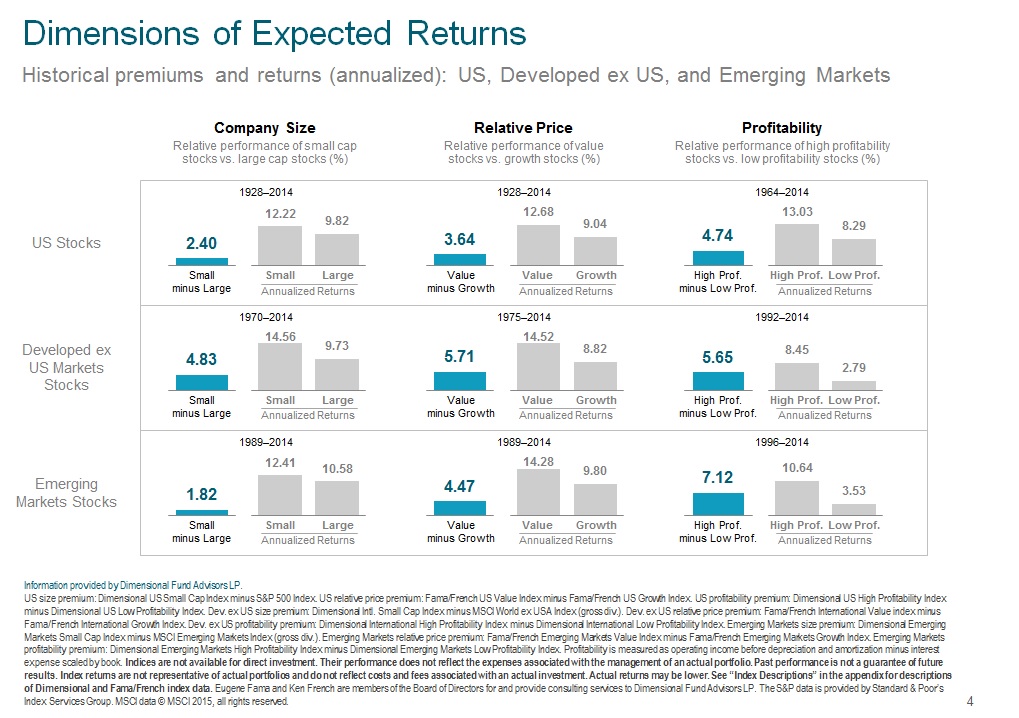
For stocks, there are four characteristics, or dimensions, that compelling evidence shows persistently over time. First is the market itself—stocks have higher expected returns than T-bills. Other characteristics include—company size (small vs. large), relative price (value vs. growth), and profitability (high vs. low).

The chart below documents the historical premiums that the size, relative price, and profitability dimensions have produced over time frames that reliable data is available. As you can see, the premiums have persisted over long time frames across different types of markets.

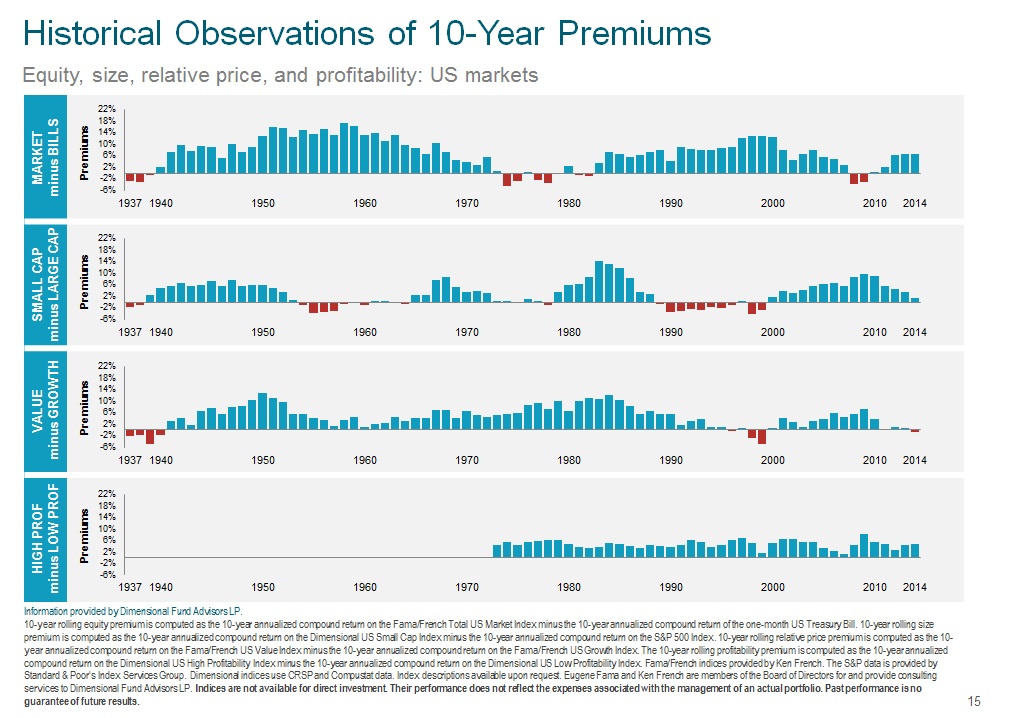
The next chart shows the yearly relative performance of dimensions in US stocks. The blue bars indicate years in which the market, small cap, value, and profitability premiums were positive. The red bars indicate years in which the premiums were negative. A positive premium indicates out-performance (e.g., small cap stocks outperform large cap stocks); a negative premium indicates under-performance (e.g., small cap stocks under-perform large cap stocks).

Over these periods, positive premiums have occurred more frequently than negative premiums across all dimensions. BUT, the premiums can and do vary widely from year to year and can experience extreme and prolonged negative relative performance. In other words, there is no free brunch.

This is why we say you should take a longer-term view and stay disciplined during periods of volatility or under-performance of any premium. Over longer periods however, we have observed a higher frequency of positive premiums.

This next chart documents the relative 5-year annualized performance of return dimensions in the US equity market. When looking at longer time spans, observations of premiums are more consistent compared to one observation in any given year.

As you can see, there are fewer negative (red bars) 5-year periods versus positive (blue bars) periods. The difference is even more pronounced in historical observations of 10-year premiums as illustrated below.

Please remember that despite the higher frequency of positive premiums, outperformance may not be consistent, even over longer periods of time. Long-term investors should consider that premiums are never guaranteed and can undergo periods of negative returns in both relative and absolute terms.

All we have to do is look at the last 10-year period to remind ourselves of these facts, as many of the premiums have been smaller than historical averages.

10 Yr Dimension Performance.jpg

If the first several slides show why we stick to our strategy of indexing the total market with weightings tilted to those dimensions that have demonstrated historical premiums. It is this last chart that illustrates why our philosophy isn't likely to change when short term divergences from historical averages occur. It suggests strongly that the longer our investment period was, the more likely we were to see a premium in all of the dimensions. That's not nearly as exciting as screaming about market tops or bottoms, but it is pretty compelling evidence to stay the course no matter how loud the carnival barker chorus.

If nothing else, all of this reminds us of the old adage, “Time in the market is more important than timing the market.” T-I-M-E, now that's a 4-letter word worth worth repeating.

If you or someone you know lacks the time to plan and manage your portfolio, let's get acquainted.